
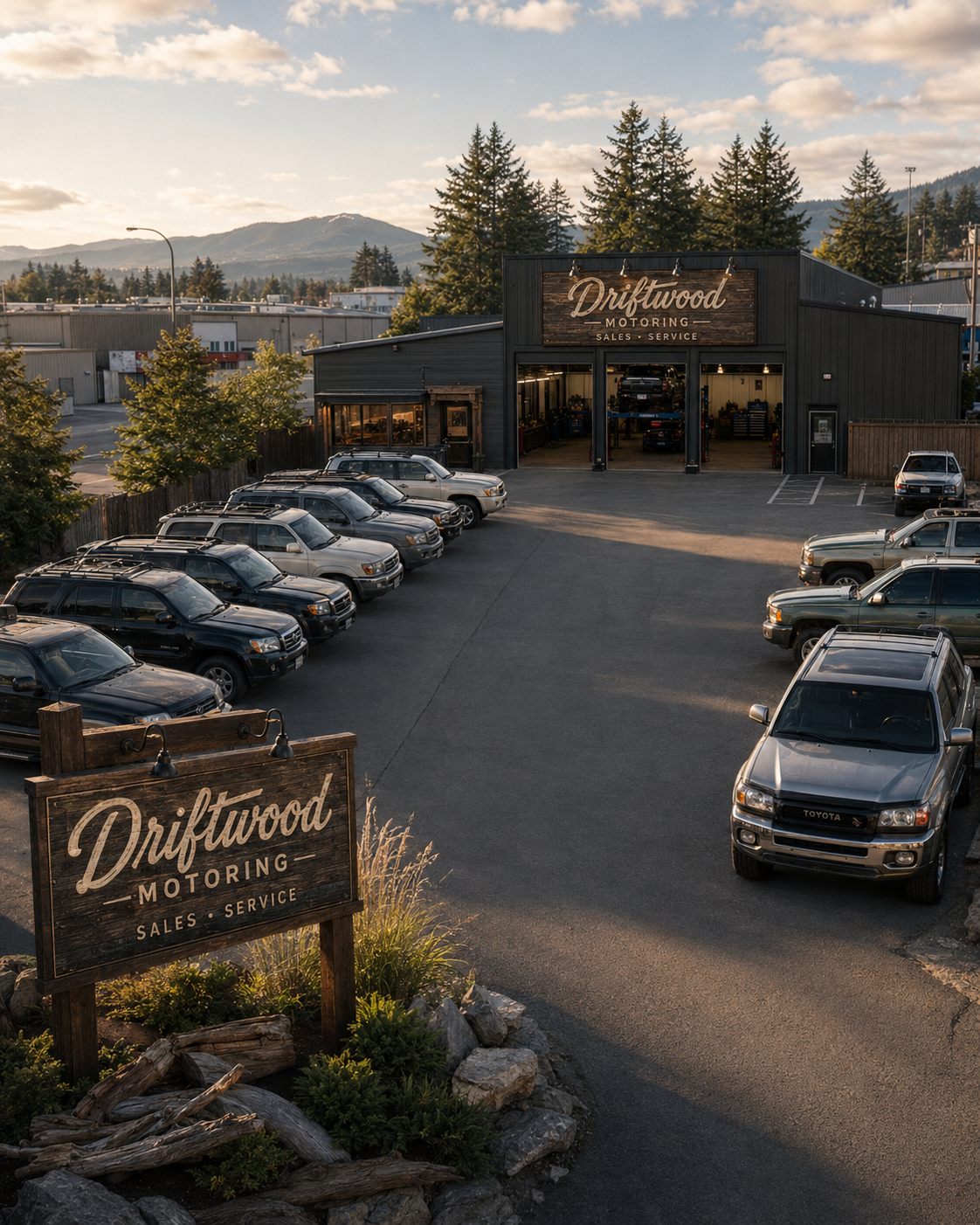
The shop is currently imaginary.
The automotive obsession is not.
Why the GMT800 Might Be GM’s Best Truck Platform
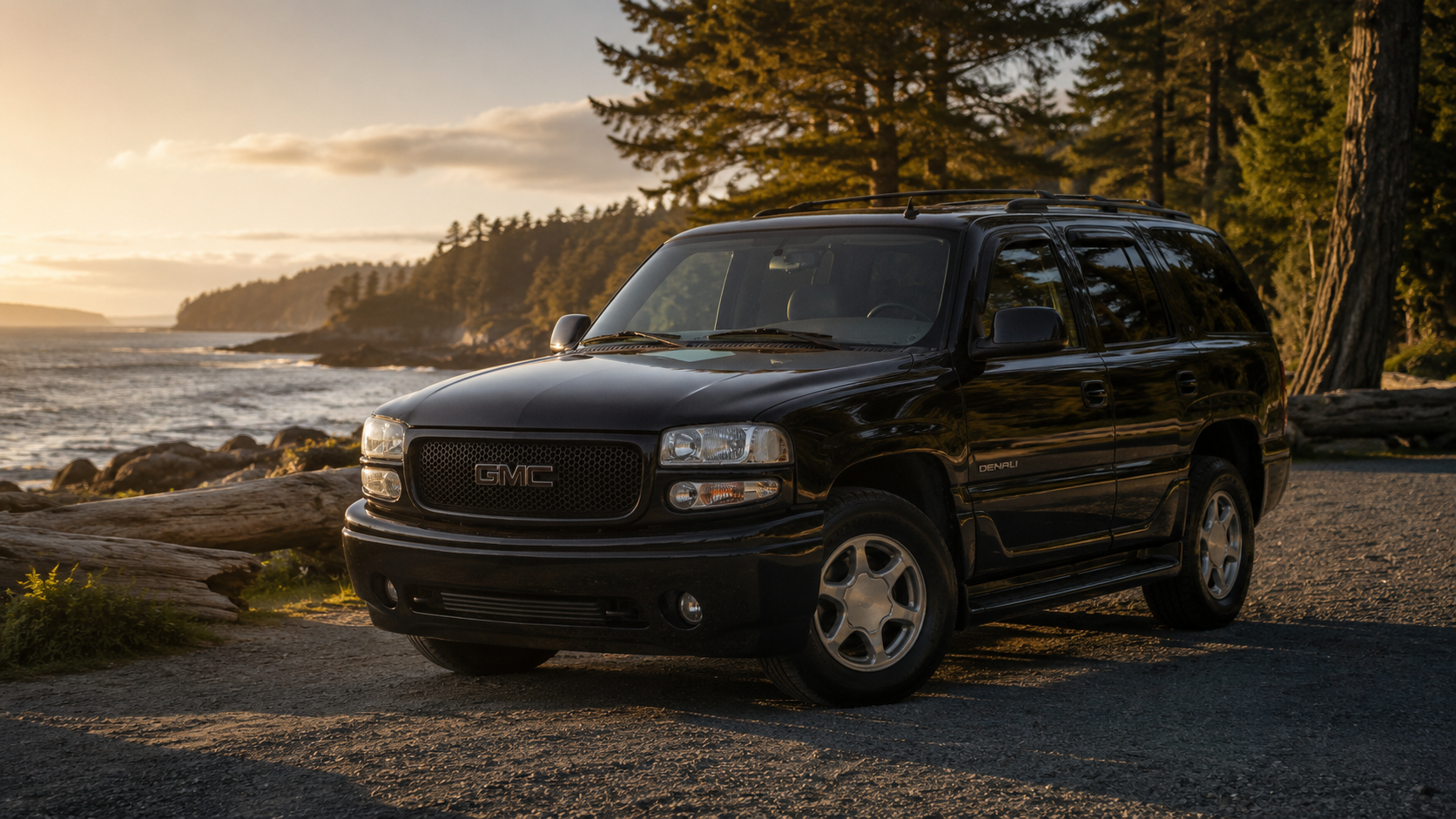
I’m going to say something that will immediately piss off at least three generations of General Motors truck owners:
The GMT800 might be the best truck platform GM ever built.
Not the fastest. Not the most powerful. Not the most luxurious. Definitely not the most fuel-efficient. My 2003 Yukon Denali can turn a quick run for milk into a minor petroleum-industry stimulus package.
But when you combine comfort, capability, simplicity, repairability, drivetrain choices and the frankly ridiculous number of them still driving around more than twenty years later, the GMT800 landed in a sweet spot that GM may never find again.
The GMT400 crowd is already typing that their trucks were simpler.
They were.
The new-truck crowd will point out that their trucks tow more, stop better, make more power, burn less fuel and have enough cameras to document their own eventual repossession.
Also true.
But the GMT800 arrived at exactly the right moment. Trucks had become comfortable enough to serve as daily drivers and family vehicles, but they had not yet become rolling mortgage applications with software updates, subscription features and dashboards designed by someone with a personal vendetta against physical buttons.
They were modern without being exhausting.
That matters.
What the hell is a GMT800?
GMT800 was General Motors’ internal platform designation for the full-size trucks and SUVs it produced from the late 1990s into the mid-2000s.
That family included the Chevrolet Silverado, GMC Sierra, Chevrolet Tahoe, GMC Yukon, Chevrolet Suburban, GMC Yukon XL, Cadillac Escalade and the heavy-duty trucks.
Basically, if you see an older GM truck still hauling landscaping equipment, towing a boat, carrying six children or idling outside Canadian Tire with one headlight slightly dimmer than the other, there is a decent chance you are looking at a GMT800.
Mine is a 2003 GMC Yukon Denali with a 6.0-litre V8, all-wheel drive and roughly 276,000 kilometres.
It carries our family, tools, toys, drone gear, a paddleboard, a kayak, lawn chairs and enough life jackets to satisfy a nervous ferry captain.
It is also still one of the most comfortable vehicles I have ever owned.
That does not mean it is perfect.
The steering offers approximately the same feedback as a strongly worded email. The dashboard contains enough grey plastic to furnish a government office. The fuel gauge moves quickly enough to qualify as animation.
I still love the damn thing.
GM gave buyers an actual choice of engines
One of the biggest reasons the platform became so successful was that GM offered an entire family of drivetrains instead of pretending one turbocharged four-cylinder could meet the needs of every human being with a driver’s licence.
The 4.8, 5.3 and 6.0-litre gas V8s are a huge part of the GMT800 story.
They are simple, durable and supported by an aftermarket so large you could probably assemble an entire 5.3 from parts found within twelve kilometres of any medium-sized Canadian town.
They generally followed a sophisticated maintenance philosophy:
Give them oil occasionally and try not to do anything catastrophically stupid.
They make decent power, produce useful torque and usually sound good doing it. They are naturally aspirated pushrod V8s from a period when an engine could operate without constantly turning cylinders off, changing its own valve timing, adjusting six cooling circuits and consulting a software engineer before deciding whether to idle properly.
That simplicity matters once a vehicle becomes old enough to buy its own alcohol.
Modern engines can produce more power from less displacement while burning less fuel and producing fewer emissions. That is impressive, and I am not going to stand on the beach yelling at direct injection like it parked on my lawn.
But when modern equipment fails, repairs can involve turbochargers, high-pressure fuel systems, emissions hardware, integrated assemblies, software and enough networked modules to make the vehicle feel like an IT department with cupholders.
When an old GM V8 has a problem, your local shop has probably already seen it, the parts store probably has what you need, and somebody on YouTube has filmed the entire repair in a gravel driveway while wearing flip-flops.
That has value too.
Then there’s the Duramax and Allison combination
You cannot talk about GMT800 drivetrains without talking about the heavy-duty diesels, unless your goal is to attract an angry mob of men wearing wraparound sunglasses and shirts with injection-pump company logos.
The Duramax diesel paired with the Allison automatic transmission became one of the defining combinations of this truck generation.
A clean GMT800 diesel is still seriously desirable today. In particular, plenty of diesel enthusiasts view the later trucks from around 2005 and 2006—especially the LBZ-era 2006 models—as something close to the perfect old diesel pickup: strong, usable, still relatively straightforward and built before modern diesel-emissions systems became substantially more complicated. The 2006 Duramax was offered with an Allison six-speed automatic, making 360 horsepower and 650 lb-ft in LBZ form.
I wish I had one.
A crew-cab, four-wheel-drive GMT800 Duramax with an Allison, in good condition and without seventeen questionable tuning devices zip-tied under the dashboard, would be damn close to dream-truck territory.
The problem is that everybody else knows this too.
Clean examples are sought after, and owners often price them as though the glovebox contains a small parcel of waterfront property.
And diesel ownership is not the same cheap-and-simple proposition as running a gas 5.3. Injectors, turbochargers, fuel systems and diesel-specific repairs can become expensive in a hurry.
Still, there is a reason people hunt for these trucks.
The engine makes serious torque. The Allison earned a formidable reputation. Together, they gave the GMT800 heavy-duty lineup an identity that still carries weight two decades later.
Mention “Duramax and Allison” around diesel owners and somebody will immediately begin explaining the differences between LB7, LLY and LBZ engines, whether you asked or not.
That argument could continue until the sun burns out.
I am not stepping directly into that knife fight today.
The point is that GM did not just offer one decent drivetrain. It offered everything from basic gas work trucks to heavy-duty diesels that are still being used, modified, collected, debated and lusted after.
That depth is part of what made the platform special.
GM was also trying weird shit
The GMT800 era was not only about simple engines and sensible trucks.
GM was still willing to occasionally walk into a meeting and say, “What if the rear wheels turned too?”
Enter Quadrasteer.
Developed with Delphi, Quadrasteer used four-wheel steering to turn the rear wheels. At lower speeds they turned opposite the front wheels, tightening the turning circle. At higher speeds they could turn in the same direction to improve stability during lane changes and towing.
It was offered on several GM trucks and long-wheelbase SUVs, including versions of the Sierra, Silverado, Suburban and Yukon XL.
Was it necessary?
Probably not.
Was it expensive and complicated enough that buyers became nervous?
Absolutely.
Was it cool as hell?
Yes.
A GMT800 Quadrasteer truck rolling slowly through a parking lot with the rear wheels visibly turning still looks like someone installed the suspension incorrectly until you realize what you are seeing.
It is one of those strange automotive ideas that probably deserved more success than it got. A long truck that can make tight turns and become more stable while towing is not a stupid concept.
It just arrived during an era when customers apparently looked at four-wheel steering and decided ordinary steering had been working fine since horses.
Now Quadrasteer-equipped trucks are unusual enough to make enthusiasts stop and look.
That is another thing I miss about vehicles from this period. Manufacturers were willing to experiment with genuinely mechanical ideas instead of announcing a new dashboard theme and calling it innovation.
The GMT800 family also gave us everything from basic regular-cab work trucks to Denalis, Escalades, heavy-duty tow rigs, long-wheelbase family barges and specialized configurations that could become entire collector niches on their own.
It was a proper platform.
Not one vehicle wearing six different grille designs.
Parts are absolutely everywhere
GMT800 parts are available from just about every possible source.
Parts stores have them. Wrecking yards have them. Online retailers have them. Marketplace has them.
Some guy named Darren probably has half a Yukon behind his shed and will sell you a transfer case at 9:30 at night if you bring cash and do not ask why the donor vehicle has no doors.
That availability is a huge reason these vehicles remain viable.
When something breaks, you usually have choices.
You can buy the cheapest part available because the truck is already held together with hope and deck screws. You can buy a decent aftermarket replacement. You can buy premium parts. You can upgrade the weak point. You can find used factory pieces.
You are rarely waiting six weeks for a proprietary assembly to arrive so the passenger window can begin acknowledging the switch again.
I work in automotive parts, which gives me an obvious advantage. I can source much of what my Yukon needs affordably, and after twenty years around this business I have a decent idea which brands I trust and which boxes should be gently returned to the shelf.
But even without that advantage, the parts ecosystem around these trucks is enormous.
A vehicle lasts when owners can afford to repair it.
That sounds obvious, but apparently the modern automotive industry needed a reminder.
An engine capable of running 400,000 kilometres is not much use if the first failed electronic module costs more than the vehicle is worth and requires a dealership appointment, two software subscriptions and the blessing of a regional technical representative.
GMT800s remain worth fixing.
That may be their greatest strength.
They were built to do actual truck and SUV things
A lot of modern SUVs are tall cars wearing hiking boots.
GMT800 SUVs were trucks underneath.
They could tow, haul people, carry ridiculous amounts of cargo and survive roads that had not recently been described as “curated.”
The Tahoe and Yukon were large enough to be proper family vehicles without occupying their own climate zone.
The Suburban and Yukon XL could carry a family, luggage, camping equipment, sports gear and whatever deeply unnecessary Marketplace purchase Dad made on the way home.
My Yukon is our family adventure vehicle.
At various times it contains a paddleboard, kayak, chairs, tools, toys, drone equipment and enough random equipment to make it appear we are either camping or quietly leaving the country.
It does not care.
The truck does not need the cargo arranged beautifully for social media. It does not need a roof box that costs more than my first car.
Open the hatch. Throw the shit in. Go somewhere.
That is usefulness.
The interiors were better than people remember
Nobody is going to confuse the inside of a GMT800 with the lobby of a luxury hotel.
There is a lot of grey plastic. The buttons wear. The instrument clusters occasionally decide that displaying accurate information is optional. Seat heaters can become temperamental, and the leather on the driver’s seat often begins surrendering in exactly the same place.
But the basic design was excellent.
The seats were big and genuinely comfortable. Visibility was good. The controls made sense. The buttons were large enough to operate while wearing gloves or while your five-year-old asks seventeen unrelated questions from the back seat.
You could change the temperature or fan speed without opening a menu labelled “Climate Experience.”
You did not need to wait for the infotainment system to finish booting before the defroster became available.
Mine has heated leather seats, power accessories, automatic climate control and enough comfort to make long road trips easy even after twenty-three years.
It does not feel primitive in the ways that matter.
It feels like a vehicle designed when controls were expected to work through touch rather than prolonged eye contact.
I love Apple CarPlay. I love backup cameras. Ventilated seats are glorious and should be protected under international law.
I do not hate modern features.
I hate when every feature gets buried inside an enormous screen because someone decided physical buttons did not photograph well in promotional material.
They are simple without being ancient
This is where the GMT800 really shines.
It has electronic fuel injection, anti-lock brakes, airbags, decent climate control, power equipment and enough technology to remain pleasant in modern traffic.
It is not a carbureted farm truck that requires a weather forecast and a small prayer before starting.
But it also does not have several dozen modules constantly sharing information about whether the cupholder is emotionally prepared to receive a beverage.
That middle ground is becoming harder to find.
The GMT800 was built after trucks became refined enough to live with every day, but before manufacturers became convinced every vehicle needed to function as a smartphone with a towing package.
It was modern before modern became a pain in the ass.
Obviously, they have problems
This is not some misty-eyed love letter claiming every GMT800 is immortal.
These trucks have problems.
Instrument clusters fail. Fuel pumps die. Steering components wear. Window regulators quit. Door hinges sag. Brake lines can rust. Transfer cases can develop issues. Interior plastics crack. Exhaust manifold bolts break. Some leak enough fluids to require their own environmental assessment.
And rust can absolutely murder them.
A mechanically perfect truck is not particularly useful when the frame has developed the structural integrity of wet toast.
They are also old enough that previous owners become one of the largest reliability variables.
A well-maintained GMT800 can be a fantastic vehicle.
A neglected one purchased from somebody who says “easy fix, just don’t have time” may introduce you to entirely new forms of financial and emotional suffering.
Rubber deteriorates. Seals harden. Wiring ages. Repairs get performed with hardware-store fasteners, wire nuts and optimism.
The platform’s durability does not mean every surviving truck is good.
It means a good one is worth preserving.
That is an important difference.
New trucks are better at plenty of things
A new truck will probably make more power, tow more, stop better, use less fuel and protect its occupants better in a serious crash.
That is progress.
New trucks can be incredibly comfortable. Some offer excellent camera systems, advanced driver assistance, ventilated and massaging seats and enough horsepower to embarrass performance cars from the period when the GMT800 was new.
I would happily use many of those features.
The problem is not that modern trucks are bad.
The problem is that they have become unbelievably expensive, increasingly complicated and, in some cases, financially terrifying to own outside warranty.
A truck can perform brilliantly when new and still become a questionable long-term ownership proposition.
Longevity is not only whether the engine can physically keep running.
It is whether the entire vehicle remains economically worth repairing.
Can a normal independent shop diagnose it?
Can the owner buy the part?
Can one component be replaced without purchasing an entire integrated assembly?
Can the vehicle remain useful after the manufacturer stops caring about it?
The GMT800 usually answers yes.
The platform hit the sweet spot
That is why I think the GMT800 might be GM’s best truck platform.
It combined proven gas V8s, the legendary Duramax and Allison pairing, interesting technology like Quadrasteer, proper truck capability, comfortable interiors and an enormous parts supply.
It was sophisticated enough to be pleasant but basic enough to understand.
It could be a work truck, tow rig, luxury SUV, family vehicle, off-road project, diesel monster, lowered street truck or something your uncle has been “almost finished restoring” since 2018.
The platform gave owners choices.
And twenty-plus years later, many are still commuting, hauling, towing, plowing snow, carrying families and showing up at beaches loaded with far too much recreational equipment.
Mine is still doing exactly what I bought it to do.
It is not flawless. It is not cheap to fuel. It does not have a 360-degree camera, ventilated seats or enough computing power to mine cryptocurrency while I drive.
But it is comfortable, capable, repairable and paid for.
I understand it. Local shops understand it. Parts stores understand it.
That relationship between a person and a machine is becoming rarer than it should be.
So yes, I am biased.
I own one. I have spent roughly twenty years working around automotive parts, service departments, dealerships and repair shops. I have seen enough vehicles age to understand that newer does not automatically mean better, and simple does not necessarily mean crude.
The GMT800 got the balance right.
Maybe better than anything GM built before it.
Maybe better than anything GM has built since.
And somewhere, right now, a diesel owner is preparing a four-paragraph response explaining why I should have devoted the entire article to the LBZ.
Honestly, he might have a point.
Related Reads
The Best GMT800 Upgrades: What’s Worth Doing—and What I’d Skip
From suspension and brakes to cooling, tuning, CarPlay and the popular modifications I’d probably leave on the internet.
Is the GMT800 Still the Smartest Vehicle to Own in 2026?
Why a paid-for old GM truck or SUV can still make more sense than replacing it—fuel bill, repair list and all.
The GMT800 Duramax: Why These Old Diesel Trucks Became Legends
LB7, LLY and LBZ engines, Allison transmissions, rust, Canadian scarcity and why these old diesel trucks earned their reputation.
The Last Honest Powertrains Are Becoming a Selling Feature
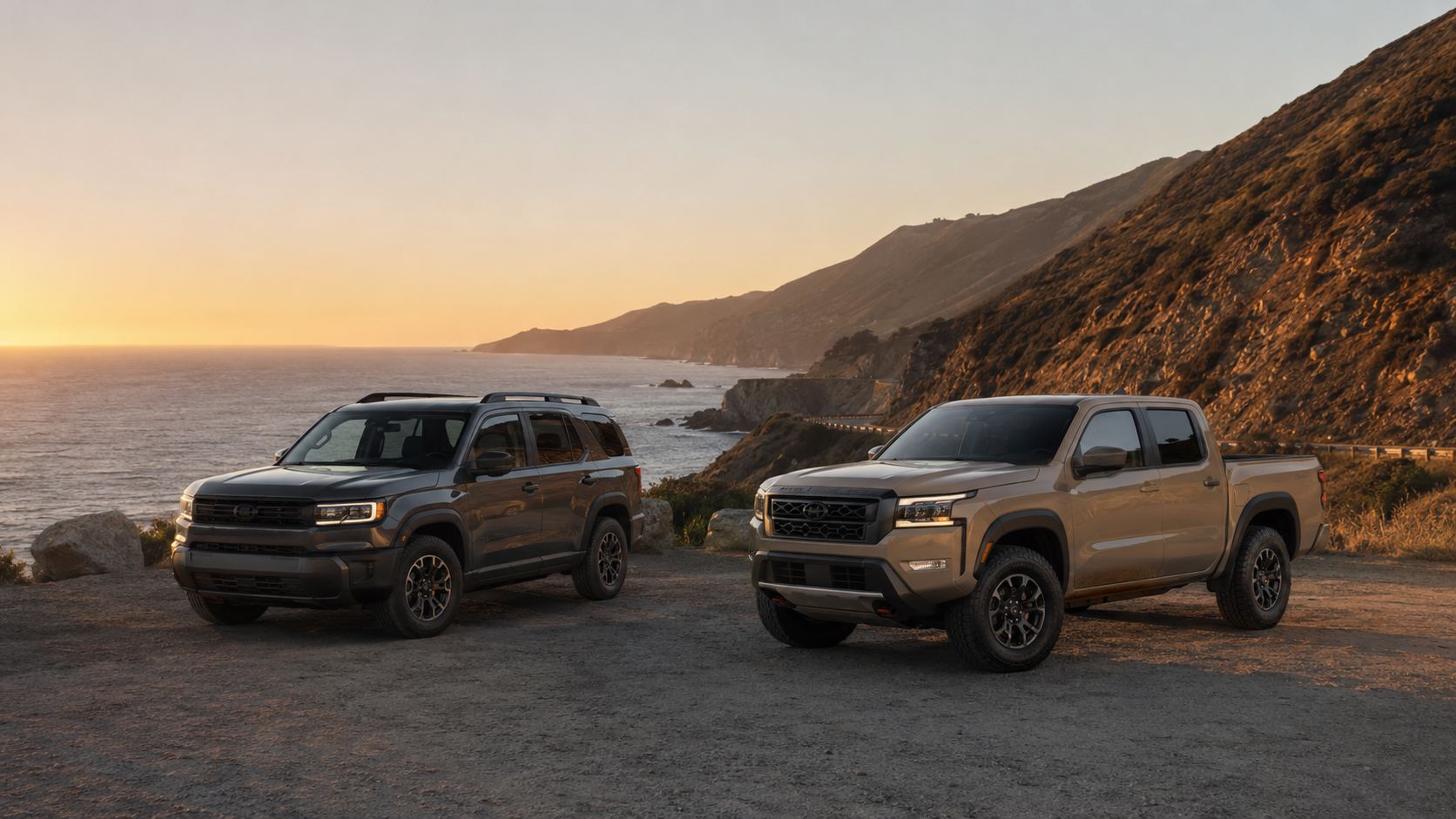
Somewhere along the way, a naturally aspirated V6 and a normal automatic transmission became exciting.
Not exciting because they’re exotic. Not exciting because they’re fast enough to rearrange your internal organs. Exciting because they aren’t trying to shut off half their cylinders, spool two turbos, simulate eight fake CVT shifts and save half a teaspoon of fuel before the warranty expires.
A regular engine breathing regular air through regular plumbing now feels almost rebellious.
And honestly, I’m here for it.
I’ve owned turbocharged vehicles. I’ve owned a tuned twin-turbo V6 that was an absolute riot. Put your foot into it, wait half a heartbeat and suddenly every responsible decision you’ve ever made feels wildly overrated.
Boost is fun.
Boost after 180,000 kilometres may be less fun.
That’s the distinction people seem determined to miss. A vehicle can be exciting to lease for three years and still be something I wouldn’t want to own for fifteen. Those are two completely different tests.
I’m not afraid of turbochargers. I’m afraid of receiving the invoice for turbochargers after they’ve spent a decade living beside a hot engine, pushing extra air into an already highly stressed collection of expensive parts.
Apparently, simple is premium now
The new Honda Passport caught my attention immediately because it looks fantastic.
It has a proper SUV shape. It looks rugged without looking like a Transformer suffering from unresolved childhood trauma. It has some presence, some width and enough character that you don’t need three different exterior packages just to stop it resembling a rental appliance.
Then I looked under the hood.
A 3.5-litre naturally aspirated V6.
No turbochargers.
No CVT.
A conventional 10-speed automatic.
Honda rates the redesigned 2026 Passport’s V6 at 285 horsepower, paired with its first 10-speed automatic in the model.
That got my attention more than any giant screen or clever drive mode.
Now, this is still a modern engine. It has direct injection, variable valve timing, cylinder-management technology and plenty of computers making decisions behind the scenes. It is not a carbureted tractor motor accidentally installed in a family SUV.
But compared with the industry’s rush toward smaller turbocharged engines and continuously variable transmissions, it feels almost refreshingly normal.
That is how far we’ve gone.
Honda announces a V6 and a real automatic transmission and I react like they’ve rediscovered fire.
The Frontier quietly kept doing truck things
The Nissan Frontier fits into the same conversation.
Nissan has made plenty of decisions over the years that I would not personally frame and hang in the boardroom. I own a Nissan Kicks with a CVT, so my relationship with the company includes a small but persistent sense of mechanical dread.
But the Frontier?
That thing makes sense to me.
The 2026 Frontier still uses a naturally aspirated 3.8-litre V6 making 310 horsepower, paired with a conventional nine-speed automatic.
No turbo four-cylinder screaming for help.
No belt-and-pulley transmission making a prolonged groaning noise while the truck gradually catches up with the engine.
Just a V6 and gears.
Remember gears?
You press the accelerator. The transmission selects one. The truck moves. Nobody needs to simulate a shift to reassure the driver that mechanical events are still occurring.
Nissan even describes the V6 as part of its long-running VQ engine family and specifically promotes the engine’s longevity and reliability. Marketing departments say many things, obviously, but at least this one is advertising the quality I actually give a shit about.
I wouldn’t claim the Frontier is perfect. Every vehicle has problems, and anyone who says otherwise is either selling one or has owned it for twelve minutes.
But I understand why a buyer looking for a long-term midsize truck might stop and stare at it.
It isn’t winning the engineering arms race.
That may be the appeal.
Toyota used to understand this better than anyone
Toyota built its reputation on vehicles that were often deeply unexciting right up until you realized they had survived eighteen years of neglect, three owners and an interior permanently scented by old French fries.
That was the magic.
Toyota didn’t always produce the most power. It didn’t always have the best infotainment. It occasionally sold vehicles with acceleration best measured using geological equipment.
But they lasted.
People trusted them because Toyota seemed willing to leave a proven design alone after everyone else had started attaching more shit to theirs.
Then the Tundra lost its naturally aspirated V8 and moved to a twin-turbo V6.
On paper, the newer engine is better. More torque. Better fuel economy. Modern technology. Stronger numbers for people who shop for trucks by comparing PDFs.
And then Toyota had to recall certain newer Tundras because machining debris could remain in the engine and potentially lead to knocking, rough running, failure to start or loss of power. Toyota expanded related engine recalls again in 2025 and 2026.
To be fair, that specific problem involved manufacturing debris. It does not prove turbocharged V6 engines are inherently doomed.
But it still lands badly.
Toyota spent decades building its identity around engines that would outlive the mortgage, the garage and possibly the owner. Then it replaced a well-known V8 with a more complicated twin-turbo drivetrain and immediately gave everyone something new to worry about.
That doesn’t mean the new Tundra is garbage.
It means Toyota gave up some of the simplicity people trusted and now has to prove the replacement deserves the same faith.
That proof takes years.
Horsepower takes one press release.
More power from less engine is not free
Turbocharging lets manufacturers get larger-engine performance from smaller displacement.
That sounds like free power.
It isn’t.
You’re adding turbochargers, oil and coolant lines, wastegates, intercoolers, extra heat, higher cylinder pressures and more plumbing packed into an engine bay already designed by someone who apparently hates mechanics’ hands.
None of that guarantees failure.
Turbocharged engines can last a long time when they are engineered properly, maintained well and operated by someone who doesn’t treat oil-change intervals as loose philosophical suggestions.
But the simple truth remains:
More parts create more possible failures.
More heat creates more stress.
More pressure leaves less room for neglect.
That may be worth it in a performance car. My tuned twin-turbo V6 was stupid fun. I knew what I had. I enjoyed it for what it was.
But for a family vehicle I want to keep for fifteen years?
My priorities change.
I don’t need every traffic-light departure to feel like the opening scene of a police documentary.
I need it to start on a wet Tuesday morning in 2039.
The CVT is where I become less diplomatic
I understand why manufacturers use CVTs.
They can keep the engine operating in an efficient range. They’re often lighter. They can help improve fuel economy. They make the numbers on the window sticker look a little prettier.
Wonderful.
I still hate the fucking things.
I hate the way most of them drive. I hate the disconnect between engine noise and vehicle speed. I hate the prolonged droning sound that makes it seem like the engine is holding a note while the rest of the vehicle searches for motivation.
Then manufacturers started programming fake shifts into them because apparently even the people building CVTs realized customers preferred the sensation of having an actual transmission.
That’s a hell of an admission.
We invented a gearbox without gears, then programmed it to pretend it had gears because people found the gearless experience annoying.
Progress.
And yes, there are important exceptions. Toyota’s hybrid e-CVT system is mechanically different from the belt-and-pulley CVT found in vehicles like our Nissan Kicks. They share a name, not necessarily the same operating design or reputation.
But our Kicks has exactly the kind of CVT that keeps a little question mark floating in the back of my mind.
The car is currently fine.
That is how anxiety works.
You don’t worry because it has exploded. You worry because you’ve read enough, worked around enough vehicles and know that if the transmission does eventually fail, nobody is going to say, “Excellent news, Ryan. This will be cheap and emotionally painless.”
I’m not demanding ancient technology
I’m not asking manufacturers to stop improving vehicles.
I like modern features.
Ventilated seats are glorious. Apple CarPlay is excellent. Backup cameras are useful. A warning that I’m about to drive into something because I was distracted by my five-year-old asking why birds don’t wear shoes is appreciated.
I like good crash protection. Better emissions matter. Fuel economy matters.
But I reject the idea that every improvement on a laboratory test automatically creates a better ownership experience.
A smaller engine making more power is impressive.
A transmission extracting another fraction of efficiency is impressive.
Cylinder deactivation, stop-start and ultra-thin oil all make sense when you examine the specific engineering goal.
Then you put all of it together, age it for twelve years, add Canadian winters, missed maintenance, towing, overheating, software problems and three owners, and ask whether the vehicle is still economically worth repairing.
That is the test I care about.
Not whether it saved twelve dollars during an official fuel-economy cycle when everything was new.
Efficiency can become a very expensive bargain
Imagine two vehicles.
One has a naturally aspirated V6 and uses slightly more fuel.
The other has a smaller turbo engine, complicated emissions equipment and a CVT, but saves a litre or two per hundred kilometres.
The second vehicle wins the fuel-economy argument.
No question.
But does it win the ownership argument?
Not automatically.
How much fuel do you actually save in a year?
How many years does it take before those savings equal one major drivetrain repair?
What happens when the turbo fails?
What happens when the CVT fails?
What happens when a high-pressure fuel-system component fails?
A person can save a couple hundred dollars a year at the pump and lose every dollar of it in one afternoon at the repair shop.
With tax.
Efficiency is visible. The number appears on the dashboard every day.
Future repair risk is invisible.
That makes efficiency much easier to sell.
I want the vehicle they forgot to ruin
The 2026 Passport appeals to me because it looks like somebody designed a genuinely modern SUV and then forgot to ruin the drivetrain.
The Frontier appeals to me because Nissan kept a V6 and a conventional automatic while other manufacturers looked for more creative ways to turn a pickup into a fuel-economy demonstration.
That doesn’t make either vehicle perfect.
The Passport still has modern engine-management technology. The Frontier still uses direct injection. The days of truly simple new vehicles are mostly gone.
But there are levels to this shit.
A naturally aspirated V6 with a normal automatic starts with fewer long-term question marks than a highly boosted little engine attached to a transmission I already dislike.
That matters to me.
I have spent about twenty years around automotive dealerships, parts, service departments and repair shops. I’ve watched customers buy new vehicles because they wanted reliability and peace of mind, then discover that “new” and “simple” stopped meaning the same thing a long time ago.
I’ve seen technology make vehicles better.
I’ve also seen it make them expensive as hell to fix.
So when a manufacturer introduces something that looks good, works well and still uses a drivetrain I can imagine owning after the warranty expires, I notice.
That shouldn’t be unusual.
But apparently, in 2026, a naturally aspirated V6 and a regular automatic transmission are enough to make me emotional.
The bar is on the floor.
At least the Passport and Frontier managed not to trip over it.
Modern Cars Are More Efficient. But Are They Built to Last?
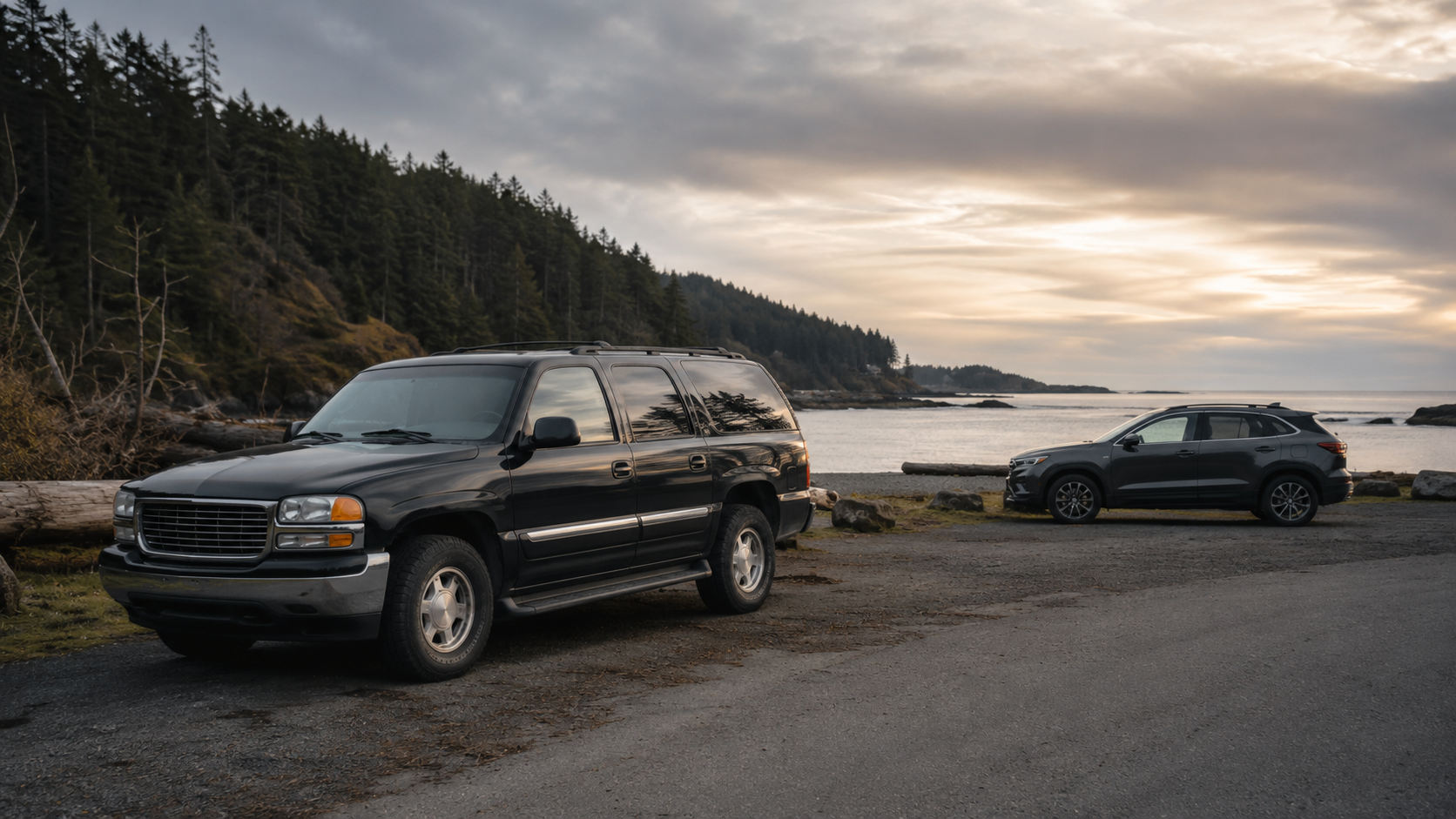
Modern cars are more efficient than old ones.
There. I said it.
They use less fuel, make more power from smaller engines, produce fewer emissions and can squeeze an extra kilometre or two out of every litre through a combination of direct injection, turbocharging, ultra-thin oil, cylinder deactivation, stop-start systems, CVTs and enough computer control to manage a small airport.
That’s impressive.
But here’s the question nobody seems nearly as excited to ask:
How long is all this shit supposed to last?
Because saving a little fuel is great. Replacing a turbocharger, high-pressure fuel pump, CVT, direct-injection component or complicated cylinder-deactivation system after the warranty expires is slightly less great.
I spent years working as a service advisor. I watched people trade perfectly serviceable vehicles because they were terrified of repair bills. They wanted something new, dependable and covered by warranty.
Fair enough.
But over time, I also watched new vehicles become more complicated in the name of efficiency while the customer was still being sold the same comforting story:
Buy new. Avoid repairs. Enjoy peace of mind.
Except many modern vehicles are no longer simple machines with fewer old, worn-out parts. They’re brand-new collections of expensive future problems.
Efficiency has become the answer to everything
Need better fuel economy?
Use a smaller engine.
Need the smaller engine to make the same power as the old larger engine?
Add a turbocharger.
Need even more efficiency?
Add direct injection, variable valve timing, cylinder deactivation, a ten-speed transmission, automatic stop-start and engine oil with roughly the consistency of warm disappointment.
The EPA openly describes turbocharging as a way to replace a larger engine with a smaller, more fuel-efficient one without giving up power. Gasoline direct injection and turbocharging have become major tools for improving efficiency and meeting emissions targets.
None of that means the technology is automatically bad.
Turbochargers have existed forever. Direct injection can work well. Thin synthetic oils are engineered products, not tap water with a convincing label. Modern engines can produce excellent power and economy.
But every added system introduces more parts, more heat, more pressure, more software and more opportunities for the vehicle to eventually ask for your credit card.
A naturally aspirated V6 has fewer expensive things attached to it than a small turbocharged engine working hard to produce the same output.
That isn’t nostalgia.
That’s counting.
I don’t trust anything called “lifetime fluid”
The automotive industry loves the word lifetime.
Lifetime transmission fluid.
Lifetime coolant.
Sealed components.
No service required.
Whose lifetime?
The transmission’s?
Because once the transmission dies, technically the fluid did last its entire life.
That feels less like engineering and more like a clever legal argument.
When I worked in service, preventative maintenance still mattered. Fluids aged. Heat mattered. Driving conditions mattered. Machines wore out because machines are rude like that.
Now we increasingly see drivetrains marketed as low-maintenance units that owners are discouraged from touching. Then, years later, the whole assembly may be treated as one giant replaceable component.
That is efficient for manufacturing and warranty administration.
It is not necessarily efficient for the person who plans to own the vehicle for fifteen years.
The CVT can eat a bag of dicks
I know CVTs can improve fuel economy by keeping an engine operating within a more efficient range.
I understand the theory.
I still hate them.
I hate the way they feel. I hate the engine droning while the vehicle gradually catches up to the noise. I hate that many drivers have absolutely no idea what is happening because the transmission is pretending to shift in order to feel more like the transmission it replaced.
And more importantly, I don’t want my long-term ownership plans resting on a transmission that may be economically disposable when it fails.
Traditional automatic transmissions aren’t immortal. Plenty of them have been complete pieces of shit.
But I would still rather own a conventional, proven automatic than spend years wondering whether my fuel-saving belt-and-pulley box is quietly preparing a five-figure surprise.
Maybe your CVT will run forever.
Fantastic.
Mine won’t, because I’m not buying one.
Ultra-thin oil didn’t happen because engines suddenly became relaxed
Modern engines use oils such as 0W-20, 0W-16 and, in some applications, 0W-8. These oils are designed for modern tolerances, cold-flow performance and reduced internal friction. Lower-viscosity oil is part of the broader push toward efficiency.
Again, that does not mean the oil is automatically failing to protect the engine.
But it illustrates the larger engineering direction.
Everything is being optimized.
Less friction. Less pumping loss. Smaller clearances. Lower emissions. Better test-cycle fuel economy.
An engine designed around extremely thin oil may operate perfectly when everything is new, clean and exactly within specification.
But vehicles don’t stay new.
They overheat. They miss oil changes. They accumulate deposits. Seals age. Clearances change. Owners tow things they shouldn’t tow and ignore warning lights because the light “usually goes away.”
Older engines often had a little more mechanical forgiveness built into them. They weren’t as efficient, but they could tolerate abuse, neglect and questionable life choices in a way that many highly optimized modern systems may not.
Efficiency is about reducing waste.
Unfortunately, some of that “waste” may have been margin for error.
Toyota is the warning that gets everyone’s attention
Toyota built its reputation on dependability.
That reputation was not created by making the most exciting vehicles in every segment. It was built by producing machines that would generally start every morning long after the owner stopped appreciating them.
The old Toyota Tundra used a naturally aspirated 5.7-litre V8. For 2022, Toyota replaced it with twin-turbo V6 powertrains, promoting more torque, more power and greater efficiency.
On paper, the new drivetrain is better.
That’s how this always starts.
Then Toyota issued recalls involving certain Tundra and Lexus models because machining debris could remain inside the engine and lead to rough running, failure to start or loss of power. Toyota Canada announced recalls covering thousands of affected vehicles, and further Tundra engine recalls continued into 2026.
To be fair, machining debris is a manufacturing problem. It does not prove that turbocharged V6 engines are inherently unreliable.
But the entire situation still hits differently because it happened to Toyota after it replaced a simple, well-known V8 with a more complicated twin-turbo system.
Toyota spent decades training customers to believe boring was beautiful.
Then even Toyota decided boring needed intercoolers.
That should make people pay attention.
Not panic. Not declare every new Toyota garbage.
Just pay attention.
Are we saving enough fuel to justify all this?
This is where the argument gets uncomfortable.
A newer vehicle might use seven litres per hundred kilometres while an older, simpler version uses nine.
That difference matters if you drive an enormous distance every year.
But for many average drivers, how much money does it really save?
Enough to offset the higher purchase price?
Enough to offset financing interest?
Enough to offset depreciation?
Enough to offset one major repair to the complicated equipment that helped create the fuel savings?
Saving two litres per hundred kilometres sounds meaningful because fuel consumption is visible. You watch the number change every time you fill up.
The repair waiting somewhere beyond the warranty is invisible.
Until it isn’t.
Then the service advisor gets to explain that the money you saved at the pump for six years has been summoned back to the dealership all at once.
With tax.
New vehicles are dependable—until they aren’t
One of the biggest reasons people buy new vehicles is to avoid repairs.
I saw it constantly in service.
A customer would have an older car that needed brakes, suspension work and perhaps an oil leak repaired. The estimate scared them, so they traded the vehicle and committed to years of payments.
They had successfully avoided a $3,000 repair by purchasing $45,000 worth of car.
Problem solved.
New vehicles feel dependable because most of the parts are new and the warranty absorbs early failures. That doesn’t necessarily tell us how the vehicle will behave at twelve or fifteen years old.
We won’t truly know which current engines and transmissions are durable until enough of them have accumulated years, kilometres, poor maintenance and three owners.
That is the annoying thing about dependability.
You can’t download it in a software update.
It has to be proven.
.
A basic naturally aspirated engine with a conventional transmission starts with fewer unknowns. It may use more fuel. It may produce less horsepower. It may not win a specification-sheet argument.
But it has less shit to go wrong.
That is still a feature, even when it doesn’t appear on the window sticker.
I believe disposability is part of the business model
Can I prove that every manufacturer sits in a boardroom and deliberately designs each vehicle to die at eight years and one day?
No.
And I’m not going to invent evidence because the rant sounds better that way.
But I can look at the direction of the industry.
Long financing terms.
Expensive integrated components.
Software-dependent features.
Increasingly complicated powertrains.
Subscription services.
Vehicles that may become economically unreasonable to repair long before they become physically impossible to repair.
Manufacturers make money when vehicles are sold.
Lenders make money when vehicles are financed.
Shareholders like predictable growth and recurring revenue.
Nobody in that chain makes much money from a person driving the same paid-off V6 for eighteen years.
So perhaps the industry isn’t stamping an exact expiry date on the firewall.
It doesn’t need to.
Build a vehicle that is complicated, expensive to diagnose and financially frightening outside warranty, then offer the owner a shiny new replacement with another eight-year payment.
The result looks a hell of a lot like planned obsolescence, even if the marketing department calls it innovation.
Manufacturers used to need loyal customers.
Now they need captive ones.
What about the environmental argument?
More efficient cars use less fuel and produce fewer tailpipe emissions.
That is good.
I’m not going to pretend burning more gasoline is secretly wonderful for the planet because I like V8 noises.
But environmental impact is bigger than the number on a fuel-economy display.
Vehicles require raw materials, factories, transportation, batteries, plastics, electronics and energy to produce. Then the old vehicle has to go somewhere.
If we save fuel by building cars that are financially disposable after a relatively short life, have we actually solved the problem?
Keeping an existing vehicle operating safely for a long time avoids manufacturing its immediate replacement.
That does not mean every old gas-guzzler is automatically greener than every new car. The calculation depends on use, fuel consumption, emissions and many other factors.
But vehicle lifespan should be part of the conversation.
A car that uses slightly less fuel but gets scrapped years earlier should not receive automatic sainthood because its window sticker had a prettier number.
Durability is environmental too.
We just don’t advertise it as aggressively because “keep your old car” is a terrible sales campaign.
Simple engines still make sense
Give me a dependable naturally aspirated V6.
Give me a simple V8.
Give me conventional fuel injection, a normal automatic transmission and an engine that does not shut half of itself off while cruising down the highway.
I will accept slightly worse fuel economy.
I will accept fewer horsepower.
I will even accept that the engine may not represent the absolute cutting edge of thermodynamic achievement.
What I want is a vehicle that can reach old age without becoming an economic hostage situation.
I want independent shops to repair it.
I want replacement parts to exist.
I want the vehicle to remain useful after the manufacturer stops sending me cheerful emails about upgrading.
That used to be normal.
Now it sounds like an unreasonable list of demands from a grumpy old bastard.
Cars aren’t necessarily garbage. The priorities are.
Modern cars can be remarkable.
They are safer, cleaner, faster and more efficient than the vehicles we had twenty or thirty years ago.
The engineering talent involved is incredible.
My problem is where that talent is being directed.
It is being directed toward emissions targets, fuel-economy tests, performance numbers, manufacturing efficiency, shareholder returns and ways to keep customers financially attached to the product.
Long-term repairability feels like it is somewhere much lower on the list.
Maybe modern cars will prove me wrong.
Maybe today’s tiny turbo engines, CVTs, ultra-thin oils and highly integrated electronics will routinely survive twenty years of Canadian winters, missed services and family abuse.
I genuinely hope they do.
But I’ve spent too long around automotive service to automatically believe every new efficiency technology is also an ownership improvement.
Sometimes efficiency benefits the driver.
Sometimes it benefits the manufacturer.
And sometimes it saves you nine cents at the pump while quietly preparing a $7,000 repair.
That isn’t progress.
That’s a payment plan with better fuel economy.
Stop Charging Me to Use Features Already Installed in My Car
I don’t hate modern cars.
I hate several of the things modern cars do, which is different.
Ventilated seats are glorious. Backup cameras are useful. Apple CarPlay is excellent because it lets my phone replace whatever half-assed infotainment system the manufacturer thought I should be grateful for. A warning that something has stopped unexpectedly in front of me is also appreciated. I enjoy not crashing.
Adaptive cruise control can fuck off.
Lane-keep assist can stop tugging at the steering wheel because I moved six inches within my own lane to avoid a pothole. And the starter does not need to shut the engine off at every red light like we’re desperately trying to preserve one final teaspoon of gasoline for future generations.
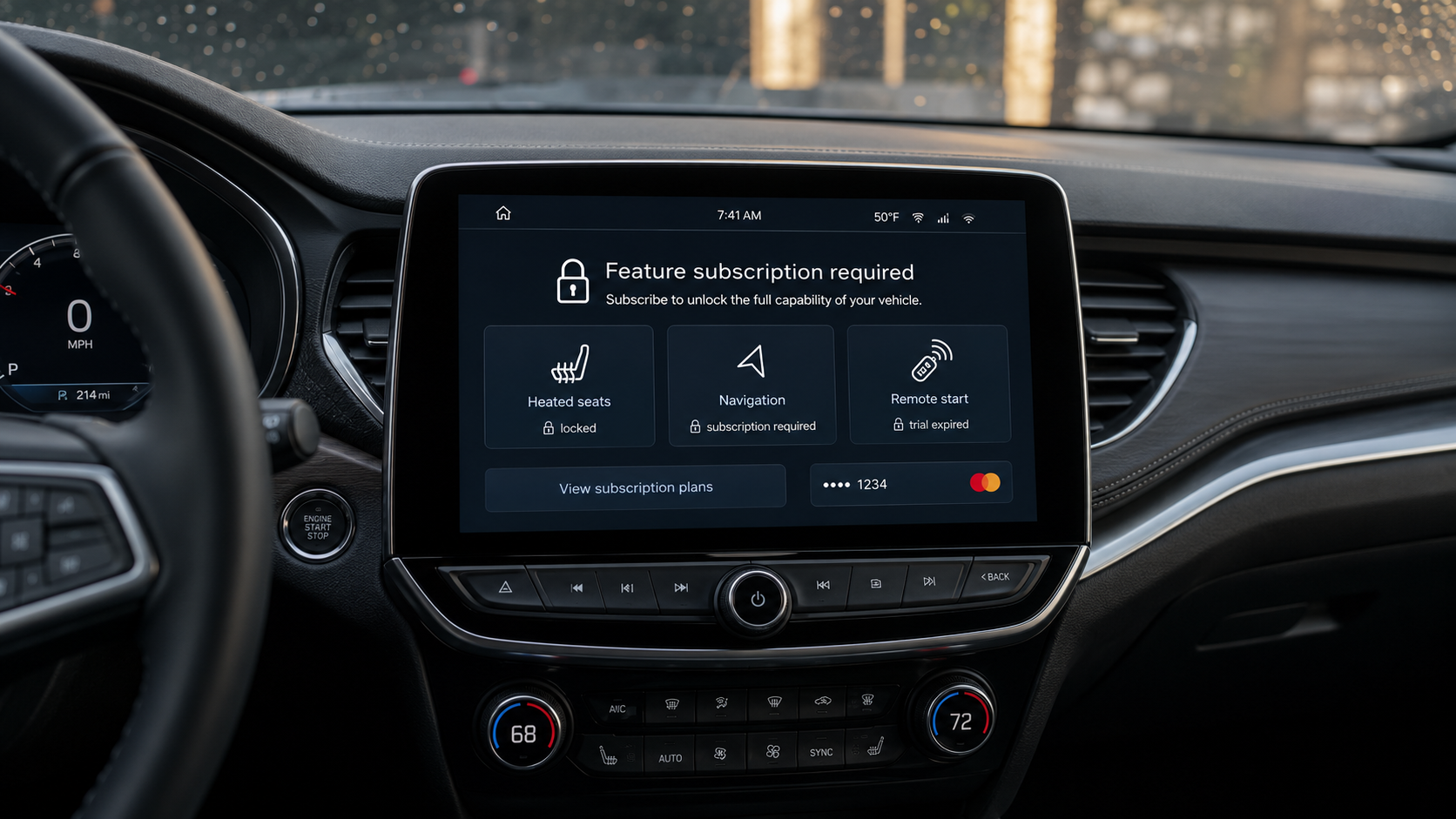
I can accept that modern cars are complicated. What I cannot accept is paying a substantial amount of money for one and then discovering that some of the features are only visiting for the complimentary trial period.
Apparently, the new automotive ownership model goes something like this:
You buy the car. You finance the car. You insure the car. You pay interest on the car. You pay the dealer’s collection of mysterious fees.
Then, just when you think the transaction is over, the manufacturer reaches back into your pocket and asks for another monthly payment so the car will continue doing some of the shit it did when you drove it off the lot.
No.
Absolutely not.
BMW tried renting people their own heated seats
BMW became the poster child for this nonsense when it offered subscriptions in some countries to activate heated seats that were already physically installed in the vehicle.
The widely reported price was roughly $18 a month, with longer-term and permanent-purchase options available. The heating elements, wiring and electronics were already sitting inside the car. The subscription simply granted the owner permission to use them. Customers reacted about as warmly as you would expect, and BMW dropped the heated-seat subscription model in 2023.
Let’s walk through that slowly.
I bought the seat.
I bought the heating element inside the seat.
I bought the wiring running from the seat.
I bought the module controlling the seat.
I bought the entire goddamn car wrapped around the seat.
But I’m renting permission to make my ass warm?
That isn’t a connected service. It’s a hostage situation with leather upholstery.
BMW argued that installing hardware broadly and allowing customers to activate features later offered flexibility. There is at least some logic there. Standardizing production can simplify manufacturing, and a second owner might decide they want an option the original buyer skipped.
Fine.
Sell them the option once.
What people hated was not the ability to add a feature later. It was the idea that a physical component already sitting inside a vehicle could become another recurring bill.
BMW abandoned that particular fight, but it did not abandon digital add-ons and connected products altogether. Its ConnectedDrive ecosystem still offers digital services and features tied to the vehicle.
So the heated-seat disaster was not the end of the idea.
It was the industry learning which part of the idea made customers reach for torches and pitchforks.
Some subscriptions are actual services
There is an important distinction here.
Not every automotive subscription is automatically bullshit.
Satellite radio costs money to operate. Cellular connectivity costs money. Live traffic data, emergency response centres, cloud storage and regularly updated mapping all require infrastructure after the vehicle leaves the factory.
I may not choose to pay for those things, but I understand why the bill exists. Someone is still providing something.
A heated seat does not require a communications network.
There is no employee at BMW headquarters personally warming my backside.
The seat is not downloading weather data to determine the appropriate temperature for my arse.
It is a wire that gets hot.
The problem is that once manufacturers established the screen, the cellular connection and the phone app, they also created a convenient little tollbooth between drivers and their own vehicles.
And just about everyone appears interested in collecting.
Your free trial has ended
Toyota Canada offers Remote Connect features through the Toyota app on compatible vehicles. Those features can include starting and stopping the engine, locking and unlocking the doors, checking vehicle status and locating the vehicle. Toyota provides complimentary trials on eligible vehicles, but says continued use after the trial requires a paid monthly subscription.
So the vehicle may have remote start.
Your phone may have the app.
The cellular hardware may be built into the car.
But at some point, your ability to use the whole arrangement can expire like a streaming-service promotion.
Now, to be fair, phone-based remote access uses a cellular network and back-end systems. That has an operating cost. This is not exactly the same as BMW switching off a seat heater.
But from an owner’s perspective, it still feels strange to buy a modern vehicle full of connectivity, use those features for several years, and then have the car politely explain that your relationship has moved to the payment stage.
Toyota is far from alone.
Ford Canada charges $120 per year for Connected Navigation after the included or trial period on equipped vehicles. Ford’s BlueCruise hands-free highway system is offered at $64.99 a month, $650 a year or, on eligible vehicles, a one-time purchase priced at $3,295.
I personally wouldn’t pay sixty-five bucks a month for my truck to drive while I remain legally and morally responsible for everything it does.
I already dislike adaptive cruise control when it changes speed because a car two postal codes ahead touched its brakes. Paying monthly for an even more involved driver-assistance system is not high on my list.
But at least Ford offers a permanent-purchase option.
That feels more like buying a feature and less like leasing another tiny piece of your own dashboard forever.
Mercedes-Benz has also embraced what it calls Digital Extras. Its Canadian app promotes downloadable features and connected services, including an Acceleration Increase for certain electric models. Mercedes announced that the upgrade could add up to 80 horsepower and improve the zero-to-100-km/h time by as much as one second on eligible EQE and EQS vehicles. Its current Canadian terms describe some upgrades as permanent enhancements purchased with a one-time payment.
Think about that for a second.
The motors are already in the car.
The battery is already in the car.
The car is physically capable of producing the extra power.
You are paying to have the software stop holding it back.
That is not quite the same as renting heated seats every month. A permanent software upgrade is closer to buying a factory tune after purchase.
But it still shows where this is all heading.
Manufacturers are no longer limited to selling you whatever configuration rolled off the assembly line. They can keep a catalogue of dormant capabilities inside the vehicle and offer to wake them up later—for a fee.
From a business perspective, it is brilliant.
From a customer perspective, it feels like finding out your refrigerator has a second shelf that requires a licence key.
The phone app is becoming the new dealership finance office
The old model was straightforward.
You selected the trim and options you wanted. You paid for them. The car came with those features, and they worked until something broke or the vehicle returned to the earth.
Now the vehicle can arrive with a collection of software-controlled functions, trial periods and connected packages that vary by model, trim and year.
Some features are included for one year.
Some for three years.
Some for longer.
Some depend on which package was bundled into the original purchase.
Eventually, you may have to visit an app, check which subscriptions are active and decide which parts of the ownership experience you would like to continue receiving.
I can already picture the future Marketplace ad:
Fully loaded. Leather. Panoramic roof. All subscriptions expired. Bring a credit card.
The phone app is convenient. I get it.
Being able to locate your vehicle, check whether the doors are locked or start it from far away can be genuinely useful. I’m not arguing that the technology should not exist.
I’m arguing that car buyers need to pay attention to which advertised features belong to the car and which ones are merely included for the first few years.
Because “equipped with remote start” and “includes temporary access to remote start through an app” are not the same sentence.
One describes a feature.
The other describes a free sample.
Cars already cost enough
This entire trend would be irritating on a cheap appliance.
It is infuriating on a vehicle that costs $50,000, $70,000 or considerably more.
New vehicles have become expensive enough that six-, seven- and eight-year financing terms are now treated as normal ways to make the monthly number look less terrifying.
You can spend most of a decade paying for the vehicle itself, then stack connected services, navigation, driver assistance, entertainment and feature upgrades on top.
The car payment comes out.
The insurance comes out.
The app subscription comes out.
The navigation subscription comes out.
The hands-free-driving subscription comes out.
At some point the vehicle stops being transportation and becomes a collection of recurring billing opportunities with cupholders.
Automakers love recurring revenue for the same reason every other business loves it.
Selling you something once is good.
Charging you for it repeatedly is better.
That may be excellent news for shareholders.
I do not own enough shares to give a shit.
What happens when these cars get old?
This is the part that concerns me most.
What happens when today’s connected vehicle is fifteen or twenty years old?
Will the app still support it?
Will the cellular hardware still work on whatever networks exist then?
Will the digital store remain open?
Will a second or third owner be able to activate the same features?
Will the manufacturer still care enough to maintain the servers?
Mercedes-Benz’s own Canadian terms say fee-based services may depend on availability, technical compatibility and continued offering for the vehicle. New Mercedes material also notes that limited-term Digital Extras may be extended for a fee provided they are still offered for that vehicle.
That last part matters.
Provided they are still offered.
My 2003 Yukon’s heated seats do not need GM to remember my truck exists.
The switches may fail. The elements may burn out. The wiring may need repair. But the system is physically mine, and a competent shop can diagnose it without asking a remote server whether I still deserve warmth.
That is ownership.
A modern connected feature can be mechanically perfect and still disappear because the supporting service, software or corporate interest went away.
We are building vehicles whose long-term usefulness may depend not only on parts availability, but on whether somebody keeps the digital lights on.
That is a hell of a thing to discover after the warranty is gone.
I don’t need my car to become Netflix
We have already accepted subscriptions for television, music, software, cloud storage, food delivery and apparently the privilege of receiving printer ink before the printer decides I am unworthy.
I do not need my vehicle joining the pile.
Sell me the car.
Sell me the optional equipment.
Charge me for genuine ongoing services when there is a real continuing cost.
But do not install functioning hardware in my vehicle and then ask me to rent access to it.
Do not advertise app-based features without making it painfully clear that they may expire.
And do not tell me this is somehow more convenient because I can activate features whenever I want.
I could also activate them by purchasing them once and then owning them.
We had already invented that system.
It was called buying shit.
I know this probably makes me sound like the grumpy old bastard I am rapidly becoming.
That’s fine.
I have spent roughly twenty years around dealerships, service departments, repair shops and automotive parts. I have watched vehicles become safer, faster, cleaner, more comfortable and more capable.
I have also watched them become more complicated, more expensive and increasingly dependent on software ecosystems that owners do not control.
There are plenty of modern features I enjoy.
Give me the ventilated seats.
Give me the backup camera.
Give me Apple CarPlay and a forward-collision warning.
Lane-keep assist can release the steering wheel. Adaptive cruise can mind its own business. Automatic stop-start can quit shutting off the engine every time I pause long enough to consider my life choices.
And the subscriptions can eat a bag of dicks.
Because when I buy the car, I would like to buy the whole fucking car.
Your Fuel-Efficient Car Isn’t Saving You Money
Every time somebody tells me their new crossover is saving them a fortune because it gets six litres per hundred kilometres, I have the same question:
What’s the payment?
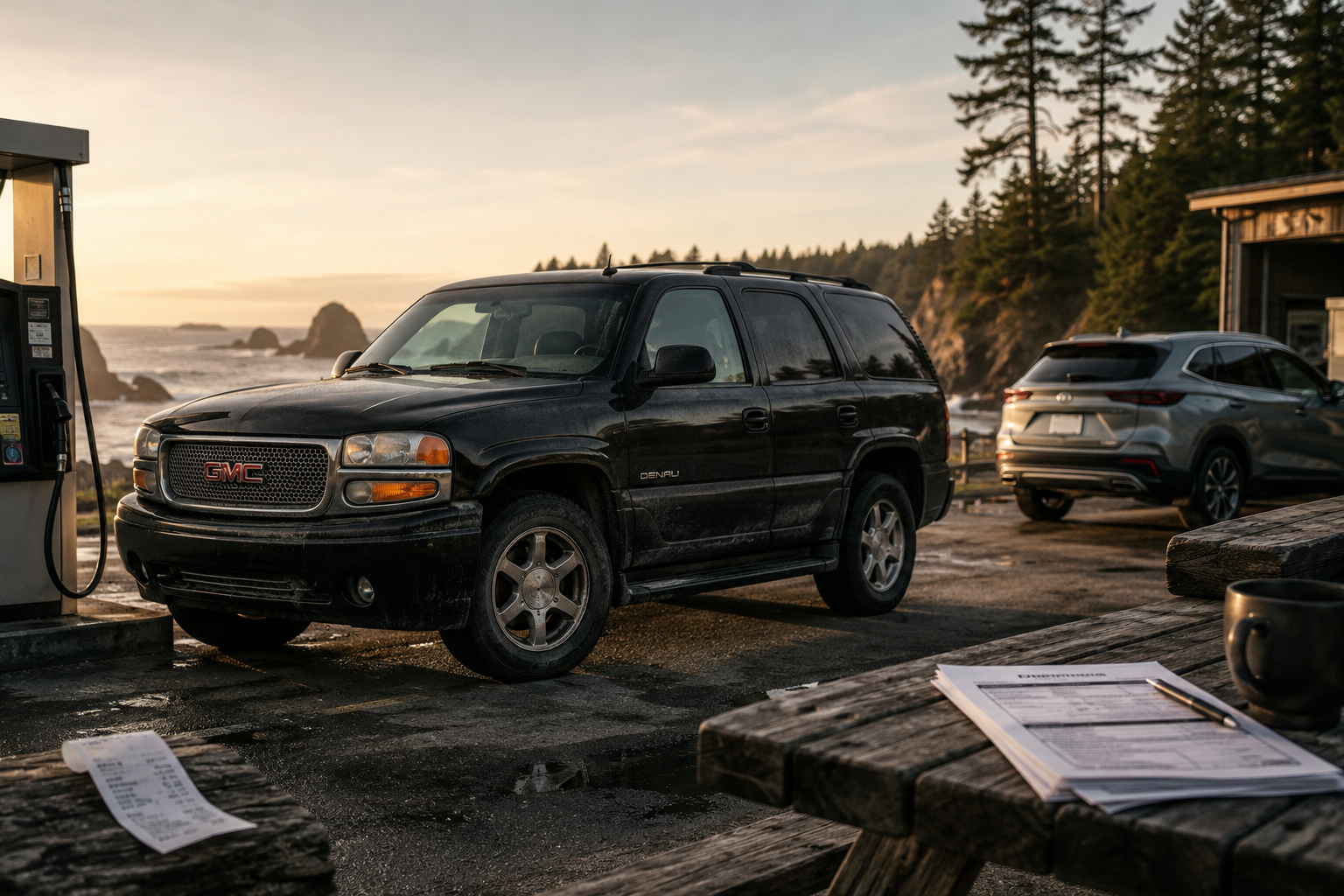
Because fuel economy is apparently the only vehicle expense we’re allowed to talk about anymore. People will stand beside a brand-new SUV with a $700 monthly payment, higher insurance, years of interest and the depreciation curve of a falling piano, then look at my 23-year-old Yukon and tell me I’m wasting money on gas.
Sure. My Yukon drinks fuel.
It has a 6.0-litre V8, all-wheel drive, the aerodynamics of a garden shed and absolutely no interest in pretending otherwise. I’m not going to insult your intelligence by claiming it’s economical. Every trip past a gas station is a meaningful financial event.
But it’s also paid for.
That part seems to get left out of the conversation.
A $700 monthly payment is $8,400 a year before you buy a single litre of fuel. Before insurance. Before interest. Before winter tires, dealer service packages or whatever monthly subscription now allows the steering wheel to remain connected to the front tires.
You can buy a hell of a lot of gas for $8,400.
I’m not saying everyone should immediately sell their new vehicle and buy a 23-year-old truck from Marketplace with four warning lights and a mysterious smell. That would be irresponsible advice, even by internet standards.
I’m saying fuel economy is only one part of the cost of owning a vehicle, and it’s probably the easiest number for people to obsess over because it appears right in front of them at the pump.
The car payment quietly leaves the bank account every month. Depreciation happens invisibly. Interest gets buried in the financing paperwork. Increased insurance becomes another automatic withdrawal. Then somebody saves $120 a month in fuel and acts like they’ve solved personal finance.
Congratulations. You spent $700 to save $120.
That’s not efficiency. That’s a marketing department with excellent lighting.
The old truck isn’t free either
Before somebody starts typing furiously, yes, older vehicles need repairs.
My Yukon is 23 years old and has around 276,000 kilometres on it. Things wear out. Rubber gets old. Steering components develop play. Oil and transmission lines eventually decide they would rather lubricate the underside of the vehicle than remain sealed.
I recently spent about $700 having the oil changed, coolant flushed, brake fluid serviced, the air conditioning diagnosed and recharged, and the whole truck inspected properly.
The inspection found more work. It needs some steering and suspension pieces, leaking transmission cooler lines and rear brakes eventually. That is real money.
But here’s the difference: I can decide when to spend it.
I’m not automatically committed to another $700 next month, and the month after that, and every month until my five-year-old is old enough to borrow the damn thing.
A repair bill is annoying. A large car payment is scheduled annoyance.
There is also a point where fixing an old vehicle stops making sense. Engines fail. Transmissions fail. Rust can turn a perfectly good vehicle into a structural suggestion. Nobody should pour endless money into a lost cause just because the loan is paid off.
But there is an equally stupid idea at the other end of the argument: that an older vehicle should automatically be replaced because it needed a repair.
People will trade a paid-off vehicle because it needs $2,000 worth of work, then proudly sign up for $30,000, $40,000 or $60,000 of debt so they can avoid repair bills.
That is not avoiding an expense. That is replacing one expense with a much larger, shinier expense that smells better for the first six months.
I don’t hate modern vehicles
This is probably where people assume I’m about to claim that every vehicle made after 2006 is garbage and we should all return to crank windows.
Not quite.
Modern vehicles have some fantastic features. Ventilated seats are glorious. Apple CarPlay and Android Auto are genuinely useful. Backup cameras are great, especially when you have kids, bicycles, toys and half the contents of your garage scattered behind the vehicle.
Modern safety systems have improved tremendously. New vehicles are quieter, cleaner and more efficient. Some of them are remarkably comfortable.
I can appreciate all of that while still questioning whether the total ownership model makes any sense.
What I don’t love is increasing complexity, expensive integrated components and the idea that every problem should require a laptop, three software updates and a technician who has completed a manufacturer-specific course on door handles.
I especially don’t love subscriptions.
When I buy a vehicle, I would prefer to also buy the features installed in the vehicle. Apparently that is becoming an unreasonable expectation.
There is a fair argument for paying for services that continue to cost money to provide. Cellular connectivity, live traffic information, satellite services and cloud-based features are not free to operate forever.
But charging someone monthly to use hardware already installed in the car is bullshit.
The heated seat is physically inside the seat. I bought the seat. I bought the wiring. I bought the switches, control modules and entire goddamn car surrounding it.
Why am I renting permission to make my ass warm?
Eight-year loans don’t make cars affordable
The price of new vehicles has reached the point where the industry’s solution is not necessarily to make them cheaper.
It’s to make the loan longer.
Six years. Seven years. Eight years.
Stretch the financing far enough and almost anything can be presented as an acceptable monthly payment. Never mind how much interest you pay or whether you’ll still owe money when the vehicle starts needing meaningful repairs.
The monthly number looks manageable. That’s the magic trick.
A vehicle does not become affordable because the debt has been spread across most of a decade. It just means you get to enjoy being upside down for longer.
Meanwhile, the person driving the paid-off older vehicle is treated as financially irresponsible because their fuel bill is higher.
Maybe it is.
But I would rather spend money operating a vehicle I own than spend the next eight years renting money from a bank so I can tell strangers my average fuel consumption.
The Yukon works for our actual life
Our Yukon isn’t a theoretical spreadsheet vehicle.
It’s our family adventure vehicle. It carries our paddleboard, kayak, lawn chairs, tools, toys, drone equipment and a completely unreasonable number of life jackets. It is comfortable on road trips, has room for everybody and does the things we actually need it to do.
Could we replace it with something newer and more efficient? Absolutely.
Would that replacement save enough fuel to offset the purchase price, financing, insurance and depreciation?
Not even close.
That calculation would be different for someone commuting huge distances every day. It would be different for someone whose old vehicle is unreliable, unsafe or rusting into the earth. It would be different for a business that depends on uptime and predictable operating costs.
There is no single correct vehicle for everybody.
But “it uses less gas” is not a complete financial argument.
It’s one line on a much larger bill.
So yes, my Yukon is thirsty. I’m aware. The fuel gauge moves fast enough to be considered an animated feature.
But it’s paid for, useful, comfortable and still in good mechanical condition. I know its history. Parts are widely available. I work in the automotive industry and can source many of them affordably. For my family and the way we use it, keeping the old truck makes sense.
Your six-litre-per-hundred-kilometre crossover may be a great vehicle. It may genuinely suit your life better than mine suits mine.
Just don’t tell me it’s saving you money until we talk about the other $700 leaving your account every month.
Because that number counts too.
GMT800 vs First-Gen Tundra: Which Old V8 Truck Would I Actually Buy?
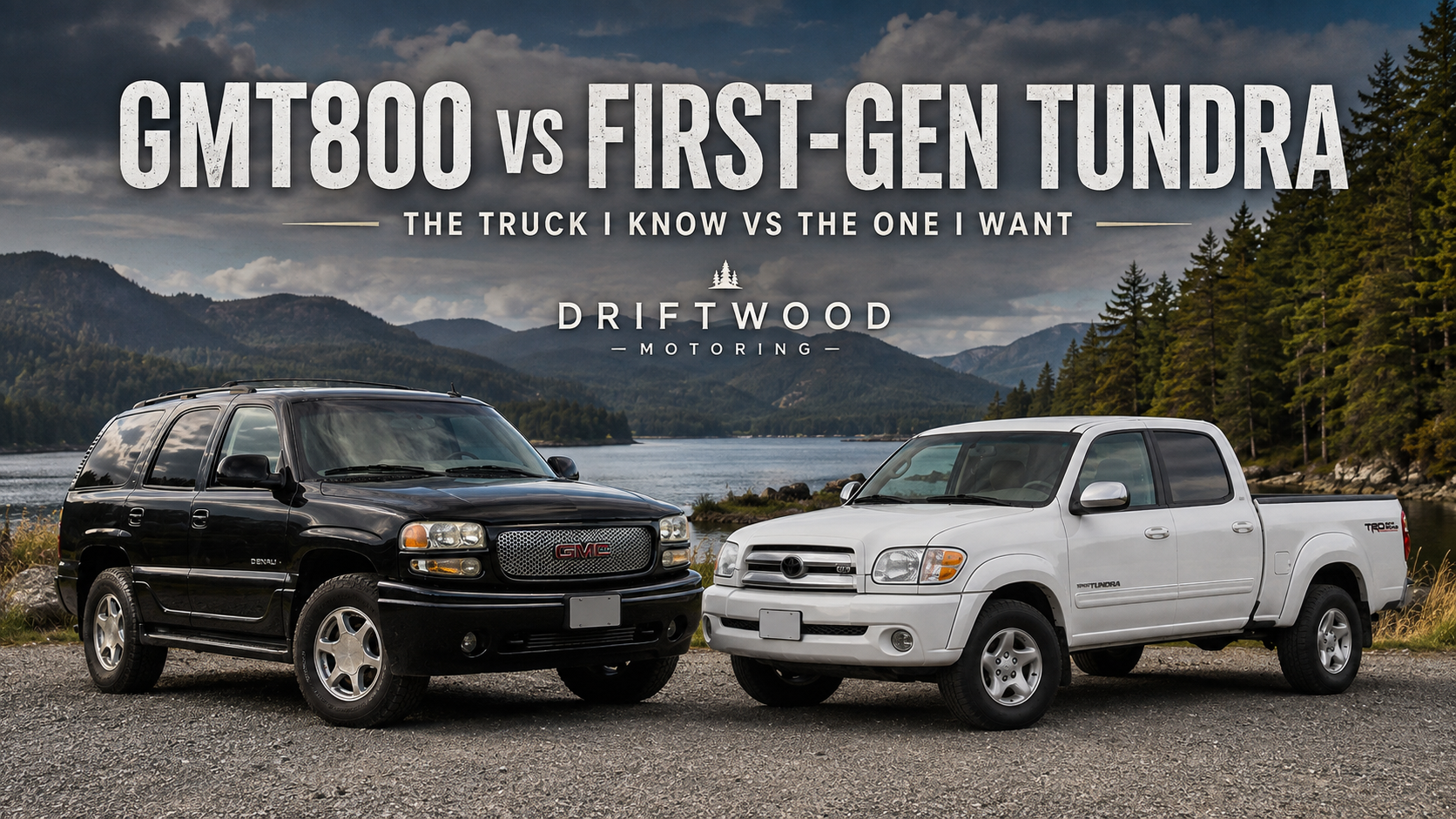
I already own a GMT800.
Mine is a 2003 GMC Yukon Denali, which means I have all the things I love about the GMT800 platform — the 6.0-litre V8, comfortable seats, simple controls, parts everywhere, enough room to lose a small child in the cargo area — without the one thing I currently keep convincing myself I need.
A pickup bed.
And that stupid little distinction has sent me down yet another automotive rabbit hole.
Because apparently owning a perfectly functional vehicle that I genuinely love is not enough.
I have to wonder whether another old truck might solve a problem I only recently decided I had.
The Yukon Is Excellent at Carrying Everything Except My Patience
The Yukon has been our everything vehicle for years.
Camping gear.
Kayaks.
Paddleboards.
Bikes.
Tools.
Beach chairs.
Life jackets.
Enough random family crap that opening the rear hatch sometimes feels like dismantling a poorly packed storage locker.
It handles all of it.
That isn't the problem.
The problem is that I have developed a growing desire to keep the dirty shit out of the passenger compartment.
Sand.
Mud.
Wet life jackets.
Bike tires.
Whatever mysterious organic material attaches itself to a five-year-old during fifteen minutes at the beach.
I like my interior.
I'm also slightly obsessive.
These two characteristics do not always coexist peacefully with outdoor hobbies.
A pickup bed suddenly starts sounding wonderful.
Throw the bikes in.
Throw the wet gear in.
Throw the sandy shit in.
Close tailgate.
Go home.
Hose things out later.
Nobody has to worry about whether a bicycle pedal is slowly machining its way through an interior panel.
Simple.
Which immediately brings me to the two trucks I keep coming back to.
A GMT800 pickup.
Or a first-generation Toyota Tundra.
The GMT800 Is the Devil I Already Know
There is an extremely strong argument for simply buying another GMT800.
I already know the platform.
I've lived with one for years.
I know what they feel like when they're healthy.
I know what they feel like when the steering has approximately the precision of a shopping cart.
I know the interiors.
I know the 5.3.
I know the 6.0.
I know parts availability is ridiculous.
I know there are enough GMT800s being dismantled behind sheds across North America that civilization could collapse tomorrow and we'd probably still be able to source a window regulator.
That matters.
If I bought a clean GMT800 Crew Cab with a 5.3 or 6.0, there would be very little learning curve.
Add a decent double-DIN stereo with Apple CarPlay.
Add a backup camera.
Maybe improve the speakers.
Done.
That's basically all the modern technology I need.
I don't need the truck to monitor my face.
I don't need it deciding whether I've changed lanes correctly.
I don't need twelve cameras showing me a cinematic overhead view of the parking stall at Costco.
I need Spotify.
I need Google Maps.
I would like to see what's behind me.
We solved this.
But I've Always Had a Thing for the First-Gen Tundra
This is where Toyota keeps ruining the simplicity of the decision.
I've always liked the first-generation Tundra.
Especially the later Double Cab trucks with the 4.7-litre V8.
There is something about the proportions that just works.
It is a full-size pickup from an era before full-size pickups became the approximate dimensions of a municipal recreation centre.
The doors are normal.
The bed is useful.
The hood does not begin somewhere near your sternum.
You don't need a spotter to enter an underground parking garage.
It just looks like a truck.
And the 4.7 has developed exactly the sort of reputation that attracts me now.
Proven.
Naturally aspirated.
Simple enough.
Known problems.
Known maintenance.
Lots of people have put deeply unreasonable numbers of kilometres on them.
It's the kind of drivetrain where someone says:
“It's got 270,000 kilometres.”
And instead of immediately recoiling, everyone pauses and goes:
“Okay. So what's the timing belt history?”
That is a very specific kind of automotive insanity.
I understand it completely.
Toyota Has Its Own Weird Fan Lore
There is another difference between the two trucks that I can't quite explain without sounding mildly ridiculous.
The Tundra somehow feels more socially acceptable.
I know.
That's a stupid sentence.
But stay with me.
A GMT800 pickup has a certain reputation now.
It can be a beautiful, clean, tastefully maintained old truck.
It can also have six light bars, one tow mirror extended permanently, a Monster Energy sticker, three mismatched tires and an exhaust system designed primarily to wake infants.
There's a little redneck energy built into the platform.
Which suits me just fine, tell you what.
I'm not judging.
I've spent enough time around old GM trucks that I understand the ecosystem.
But Toyota has a different mythology around it.
The Tundra gets wrapped into the greater Toyota multiverse.
Land Cruisers.
Tacomas.
4Runners.
Million-mile engines.
People talking about frame condition with the seriousness normally reserved for structural engineers inspecting bridges.
Toyota owners don't merely own vehicles.
They join a small religion.
The first-gen Tundra benefits from that.
Even people who aren't really truck people look at a clean old Toyota and go:
“That's cool.”
A clean old GMT800 sometimes gets:
“My uncle had one of those.”
Different emotional response.
Neither is better.
It's just interesting.
The Tundra Is Almost the Toyota Version of What I Already Like
This is probably the real reason I keep looking at them.
The GMT800 and first-gen Tundra come from a similar moment in automotive history.
Modern enough.
Comfortable enough.
Safe enough for their era.
Fuel injected.
Good climate control.
Power accessories.
Decent brakes.
Useful cabins.
But still mechanically understandable.
They're not antique trucks.
I wouldn't put either one into the same category as a '50s pickup, a '60s Ford or even a square-body Chevy.
They're just older vehicles now.
And they're from an era that increasingly appeals to me.
Give me an old truck with a good engine and a normal automatic.
Then let me bolt in the handful of modern features I actually want.
Apple CarPlay?
Easy.
Backup camera?
Easy.
Better headlights?
Easy.
Bluetooth?
Already included with the stereo.
Done.
I don't need to replace the entire vehicle because the dashboard was designed before Spotify existed.
GMT800 Wins the Parts Argument
This one isn't even close for me.
GMT800 parts availability is one of the platform's greatest strengths.
They're everywhere.
I work around automotive parts every day, and there's enormous value in owning something the entire repair industry understands.
Need steering parts?
Of course.
Need brakes?
Take your pick.
Need a mirror?
There are fourteen versions on Marketplace before lunch.
Need a complete 5.3?
Someone probably has one sitting on a tire behind a shed.
The Tundra doesn't have bad parts support.
It's a Toyota.
It's not some obscure French pickup that was imported for seventeen months.
But there simply weren't GMT800 numbers of them running around North America.
GM built these things like it expected every household to require three.
That ecosystem lowers the pain of keeping one alive.
And if I'm thinking ten years ahead, that matters quite a bit.
Toyota Wins the “I Haven't Owned One Yet” Argument
This one matters more than it probably should.
I've done GMT800.
I'm still doing GMT800.
I love GMT800.
That's the problem.
Another GMT800 pickup would make enormous sense.
It would also mean I basically looked at the entire automotive universe and said:
“You know what? I'll have another one of those.”
There is part of me that wants to try another proven platform.
Not because I'm bored with the Yukon.
I'm not.
But I've spent enough years around cars to know that there is something interesting about learning a different vehicle.
Different engineering.
Different strengths.
Different stupid design decisions.
Different things owners swear are “totally normal.”
The first-gen Tundra scratches that itch without asking me to abandon everything I currently value.
V8.
Traditional automatic.
Useful size.
Repairable.
Proven.
No giant screen.
No subscription for the steering wheel.
It is different without being philosophically different.
The Tundra Might Actually Be the Better Size
This is one of the stranger things about old trucks.
They seem to be shrinking.
Obviously they aren't.
Everything else just got enormous.
Park a first-gen Tundra beside a current full-size pickup and it almost looks midsize now.
And for what I actually want a pickup to do, that's a feature.
I am not hauling a skid steer.
Our trailer remains proudly imaginary.
Our boat remains somewhere between inflatable and theoretical.
My major hauling concerns are currently an enormous e-bike, a small bicycle, a kayak, a paddleboard and enough beach equipment to make it appear that we're preparing to establish a coastal settlement.
I don't need an enormous truck.
I need a useful one.
The first-gen Tundra feels like a truck designed before everybody decided bigger automatically meant better.
But Condition Beats Everything
This is where the internet arguments become mostly useless.
Which is better?
GMT800 or first-gen Tundra?
The clean one.
Seriously.
At this age, condition matters more than tribal loyalty.
I'd rather own an extremely clean GMT800 than a tired Tundra with frame concerns, neglected maintenance and an owner who considers warning lights part of the interior ambience.
And I'd rather own a beautifully maintained Tundra than a GMT800 that has spent twenty years towing overloaded trailers down salted highways.
These things are old enough that you're not simply buying a platform anymore.
You're buying the accumulated decisions of every person who owned it before you.
That matters enormously.
A supposedly legendary drivetrain doesn't help much when everything attached to it has been abused.
The Toyota Tax Is Real
This is also where my affection for old Toyotas encounters capitalism.
People know what they have.
Or at least they believe they know what they have.
A twenty-year-old Toyota pickup with 300,000 kilometres can still be advertised for a number that causes you to refresh the page because you assume you misread it.
Sometimes the condition justifies it.
Sometimes the owner has simply spent too much time reading Toyota forums.
GMT800s have gone up too.
Clean ones are becoming harder to find.
But there are still enough of them around that you can occasionally find something sensible.
Toyota seems to begin negotiations from a place of:
“Yes, it has rust.
“Yes, the paint is gone.
“Yes, the timing belt was done sometime during the Obama administration.
“No, I will not accept less than twelve grand.”
Cool.
Thanks.
So Which One Would I Buy?
I don't know.
Helpful article.
If I wanted the safest decision?
Probably GMT800.
I know them.
Parts are everywhere.
I already trust the drivetrains.
They're comfortable.
They're cheap to improve.
And buying one would fit nicely with everything I've already learned owning the Yukon.
If I were buying with my heart?
The Tundra probably has the edge.
Not dramatically.
But enough.
I've always liked them.
I like the 4.7.
I like the size.
I like the Double Cab.
I like that it would let me try another proven old platform without entering a completely different automotive universe.
And I like that it looks good without needing much help.
No giant wheels.
No lift.
No angry headlights.
Give me a clean Double Cab Limited, some decent factory-looking wheels, a modern stereo and a backup camera.
I would be pretty damn happy.
Of Course, I Already Own the Best Argument Against Buying Either
That's the problem.
The Yukon.
I already have a vehicle I love.
It starts.
It runs.
It's comfortable.
It's paid for.
I've spent years sorting it out.
It carries the family.
It carries an obscene amount of gear.
It still looks great when I walk back toward it.
The only major thing it doesn't have is a pickup bed.
Which means I am considering replacing an entire vehicle because I would prefer the sand to be approximately six feet farther behind me.
This is how car people make decisions.
Completely rational.
So maybe I buy another GMT800.
Maybe I finally buy the Tundra I've been looking at for years.
Maybe I fix the Yukon seat, polish the paint, buy a better bike rack and stop browsing Marketplace for seventeen minutes.
That last one seems unlikely.
But stranger things have happened.
The shop is currently imaginary. The automotive obsession is not.
Related Reads
The Best GMT800 Upgrades: What’s Worth Doing—and What I’d Skip
From suspension and brakes to cooling, tuning, CarPlay and the popular modifications I’d probably leave on the internet.
Is the GMT800 Still the Smartest Vehicle to Own in 2026?
Why a paid-for old GM truck or SUV can still make more sense than replacing it—fuel bill, repair list and all.
The GMT800 Duramax: Why These Old Diesel Trucks Became Legends
LB7, LLY and LBZ engines, Allison transmissions, rust, Canadian scarcity and why these old diesel trucks earned their reputation.