
Your Fuel-Efficient Car Isn’t Saving You Money
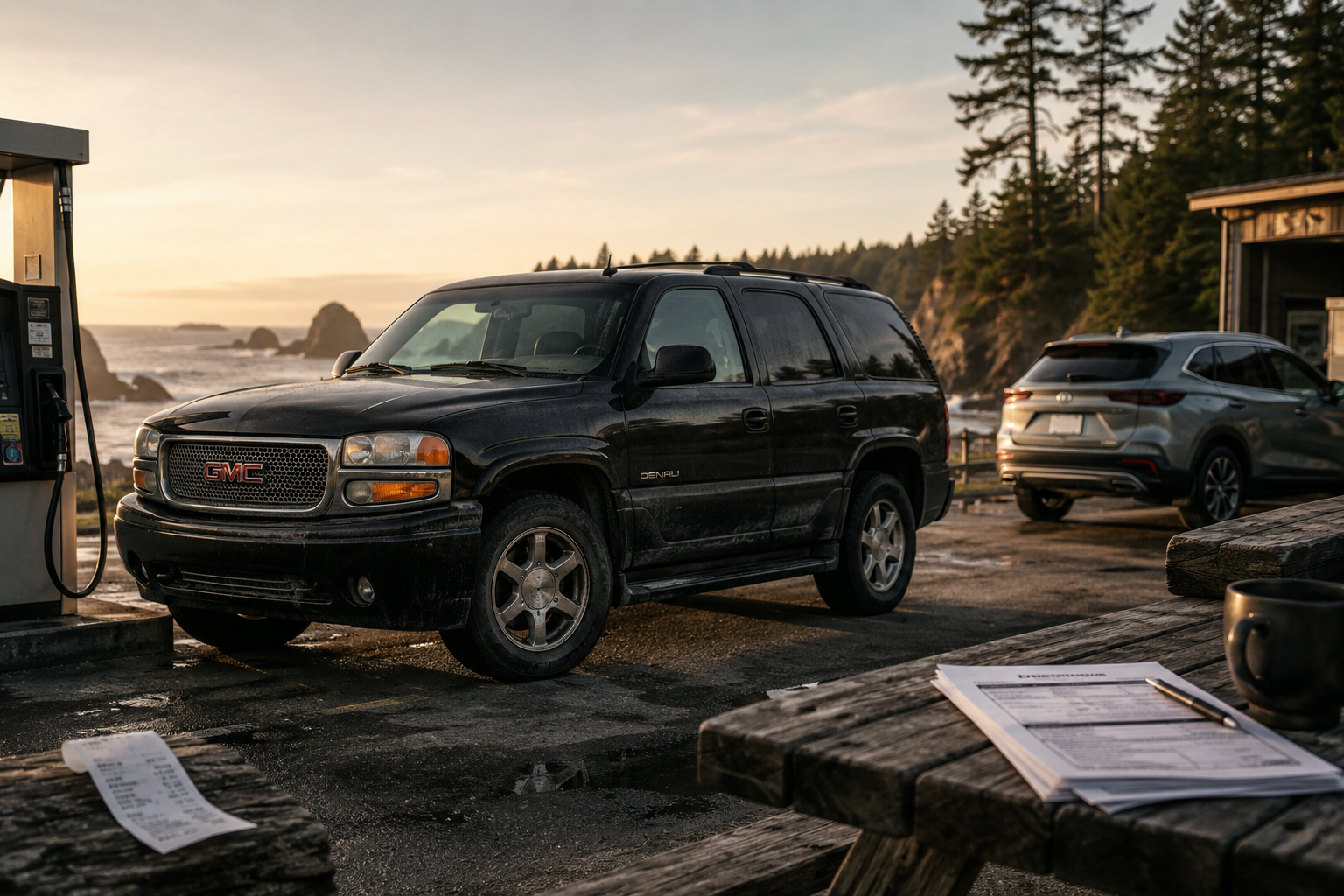
Every time somebody tells me their new crossover is saving them a fortune because it gets six litres per hundred kilometres, I have the same question:
What’s the payment?
Because fuel economy is apparently the only vehicle expense we’re allowed to talk about anymore. People will stand beside a brand-new SUV with a $700 monthly payment, higher insurance, years of interest and the depreciation curve of a falling piano, then look at my 23-year-old Yukon and tell me I’m wasting money on gas.
Sure. My Yukon drinks fuel.
It has a 6.0-litre V8, all-wheel drive, the aerodynamics of a garden shed and absolutely no interest in pretending otherwise. I’m not going to insult your intelligence by claiming it’s economical. Every trip past a gas station is a meaningful financial event.
But it’s also paid for.
That part seems to get left out of the conversation.
A $700 monthly payment is $8,400 a year before you buy a single litre of fuel. Before insurance. Before interest. Before winter tires, dealer service packages or whatever monthly subscription now allows the steering wheel to remain connected to the front tires.
You can buy a hell of a lot of gas for $8,400.
I’m not saying everyone should immediately sell their new vehicle and buy a 23-year-old truck from Marketplace with four warning lights and a mysterious smell. That would be irresponsible advice, even by internet standards.
I’m saying fuel economy is only one part of the cost of owning a vehicle, and it’s probably the easiest number for people to obsess over because it appears right in front of them at the pump.
The car payment quietly leaves the bank account every month. Depreciation happens invisibly. Interest gets buried in the financing paperwork. Increased insurance becomes another automatic withdrawal. Then somebody saves $120 a month in fuel and acts like they’ve solved personal finance.
Congratulations. You spent $700 to save $120.
That’s not efficiency. That’s a marketing department with excellent lighting.
The old truck isn’t free either
Before somebody starts typing furiously, yes, older vehicles need repairs.
My Yukon is 23 years old and has around 276,000 kilometres on it. Things wear out. Rubber gets old. Steering components develop play. Oil and transmission lines eventually decide they would rather lubricate the underside of the vehicle than remain sealed.
I recently spent about $700 having the oil changed, coolant flushed, brake fluid serviced, the air conditioning diagnosed and recharged, and the whole truck inspected properly.
The inspection found more work. It needs some steering and suspension pieces, leaking transmission cooler lines and rear brakes eventually. That is real money.
But here’s the difference: I can decide when to spend it.
I’m not automatically committed to another $700 next month, and the month after that, and every month until my five-year-old is old enough to borrow the damn thing.
A repair bill is annoying. A large car payment is scheduled annoyance.
There is also a point where fixing an old vehicle stops making sense. Engines fail. Transmissions fail. Rust can turn a perfectly good vehicle into a structural suggestion. Nobody should pour endless money into a lost cause just because the loan is paid off.
But there is an equally stupid idea at the other end of the argument: that an older vehicle should automatically be replaced because it needed a repair.
People will trade a paid-off vehicle because it needs $2,000 worth of work, then proudly sign up for $30,000, $40,000 or $60,000 of debt so they can avoid repair bills.
That is not avoiding an expense. That is replacing one expense with a much larger, shinier expense that smells better for the first six months.
I don’t hate modern vehicles
This is probably where people assume I’m about to claim that every vehicle made after 2006 is garbage and we should all return to crank windows.
Not quite.
Modern vehicles have some fantastic features. Ventilated seats are glorious. Apple CarPlay and Android Auto are genuinely useful. Backup cameras are great, especially when you have kids, bicycles, toys and half the contents of your garage scattered behind the vehicle.
Modern safety systems have improved tremendously. New vehicles are quieter, cleaner and more efficient. Some of them are remarkably comfortable.
I can appreciate all of that while still questioning whether the total ownership model makes any sense.
What I don’t love is increasing complexity, expensive integrated components and the idea that every problem should require a laptop, three software updates and a technician who has completed a manufacturer-specific course on door handles.
I especially don’t love subscriptions.
When I buy a vehicle, I would prefer to also buy the features installed in the vehicle. Apparently that is becoming an unreasonable expectation.
There is a fair argument for paying for services that continue to cost money to provide. Cellular connectivity, live traffic information, satellite services and cloud-based features are not free to operate forever.
But charging someone monthly to use hardware already installed in the car is bullshit.
The heated seat is physically inside the seat. I bought the seat. I bought the wiring. I bought the switches, control modules and entire goddamn car surrounding it.
Why am I renting permission to make my ass warm?
Eight-year loans don’t make cars affordable
The price of new vehicles has reached the point where the industry’s solution is not necessarily to make them cheaper.
It’s to make the loan longer.
Six years. Seven years. Eight years.
Stretch the financing far enough and almost anything can be presented as an acceptable monthly payment. Never mind how much interest you pay or whether you’ll still owe money when the vehicle starts needing meaningful repairs.
The monthly number looks manageable. That’s the magic trick.
A vehicle does not become affordable because the debt has been spread across most of a decade. It just means you get to enjoy being upside down for longer.
Meanwhile, the person driving the paid-off older vehicle is treated as financially irresponsible because their fuel bill is higher.
Maybe it is.
But I would rather spend money operating a vehicle I own than spend the next eight years renting money from a bank so I can tell strangers my average fuel consumption.
The Yukon works for our actual life
Our Yukon isn’t a theoretical spreadsheet vehicle.
It’s our family adventure vehicle. It carries our paddleboard, kayak, lawn chairs, tools, toys, drone equipment and a completely unreasonable number of life jackets. It is comfortable on road trips, has room for everybody and does the things we actually need it to do.
Could we replace it with something newer and more efficient? Absolutely.
Would that replacement save enough fuel to offset the purchase price, financing, insurance and depreciation?
Not even close.
That calculation would be different for someone commuting huge distances every day. It would be different for someone whose old vehicle is unreliable, unsafe or rusting into the earth. It would be different for a business that depends on uptime and predictable operating costs.
There is no single correct vehicle for everybody.
But “it uses less gas” is not a complete financial argument.
It’s one line on a much larger bill.
So yes, my Yukon is thirsty. I’m aware. The fuel gauge moves fast enough to be considered an animated feature.
But it’s paid for, useful, comfortable and still in good mechanical condition. I know its history. Parts are widely available. I work in the automotive industry and can source many of them affordably. For my family and the way we use it, keeping the old truck makes sense.
Your six-litre-per-hundred-kilometre crossover may be a great vehicle. It may genuinely suit your life better than mine suits mine.
Just don’t tell me it’s saving you money until we talk about the other $700 leaving your account every month.
Because that number counts too.
