
The GMT800 Duramax: Why These Old Diesel Trucks Became Legends
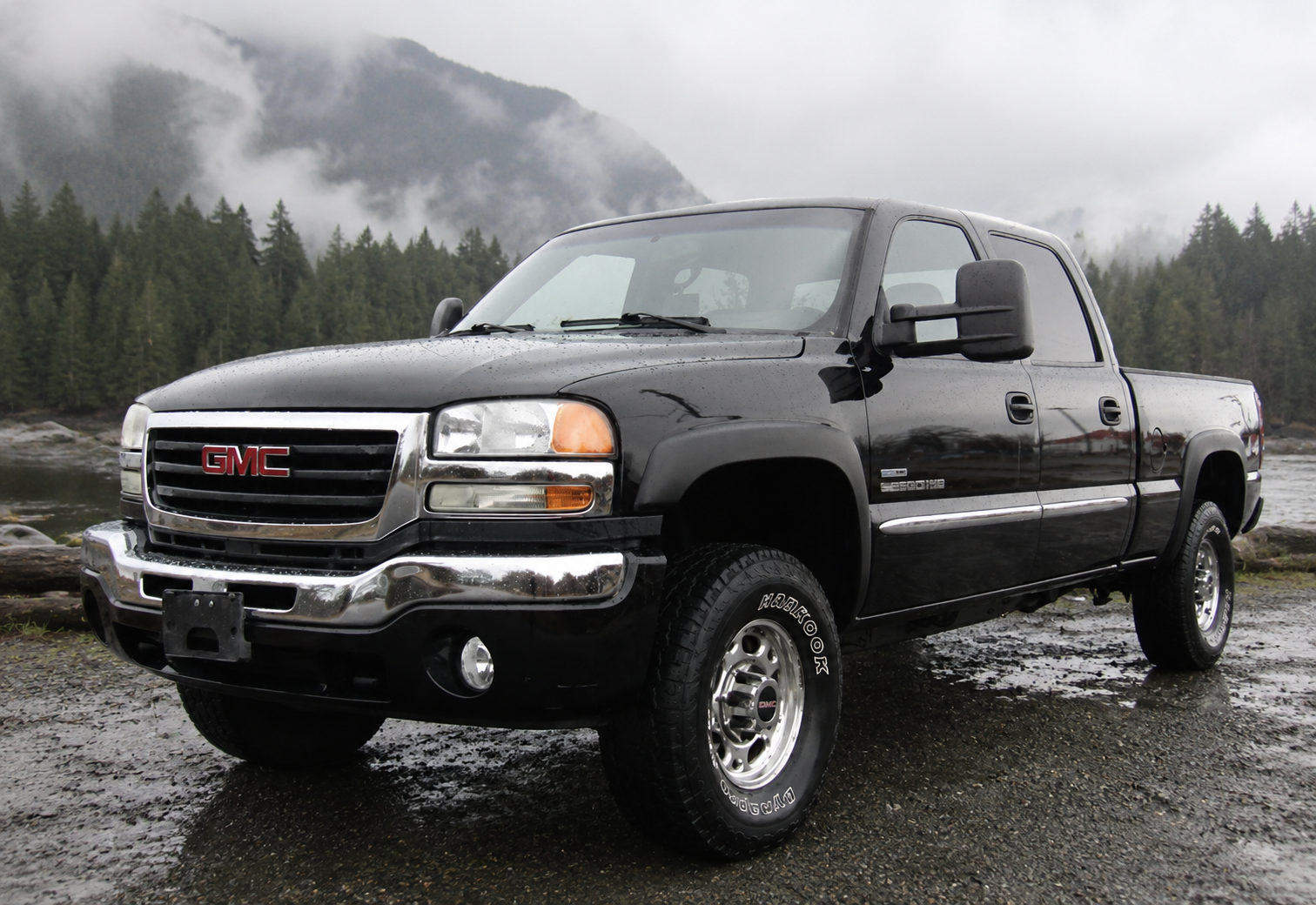
I’ve been looking at trucks lately.
I don’t desperately need one, which naturally makes this the perfect time to spend hours scrolling through used-truck listings.
The Yukon already does nearly everything we ask of it. It carries bikes, kayaks, paddleboards, camping gear, tools and enough assorted family crap to support a small expedition. But I live on Vancouver Island, and a truck bed would be useful for doing truck things without having to load everything into the same carpeted space where my family sits.
So I’ve been looking at first-generation Tundras, newer Sierras, Rams, F-150s and, inevitably, GMT800 pickups.
I already own a GMT800. I know how comfortable they are, how useful they are and how straightforward they are to fix. Buying another one with a bed makes a lot of sense.
The problem is finding one that hasn’t spent the past 20 years being slowly returned to the earth.
And then there are the Duramaxes.
The Diesel That Changed Everything for GM
Bring up the GMT800 Duramax around diesel-truck people and someone will immediately tell you about one with 700,000 kilometres that has only ever needed oil changes and one headlight bulb.
That story is probably missing a few receipts.
Still, there’s a reason these trucks have such a following.
The 6.6-litre Duramax arrived for the 2001 model year in Chevrolet Silverado HD and GMC Sierra HD pickups. More importantly, GM paired it with the Allison 1000 automatic transmission.
That combination became the legend.
The Duramax delivered serious torque and strong power without feeling like an agricultural engine someone had accidentally installed in a pickup. The Allison gave it a transmission people trusted. Together, they helped pull GM’s diesel reputation out of the hole it had spent years digging for itself.
More than 20 years later, people still actively hunt for these trucks. Clean examples still bring serious money, and owners talk about LB7s, LLYs and LBZs as though they’re discussing members of the family.
Possibly more fondly than some actual family members.
LB7, LLY and LBZ Without Writing a Diesel Textbook
The first Duramax was the LB7, offered from 2001 into 2004.
It established the basic formula and earned a reputation for strong performance, good fuel economy and very long life. It also became known for injector problems, with the injectors inconveniently buried under the valve covers because apparently GM wanted replacement to be memorable.
A properly maintained LB7 with documented injector work can still be an excellent truck. The important word is documented. “The previous owner did them” is not documentation. Neither is “my buddy looked at it.”
The LLY arrived partway through 2004 and carried the Duramax into the middle GMT800 years. Its injectors were easier to access, but the LLY developed its own reputation for cooling concerns when towing hard or making additional power.
That doesn’t make every LLY a ticking time bomb. Old-truck shoppers have a habit of memorizing engine-code stereotypes and then ignoring the condition of the actual truck sitting in front of them.
I’d take a clean, maintained LLY over a beaten-to-death LBZ every day of the week.
The LBZ arrived near the end of the GMT800 run, bringing more power, more torque and a six-speed Allison. It also came before diesel particulate filters entered the picture.
That made it the one everyone wants.
The problem with everyone wanting something is that sellers eventually notice.
A clean LBZ crew cab is no longer just an old work truck. It’s now a highly desirable old work truck being sold by someone who has recently looked at every other LBZ listing within 1,000 kilometres.
The Mechanical Stuff Doesn’t Scare Me
People love saying that a Duramax will run forever.
Maybe it will. But the engine isn’t the only thing you’re buying.
You’re also buying a 20-plus-year-old truck with an old cooling system, transfer case, front end, wheel bearings, wiring, steering components and every other part attached to it.
For me, that isn’t necessarily the frightening part.
I work for a parts company. I’ve spent most of my adult life around the automotive industry, and you can still buy practically everything for a GMT800. Front-end parts, brakes, bearings, sensors, cooling-system components, window regulators, interior pieces—it’s all available.
Mechanical problems can be diagnosed. Parts can be ordered. Things can be unbolted and replaced. None of that is free, but it’s understandable.
Even the famously destroyed GMT800 driver’s seat isn’t the crisis people seem to think it is. Replacement leather and foam are readily available and surprisingly affordable. I genuinely don’t understand how someone can drive around for five years with the foam hanging out of the seat when the parts to repair it cost so little.
Fix the damn seat. You spend every kilometre sitting on it.
No, the part that worries me is rust.
Rust Is the Problem You Own Forever
Mechanical work has a finish line.
You replace the failed part, put the truck back together and move on with your life until the next thing breaks. That’s old-vehicle ownership. I’m fine with it.
Rust is different.
Rust nags at you.
It sits underneath the truck quietly getting worse while you pretend the fresh black undercoating applied by the seller is probably completely innocent. It creeps into brake lines, rockers, cab corners, crossmembers, mounts and every fastener you may eventually need to remove.
A rusty truck makes every future repair worse. A simple job becomes a broken-bolt job. A weekend repair becomes a welding project. You stop asking whether a part is worn out and start asking whether there’s enough truck left to attach the new one to.
I don’t mind buying something that needs brakes, front-end work or a cooling-system overhaul. I can deal with that.
What I don’t want is to spend good money on a truck that bothers me every time I look underneath it.
And this is the problem with shopping for GMT800s now. Many of them have lived long, useful truck lives. They’ve towed, hauled, worked, sat outside and endured more than two decades of weather. Even here on the West Coast, trucks move around. Something currently listed on Vancouver Island may have spent its first 15 winters somewhere considerably less friendly to steel.
A shiny body and a freshly detailed interior don’t tell you what’s happening underneath.
Neither does black spray paint.
Clean Trucks Are Getting Hard to Find
I’ve been actively looking for something with a bed, and decent GMT800 pickups are becoming surprisingly difficult to find in my area.
There are trucks for sale. There are always trucks for sale.
Finding one I’d want to own for another ten years is the challenge.
Gas GMT800s are getting thin. Nice Duramaxes are even harder to find, and the clean ones are still bringing around $20,000 to the mid-$20,000s Canadian—sometimes more.
At that price, mileage matters, even if the engine has a reputation for lasting forever.
A Duramax with 400,000 or 500,000 kilometres may still have plenty of life left, but that doesn’t mean I want to start my ownership experience there after handing over $25,000. Especially if the body is already beginning its transformation into iron oxide.
The affordable trucks usually have a reason for being affordable. The clean, lower-mileage trucks are expensive. The rare truck that appears to land somewhere in the middle is either sold immediately or located far enough away to involve ferry reservations, travel costs and a full day of disappointment if the seller’s definition of “mint” turns out to be creative.
Are GMT800 Duramaxes Still Worth Buying?
Absolutely—if you find the right one.
A good GMT800 Duramax still offers enormous capability without the price, complexity and ridiculous physical size of a new diesel HD truck.
The visibility is excellent. The interiors are comfortable. The controls make sense. Parts availability is fantastic, and nearly every independent shop understands how to work on one.
They’re also from an era when trucks were large enough to do serious work without needing their own postal code.
But I wouldn’t buy one based solely on the engine code.
I’d rather have the cleanest, most honest truck I could find. Give me a solid body, a clean frame and decent maintenance records. I can replace mechanical parts. I can fix a seat. I can rebuild a front end.
I don’t want to spend the next ten years chasing rust.
GM Should Have Built a Duramax SUV
General Motors had the Duramax. It had the Allison. It had the GMT800 Tahoe, Yukon and Suburban, including heavy-duty 2500-series versions of the Suburban and Yukon XL.
Yet somehow, GM never sold us a factory Duramax–Allison SUV.
That feels like an oversight bordering on negligence.
Imagine a GMT800 Suburban 2500 with an LBZ and six-speed Allison: proper towing capability, massive enclosed cargo space and room for the family and all their gear.
Or forget being responsible and imagine a standard-length Yukon Denali with that drivetrain.
That would be magnificent.
People have built Duramax Suburbans and Yukons, of course. Given enough money, fabrication and disregard for financial planning, people will build anything.
But GM could have done it properly from the factory.
It should have.
And Now I Want One
I started looking at trucks because having a bed would be useful for bikes, kayaks, paddleboards, camping and all the other stuff that comes with living where we do.
That led me to first-generation Tundras.
Then back to GMT800s.
And now, inevitably, to Duramaxes.
A clean LBZ crew cab would be extremely hard to resist. It would provide the truck bed I keep thinking about, enough capability for nearly anything I’d reasonably—or unreasonably—ask it to do, and one of the most respected diesel drivetrains of the past 25 years.
It would also cost more than I originally planned to spend and introduce me to diesel-sized repair bills.
So naturally, I want one.
That’s the hold these trucks still have. More than two decades later, after years of towing, hauling, modifications and abuse, good GMT800 Duramaxes remain genuinely desirable.
They’re harder to find.
They’re definitely not cheap.
And GM still owes us a factory Duramax Yukon.
The shop is currently imaginary. Apparently, so is the perfect truck.
Related Reads
Why the GMT800 Might Be GM’s Best Truck Platform
The gas engines get most of the attention, but the Duramax and Allison helped turn GM’s turn-of-the-century truck platform into a genuine high-water mark.
The Best GMT800 Upgrades: What’s Worth Doing—and What I’d Skip
Suspension, brakes, cooling, tuning and the upgrades that can make an old GM truck better without emptying an entire parts catalogue into it.
2014–2018 GMC Sierras Are Getting Cheap. Are They the Next Great Old GM Truck—or Just More Trouble?
They’re handsome, comfortable and becoming dangerously affordable. Unfortunately, GM also brought more technology—and more ways to ruin your afternoon.
