
GMT800 vs First-Gen Tundra: Which Old V8 Truck Would I Actually Buy?
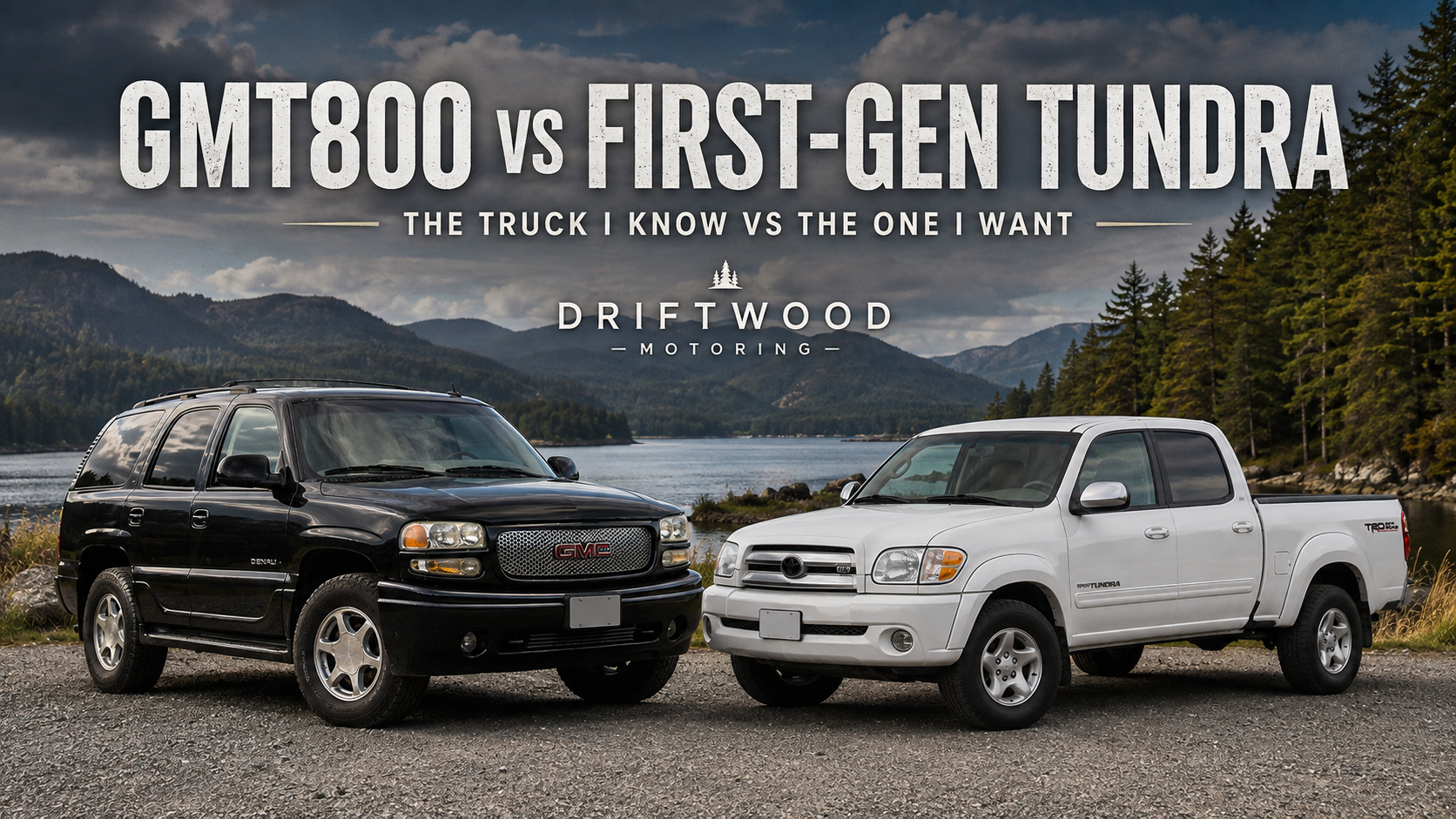
I already own a GMT800.
Mine is a 2003 GMC Yukon Denali, which means I have all the things I love about the GMT800 platform — the 6.0-litre V8, comfortable seats, simple controls, parts everywhere, enough room to lose a small child in the cargo area — without the one thing I currently keep convincing myself I need.
A pickup bed.
And that stupid little distinction has sent me down yet another automotive rabbit hole.
Because apparently owning a perfectly functional vehicle that I genuinely love is not enough.
I have to wonder whether another old truck might solve a problem I only recently decided I had.
The Yukon Is Excellent at Carrying Everything Except My Patience
The Yukon has been our everything vehicle for years.
Camping gear.
Kayaks.
Paddleboards.
Bikes.
Tools.
Beach chairs.
Life jackets.
Enough random family crap that opening the rear hatch sometimes feels like dismantling a poorly packed storage locker.
It handles all of it.
That isn't the problem.
The problem is that I have developed a growing desire to keep the dirty shit out of the passenger compartment.
Sand.
Mud.
Wet life jackets.
Bike tires.
Whatever mysterious organic material attaches itself to a five-year-old during fifteen minutes at the beach.
I like my interior.
I'm also slightly obsessive.
These two characteristics do not always coexist peacefully with outdoor hobbies.
A pickup bed suddenly starts sounding wonderful.
Throw the bikes in.
Throw the wet gear in.
Throw the sandy shit in.
Close tailgate.
Go home.
Hose things out later.
Nobody has to worry about whether a bicycle pedal is slowly machining its way through an interior panel.
Simple.
Which immediately brings me to the two trucks I keep coming back to.
A GMT800 pickup.
Or a first-generation Toyota Tundra.
The GMT800 Is the Devil I Already Know
There is an extremely strong argument for simply buying another GMT800.
I already know the platform.
I've lived with one for years.
I know what they feel like when they're healthy.
I know what they feel like when the steering has approximately the precision of a shopping cart.
I know the interiors.
I know the 5.3.
I know the 6.0.
I know parts availability is ridiculous.
I know there are enough GMT800s being dismantled behind sheds across North America that civilization could collapse tomorrow and we'd probably still be able to source a window regulator.
That matters.
If I bought a clean GMT800 Crew Cab with a 5.3 or 6.0, there would be very little learning curve.
Add a decent double-DIN stereo with Apple CarPlay.
Add a backup camera.
Maybe improve the speakers.
Done.
That's basically all the modern technology I need.
I don't need the truck to monitor my face.
I don't need it deciding whether I've changed lanes correctly.
I don't need twelve cameras showing me a cinematic overhead view of the parking stall at Costco.
I need Spotify.
I need Google Maps.
I would like to see what's behind me.
We solved this.
But I've Always Had a Thing for the First-Gen Tundra
This is where Toyota keeps ruining the simplicity of the decision.
I've always liked the first-generation Tundra.
Especially the later Double Cab trucks with the 4.7-litre V8.
There is something about the proportions that just works.
It is a full-size pickup from an era before full-size pickups became the approximate dimensions of a municipal recreation centre.
The doors are normal.
The bed is useful.
The hood does not begin somewhere near your sternum.
You don't need a spotter to enter an underground parking garage.
It just looks like a truck.
And the 4.7 has developed exactly the sort of reputation that attracts me now.
Proven.
Naturally aspirated.
Simple enough.
Known problems.
Known maintenance.
Lots of people have put deeply unreasonable numbers of kilometres on them.
It's the kind of drivetrain where someone says:
“It's got 270,000 kilometres.”
And instead of immediately recoiling, everyone pauses and goes:
“Okay. So what's the timing belt history?”
That is a very specific kind of automotive insanity.
I understand it completely.
Toyota Has Its Own Weird Fan Lore
There is another difference between the two trucks that I can't quite explain without sounding mildly ridiculous.
The Tundra somehow feels more socially acceptable.
I know.
That's a stupid sentence.
But stay with me.
A GMT800 pickup has a certain reputation now.
It can be a beautiful, clean, tastefully maintained old truck.
It can also have six light bars, one tow mirror extended permanently, a Monster Energy sticker, three mismatched tires and an exhaust system designed primarily to wake infants.
There's a little redneck energy built into the platform.
Which suits me just fine, tell you what.
I'm not judging.
I've spent enough time around old GM trucks that I understand the ecosystem.
But Toyota has a different mythology around it.
The Tundra gets wrapped into the greater Toyota multiverse.
Land Cruisers.
Tacomas.
4Runners.
Million-mile engines.
People talking about frame condition with the seriousness normally reserved for structural engineers inspecting bridges.
Toyota owners don't merely own vehicles.
They join a small religion.
The first-gen Tundra benefits from that.
Even people who aren't really truck people look at a clean old Toyota and go:
“That's cool.”
A clean old GMT800 sometimes gets:
“My uncle had one of those.”
Different emotional response.
Neither is better.
It's just interesting.
The Tundra Is Almost the Toyota Version of What I Already Like
This is probably the real reason I keep looking at them.
The GMT800 and first-gen Tundra come from a similar moment in automotive history.
Modern enough.
Comfortable enough.
Safe enough for their era.
Fuel injected.
Good climate control.
Power accessories.
Decent brakes.
Useful cabins.
But still mechanically understandable.
They're not antique trucks.
I wouldn't put either one into the same category as a '50s pickup, a '60s Ford or even a square-body Chevy.
They're just older vehicles now.
And they're from an era that increasingly appeals to me.
Give me an old truck with a good engine and a normal automatic.
Then let me bolt in the handful of modern features I actually want.
Apple CarPlay?
Easy.
Backup camera?
Easy.
Better headlights?
Easy.
Bluetooth?
Already included with the stereo.
Done.
I don't need to replace the entire vehicle because the dashboard was designed before Spotify existed.
GMT800 Wins the Parts Argument
This one isn't even close for me.
GMT800 parts availability is one of the platform's greatest strengths.
They're everywhere.
I work around automotive parts every day, and there's enormous value in owning something the entire repair industry understands.
Need steering parts?
Of course.
Need brakes?
Take your pick.
Need a mirror?
There are fourteen versions on Marketplace before lunch.
Need a complete 5.3?
Someone probably has one sitting on a tire behind a shed.
The Tundra doesn't have bad parts support.
It's a Toyota.
It's not some obscure French pickup that was imported for seventeen months.
But there simply weren't GMT800 numbers of them running around North America.
GM built these things like it expected every household to require three.
That ecosystem lowers the pain of keeping one alive.
And if I'm thinking ten years ahead, that matters quite a bit.
Toyota Wins the “I Haven't Owned One Yet” Argument
This one matters more than it probably should.
I've done GMT800.
I'm still doing GMT800.
I love GMT800.
That's the problem.
Another GMT800 pickup would make enormous sense.
It would also mean I basically looked at the entire automotive universe and said:
“You know what? I'll have another one of those.”
There is part of me that wants to try another proven platform.
Not because I'm bored with the Yukon.
I'm not.
But I've spent enough years around cars to know that there is something interesting about learning a different vehicle.
Different engineering.
Different strengths.
Different stupid design decisions.
Different things owners swear are “totally normal.”
The first-gen Tundra scratches that itch without asking me to abandon everything I currently value.
V8.
Traditional automatic.
Useful size.
Repairable.
Proven.
No giant screen.
No subscription for the steering wheel.
It is different without being philosophically different.
The Tundra Might Actually Be the Better Size
This is one of the stranger things about old trucks.
They seem to be shrinking.
Obviously they aren't.
Everything else just got enormous.
Park a first-gen Tundra beside a current full-size pickup and it almost looks midsize now.
And for what I actually want a pickup to do, that's a feature.
I am not hauling a skid steer.
Our trailer remains proudly imaginary.
Our boat remains somewhere between inflatable and theoretical.
My major hauling concerns are currently an enormous e-bike, a small bicycle, a kayak, a paddleboard and enough beach equipment to make it appear that we're preparing to establish a coastal settlement.
I don't need an enormous truck.
I need a useful one.
The first-gen Tundra feels like a truck designed before everybody decided bigger automatically meant better.
But Condition Beats Everything
This is where the internet arguments become mostly useless.
Which is better?
GMT800 or first-gen Tundra?
The clean one.
Seriously.
At this age, condition matters more than tribal loyalty.
I'd rather own an extremely clean GMT800 than a tired Tundra with frame concerns, neglected maintenance and an owner who considers warning lights part of the interior ambience.
And I'd rather own a beautifully maintained Tundra than a GMT800 that has spent twenty years towing overloaded trailers down salted highways.
These things are old enough that you're not simply buying a platform anymore.
You're buying the accumulated decisions of every person who owned it before you.
That matters enormously.
A supposedly legendary drivetrain doesn't help much when everything attached to it has been abused.
The Toyota Tax Is Real
This is also where my affection for old Toyotas encounters capitalism.
People know what they have.
Or at least they believe they know what they have.
A twenty-year-old Toyota pickup with 300,000 kilometres can still be advertised for a number that causes you to refresh the page because you assume you misread it.
Sometimes the condition justifies it.
Sometimes the owner has simply spent too much time reading Toyota forums.
GMT800s have gone up too.
Clean ones are becoming harder to find.
But there are still enough of them around that you can occasionally find something sensible.
Toyota seems to begin negotiations from a place of:
“Yes, it has rust.
“Yes, the paint is gone.
“Yes, the timing belt was done sometime during the Obama administration.
“No, I will not accept less than twelve grand.”
Cool.
Thanks.
So Which One Would I Buy?
I don't know.
Helpful article.
If I wanted the safest decision?
Probably GMT800.
I know them.
Parts are everywhere.
I already trust the drivetrains.
They're comfortable.
They're cheap to improve.
And buying one would fit nicely with everything I've already learned owning the Yukon.
If I were buying with my heart?
The Tundra probably has the edge.
Not dramatically.
But enough.
I've always liked them.
I like the 4.7.
I like the size.
I like the Double Cab.
I like that it would let me try another proven old platform without entering a completely different automotive universe.
And I like that it looks good without needing much help.
No giant wheels.
No lift.
No angry headlights.
Give me a clean Double Cab Limited, some decent factory-looking wheels, a modern stereo and a backup camera.
I would be pretty damn happy.
Of Course, I Already Own the Best Argument Against Buying Either
That's the problem.
The Yukon.
I already have a vehicle I love.
It starts.
It runs.
It's comfortable.
It's paid for.
I've spent years sorting it out.
It carries the family.
It carries an obscene amount of gear.
It still looks great when I walk back toward it.
The only major thing it doesn't have is a pickup bed.
Which means I am considering replacing an entire vehicle because I would prefer the sand to be approximately six feet farther behind me.
This is how car people make decisions.
Completely rational.
So maybe I buy another GMT800.
Maybe I finally buy the Tundra I've been looking at for years.
Maybe I fix the Yukon seat, polish the paint, buy a better bike rack and stop browsing Marketplace for seventeen minutes.
That last one seems unlikely.
But stranger things have happened.
The shop is currently imaginary. The automotive obsession is not.
Related Reads
The Best GMT800 Upgrades: What’s Worth Doing—and What I’d Skip
From suspension and brakes to cooling, tuning, CarPlay and the popular modifications I’d probably leave on the internet.
Is the GMT800 Still the Smartest Vehicle to Own in 2026?
Why a paid-for old GM truck or SUV can still make more sense than replacing it—fuel bill, repair list and all.
The GMT800 Duramax: Why These Old Diesel Trucks Became Legends
LB7, LLY and LBZ engines, Allison transmissions, rust, Canadian scarcity and why these old diesel trucks earned their reputation.
