
Stop Charging Me to Use Features Already Installed in My Car
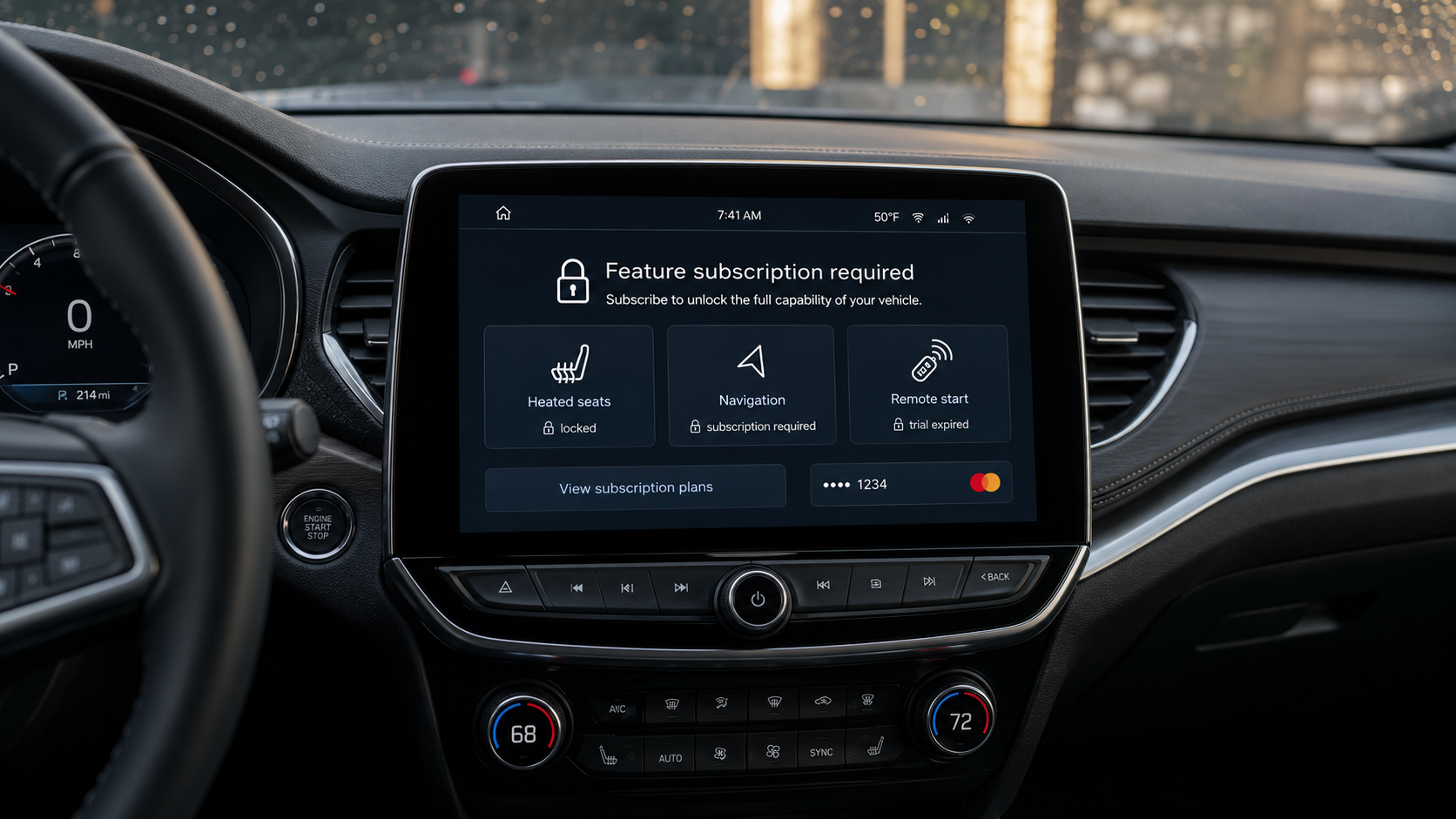
I don’t hate modern cars.
I hate several of the things modern cars do, which is different.
Ventilated seats are glorious. Backup cameras are useful. Apple CarPlay is excellent because it lets my phone replace whatever half-assed infotainment system the manufacturer thought I should be grateful for. A warning that something has stopped unexpectedly in front of me is also appreciated. I enjoy not crashing.
Adaptive cruise control can fuck off.
Lane-keep assist can stop tugging at the steering wheel because I moved six inches within my own lane to avoid a pothole. And the starter does not need to shut the engine off at every red light like we’re desperately trying to preserve one final teaspoon of gasoline for future generations.
I can accept that modern cars are complicated. What I cannot accept is paying a substantial amount of money for one and then discovering that some of the features are only visiting for the complimentary trial period.
Apparently, the new automotive ownership model goes something like this:
You buy the car. You finance the car. You insure the car. You pay interest on the car. You pay the dealer’s collection of mysterious fees.
Then, just when you think the transaction is over, the manufacturer reaches back into your pocket and asks for another monthly payment so the car will continue doing some of the shit it did when you drove it off the lot.
No.
Absolutely not.
BMW tried renting people their own heated seats
BMW became the poster child for this nonsense when it offered subscriptions in some countries to activate heated seats that were already physically installed in the vehicle.
The widely reported price was roughly $18 a month, with longer-term and permanent-purchase options available. The heating elements, wiring and electronics were already sitting inside the car. The subscription simply granted the owner permission to use them. Customers reacted about as warmly as you would expect, and BMW dropped the heated-seat subscription model in 2023.
Let’s walk through that slowly.
I bought the seat.
I bought the heating element inside the seat.
I bought the wiring running from the seat.
I bought the module controlling the seat.
I bought the entire goddamn car wrapped around the seat.
But I’m renting permission to make my ass warm?
That isn’t a connected service. It’s a hostage situation with leather upholstery.
BMW argued that installing hardware broadly and allowing customers to activate features later offered flexibility. There is at least some logic there. Standardizing production can simplify manufacturing, and a second owner might decide they want an option the original buyer skipped.
Fine.
Sell them the option once.
What people hated was not the ability to add a feature later. It was the idea that a physical component already sitting inside a vehicle could become another recurring bill.
BMW abandoned that particular fight, but it did not abandon digital add-ons and connected products altogether. Its ConnectedDrive ecosystem still offers digital services and features tied to the vehicle.
So the heated-seat disaster was not the end of the idea.
It was the industry learning which part of the idea made customers reach for torches and pitchforks.
Some subscriptions are actual services
There is an important distinction here.
Not every automotive subscription is automatically bullshit.
Satellite radio costs money to operate. Cellular connectivity costs money. Live traffic data, emergency response centres, cloud storage and regularly updated mapping all require infrastructure after the vehicle leaves the factory.
I may not choose to pay for those things, but I understand why the bill exists. Someone is still providing something.
A heated seat does not require a communications network.
There is no employee at BMW headquarters personally warming my backside.
The seat is not downloading weather data to determine the appropriate temperature for my arse.
It is a wire that gets hot.
The problem is that once manufacturers established the screen, the cellular connection and the phone app, they also created a convenient little tollbooth between drivers and their own vehicles.
And just about everyone appears interested in collecting.
Your free trial has ended
Toyota Canada offers Remote Connect features through the Toyota app on compatible vehicles. Those features can include starting and stopping the engine, locking and unlocking the doors, checking vehicle status and locating the vehicle. Toyota provides complimentary trials on eligible vehicles, but says continued use after the trial requires a paid monthly subscription.
So the vehicle may have remote start.
Your phone may have the app.
The cellular hardware may be built into the car.
But at some point, your ability to use the whole arrangement can expire like a streaming-service promotion.
Now, to be fair, phone-based remote access uses a cellular network and back-end systems. That has an operating cost. This is not exactly the same as BMW switching off a seat heater.
But from an owner’s perspective, it still feels strange to buy a modern vehicle full of connectivity, use those features for several years, and then have the car politely explain that your relationship has moved to the payment stage.
Toyota is far from alone.
Ford Canada charges $120 per year for Connected Navigation after the included or trial period on equipped vehicles. Ford’s BlueCruise hands-free highway system is offered at $64.99 a month, $650 a year or, on eligible vehicles, a one-time purchase priced at $3,295.
I personally wouldn’t pay sixty-five bucks a month for my truck to drive while I remain legally and morally responsible for everything it does.
I already dislike adaptive cruise control when it changes speed because a car two postal codes ahead touched its brakes. Paying monthly for an even more involved driver-assistance system is not high on my list.
But at least Ford offers a permanent-purchase option.
That feels more like buying a feature and less like leasing another tiny piece of your own dashboard forever.
Mercedes-Benz has also embraced what it calls Digital Extras. Its Canadian app promotes downloadable features and connected services, including an Acceleration Increase for certain electric models. Mercedes announced that the upgrade could add up to 80 horsepower and improve the zero-to-100-km/h time by as much as one second on eligible EQE and EQS vehicles. Its current Canadian terms describe some upgrades as permanent enhancements purchased with a one-time payment.
Think about that for a second.
The motors are already in the car.
The battery is already in the car.
The car is physically capable of producing the extra power.
You are paying to have the software stop holding it back.
That is not quite the same as renting heated seats every month. A permanent software upgrade is closer to buying a factory tune after purchase.
But it still shows where this is all heading.
Manufacturers are no longer limited to selling you whatever configuration rolled off the assembly line. They can keep a catalogue of dormant capabilities inside the vehicle and offer to wake them up later—for a fee.
From a business perspective, it is brilliant.
From a customer perspective, it feels like finding out your refrigerator has a second shelf that requires a licence key.
The phone app is becoming the new dealership finance office
The old model was straightforward.
You selected the trim and options you wanted. You paid for them. The car came with those features, and they worked until something broke or the vehicle returned to the earth.
Now the vehicle can arrive with a collection of software-controlled functions, trial periods and connected packages that vary by model, trim and year.
Some features are included for one year.
Some for three years.
Some for longer.
Some depend on which package was bundled into the original purchase.
Eventually, you may have to visit an app, check which subscriptions are active and decide which parts of the ownership experience you would like to continue receiving.
I can already picture the future Marketplace ad:
Fully loaded. Leather. Panoramic roof. All subscriptions expired. Bring a credit card.
The phone app is convenient. I get it.
Being able to locate your vehicle, check whether the doors are locked or start it from far away can be genuinely useful. I’m not arguing that the technology should not exist.
I’m arguing that car buyers need to pay attention to which advertised features belong to the car and which ones are merely included for the first few years.
Because “equipped with remote start” and “includes temporary access to remote start through an app” are not the same sentence.
One describes a feature.
The other describes a free sample.
Cars already cost enough
This entire trend would be irritating on a cheap appliance.
It is infuriating on a vehicle that costs $50,000, $70,000 or considerably more.
New vehicles have become expensive enough that six-, seven- and eight-year financing terms are now treated as normal ways to make the monthly number look less terrifying.
You can spend most of a decade paying for the vehicle itself, then stack connected services, navigation, driver assistance, entertainment and feature upgrades on top.
The car payment comes out.
The insurance comes out.
The app subscription comes out.
The navigation subscription comes out.
The hands-free-driving subscription comes out.
At some point the vehicle stops being transportation and becomes a collection of recurring billing opportunities with cupholders.
Automakers love recurring revenue for the same reason every other business loves it.
Selling you something once is good.
Charging you for it repeatedly is better.
That may be excellent news for shareholders.
I do not own enough shares to give a shit.
What happens when these cars get old?
This is the part that concerns me most.
What happens when today’s connected vehicle is fifteen or twenty years old?
Will the app still support it?
Will the cellular hardware still work on whatever networks exist then?
Will the digital store remain open?
Will a second or third owner be able to activate the same features?
Will the manufacturer still care enough to maintain the servers?
Mercedes-Benz’s own Canadian terms say fee-based services may depend on availability, technical compatibility and continued offering for the vehicle. New Mercedes material also notes that limited-term Digital Extras may be extended for a fee provided they are still offered for that vehicle.
That last part matters.
Provided they are still offered.
My 2003 Yukon’s heated seats do not need GM to remember my truck exists.
The switches may fail. The elements may burn out. The wiring may need repair. But the system is physically mine, and a competent shop can diagnose it without asking a remote server whether I still deserve warmth.
That is ownership.
A modern connected feature can be mechanically perfect and still disappear because the supporting service, software or corporate interest went away.
We are building vehicles whose long-term usefulness may depend not only on parts availability, but on whether somebody keeps the digital lights on.
That is a hell of a thing to discover after the warranty is gone.
I don’t need my car to become Netflix
We have already accepted subscriptions for television, music, software, cloud storage, food delivery and apparently the privilege of receiving printer ink before the printer decides I am unworthy.
I do not need my vehicle joining the pile.
Sell me the car.
Sell me the optional equipment.
Charge me for genuine ongoing services when there is a real continuing cost.
But do not install functioning hardware in my vehicle and then ask me to rent access to it.
Do not advertise app-based features without making it painfully clear that they may expire.
And do not tell me this is somehow more convenient because I can activate features whenever I want.
I could also activate them by purchasing them once and then owning them.
We had already invented that system.
It was called buying shit.
I know this probably makes me sound like the grumpy old bastard I am rapidly becoming.
That’s fine.
I have spent roughly twenty years around dealerships, service departments, repair shops and automotive parts. I have watched vehicles become safer, faster, cleaner, more comfortable and more capable.
I have also watched them become more complicated, more expensive and increasingly dependent on software ecosystems that owners do not control.
There are plenty of modern features I enjoy.
Give me the ventilated seats.
Give me the backup camera.
Give me Apple CarPlay and a forward-collision warning.
Lane-keep assist can release the steering wheel. Adaptive cruise can mind its own business. Automatic stop-start can quit shutting off the engine every time I pause long enough to consider my life choices.
And the subscriptions can eat a bag of dicks.
Because when I buy the car, I would like to buy the whole fucking car.
