
2014–2018 GMC Sierras Are Getting Cheap. Are They the Next Great Old GM Truck—or Just More Trouble?
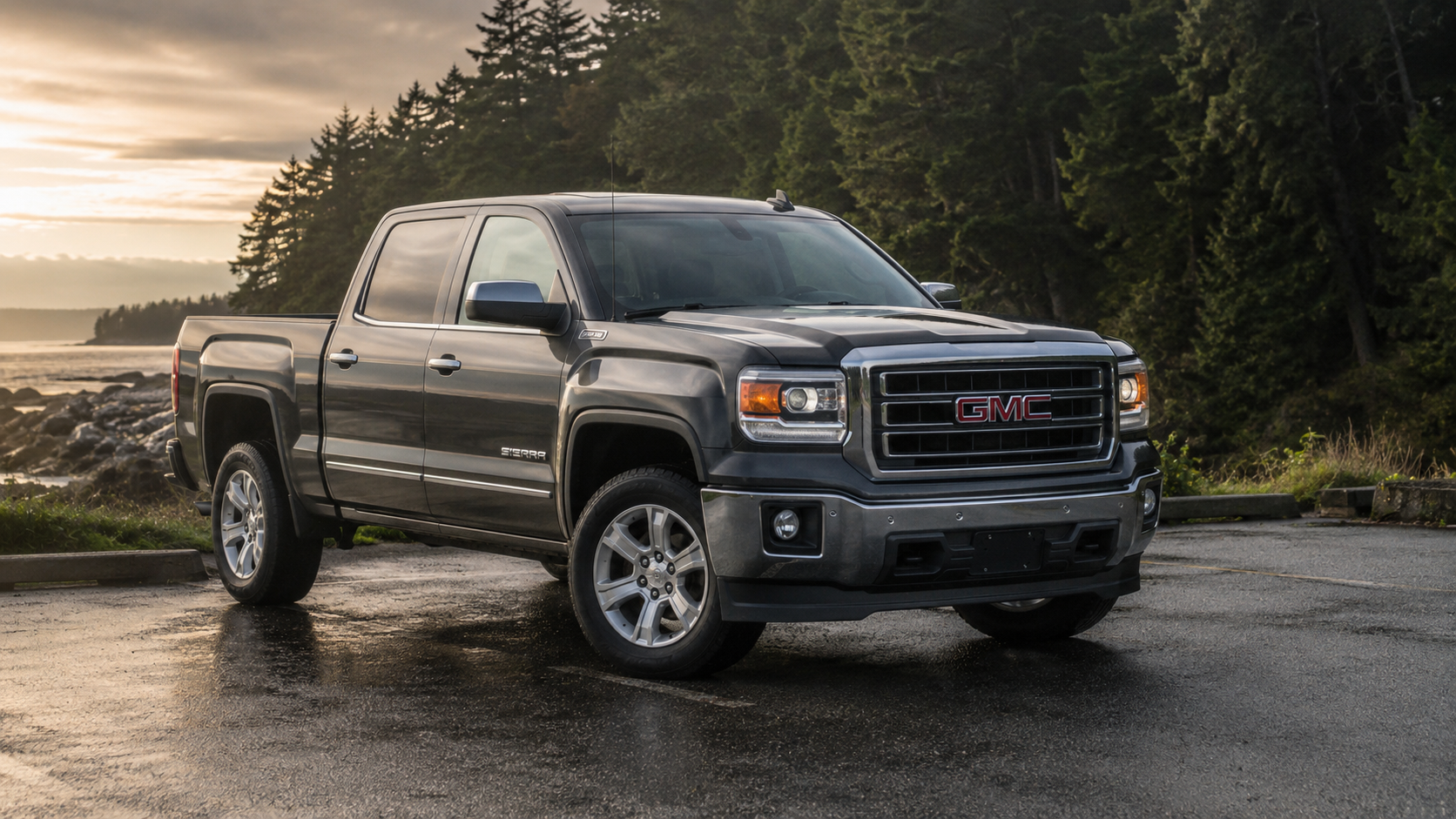
There is a dangerous moment in every truck’s life.
It happens after the first owner has absorbed the catastrophic depreciation, the second owner has finished pretending the payment was reasonable, and the truck finally appears on Marketplace at a price low enough for people like me to start making excuses.
The 2014–2018 GMC Sierra has reached that moment.
These trucks are suddenly old enough to be affordable, new enough to feel modern and still good-looking enough to make me forget everything I’ve ever said about keeping vehicles simple.
That is a dangerous combination.
I love our 2003 Yukon Denali. I’ve spent plenty of time explaining why the GMT800 might be the best truck platform GM ever built. It’s comfortable, useful, relatively simple and powered by a 6.0-litre V8 that has never once decided it would rather become a four-cylinder to save three tablespoons of fuel.
But I keep looking at newer GMC Sierras.
Not because I need one. Need left this conversation a long time ago.
I want a bed for bikes, paddleboards, kayaks and all the other crap that currently gets stuffed inside the Yukon. I want a proper crew cab, a nice interior and something that still feels like a truck rather than a rolling software agreement.
And, most importantly, I think the 2014–2018 GMC Sierra is a genuinely good-looking bastard.
Unfortunately, being attracted to a vehicle and trusting it are two very different things.
What the Hell Is a K2XX?
GM’s internal platform name for this generation is K2XX.
That includes the 2014–2018 Chevrolet Silverado and GMC Sierra 1500, along with the related 2015–2020 full-size SUVs and several HD applications. There were also 2019 Silverado LD and Sierra Limited holdovers after the newer generation arrived.
That information is useful if you’re searching forums, parts catalogues or technical bulletins.
Normal people just call them 2014–2018 Sierras and Silverados.
I’m already deep enough into GM nonsense that “GMT800” sounds completely normal to me, but even I didn’t immediately identify these trucks as K2XX. I just knew them as the newer GMCs I’ve always liked.
So we’ll use the platform name where it helps. We’re not going to make anybody pass a GM internal-code examination before they can read about a used truck.
This Might Be the Best-Looking Modern Sierra
The styling is the main reason I keep coming back to them.
The K2XX Sierra still looks like a proper GMC. It has a square front end, strong body lines and enough chrome to remind you that GM was involved without looking like the truck drove through an entire aisle at Princess Auto.
Even the lower trims look decent. Move into an SLT or Denali and they still feel expensive inside, despite now being old enough to appear beside seventeen broken lawnmowers on Facebook Marketplace.
They also landed in a sweet spot before every dashboard became an enormous tablet mounted above a row of touch-sensitive bullshit.
You get a backup camera, heated seats, Bluetooth, a more modern interior and significantly more power than an old GMT800—but it still has physical controls and generally feels like a truck.
Visually, I think they have aged extremely well.
Mechanically, I have questions.
They’re Becoming Cheap Enough to Be Tempting
At the time of writing, British Columbia listings include K2XX Sierras in the teens and low twenties, depending on trim, mileage and condition. A higher-mileage 2015 SLE Crew Cab 4x4 has recently been advertised below $15,000, while cleaner or better-equipped examples still sit considerably higher.
That is nowhere near GMT800 money, but it is no longer new-truck money either.
A truck that once represented a large monthly payment is becoming something a person might buy outright—or at least finance without agreeing to remain employed until death.
That changes the conversation.
At $40,000, I’m not especially interested in gambling on a ten-year-old GM truck.
At $15,000 to $20,000, I start zooming in on the photos.
At $12,000, I’m checking whether the seller lives close enough that I could “just go look at it.”
Nothing financially responsible has ever followed that sentence.
The problem is that depreciation only reduces the purchase price. It doesn’t reduce the cost of the parts buried inside it.
A $15,000 Sierra can still generate repair bills from a truck that once cost several times that amount.
The 5.3 Is the One I’d Consider
The realistic engine for me would be the 5.3-litre L83 V8.
It makes considerably more power than the older 5.3s, offers decent fuel economy for a full-size truck and is far more common than the 6.2. Finding parts, service information and complete used trucks isn’t going to be difficult.
I would specifically be interested in a 5.3 paired with the six-speed automatic.
That doesn’t mean the 6L80 is immortal. No automatic transmission dragging around a full-size pickup for a decade should be approached with blind faith. But if I’m shopping this generation, that is the powertrain combination I’d be most comfortable investigating.
The 4.3-litre V6 exists too. I’m sure it adequately moves the truck.
I also know myself well enough to understand that buying the engine I didn’t want would result in me shopping for another truck six months later.
So, 5.3 it is.
I Would Stay the Fuck Away From the 6.2
On paper, the 6.2-litre L86 sounds like the obvious enthusiast choice.
It makes 420 horsepower. It has piles of torque. It sounds excellent. It turns a full-size truck into something unnecessarily quick, which is generally a quality I appreciate.
I still wouldn’t buy one.
In the automotive circles I travel in, the 6.2 has earned a reputation as a notorious piece of shit. That may upset owners who have driven theirs for 300,000 kilometres without a problem, but I’m not spending my money based on the happiest exception in a Facebook group.
The 6.2 combines Active Fuel Management, direct injection and—in many configurations—the eight-speed automatic. That is an impressive collection of things I don’t particularly want packaged around an engine with more performance than I actually need.
I’m not saying every 6.2 explodes.
I’m saying I know enough people in and around automotive repair that I would not personally gamble on one. More horsepower does not make a repair estimate more enjoyable.
The 5.3 isn’t free from the same general concerns, but it’s the version I would be prepared to consider at the right price.
The 6.2 can be somebody else’s adventure.
Active Fuel Management Would Be Gone Immediately
The 5.3-litre L83 uses Active Fuel Management, which shuts down four cylinders under lighter loads.
The idea is simple: when full V8 power isn’t required, the engine runs in four-cylinder mode to reduce fuel consumption.
I hate it.
I don’t want a V8 spending half its time trying to convince me it’s an economy car. I especially don’t want the added lifters, oil-control system and failure points required to make that happen.
GM’s own technical information describes AFM lifters becoming mechanically collapsed or stuck, sometimes accompanied by misfires, ticking, bent pushrods and camshaft damage. That doesn’t mean every AFM engine is doomed, but it confirms the problem isn’t something invented by angry people in comment sections.
If I bought one of these trucks, AFM wouldn’t survive the first weekend.
Before tint, wheels, lighting or any other unnecessary nonsense, I would have it electronically disabled with a proper tuner and keep the engine operating as a V8.
Would that remove the AFM hardware?
No.
The special lifters and related components would still physically exist inside the engine. Electronic deactivation prevents the system from routinely entering four-cylinder mode; it does not perform a magical mechanical AFM delete through the diagnostic port.
A complete delete means opening the engine and replacing the relevant camshaft, lifters and supporting components. That is a very different level of commitment.
Disabling AFM doesn’t remove the grenade. It just asks everyone to stop pulling the pin.
Still, I’d do it immediately.
Direct Injection Is Another Thing I Never Asked For
The K2XX introduced GM’s EcoTec3 engines with direct injection, variable valve timing and cylinder deactivation.
That helped produce more power and better fuel economy. It also added a high-pressure fuel system and moved the injectors directly into the combustion chamber.
Technically, it is better.
Emotionally, I remain unconvinced.
Port injection has been quietly and reliably putting fuel into GM V8s for decades. It isn’t glamorous, but it works, parts are relatively inexpensive and just about every competent shop knows how to deal with it.
Direct injection adds performance and efficiency, but it also adds complexity to a truck I would be buying specifically because it has become affordable.
That’s the entire K2XX argument in miniature: it gives you more of everything, including more things that can eventually send you a bill.
Then There’s the Transmission Question
Depending on the year and configuration, K2XX trucks came with six- or eight-speed automatic transmissions.
The six-speed is the one I would target.
The eight-speed 8L90 has a documented history of shudder complaints. GM issued technical bulletins describing a shake or shudder under light throttle that owners often compared with driving over rumble strips. Diagnostic and repair procedures included fluid changes, further testing and, in some cases, torque-converter replacement.
That is not the sort of rumble-strip simulation I’m looking for in a used truck.
A transmission bulletin does not mean every eight-speed is bad. It does mean I would pay very close attention during a road test, particularly after the truck reaches operating temperature.
No ten-minute loop around the block. No radio turned up. No seller explaining that “they all do that.”
If a truck shudders, flares, bangs into gear or behaves strangely, I don’t care how good it looks in the photos. It can continue its journey with somebody else.
It Even Had a Brake-Assist Recall
Certain 2014–2018 K2XX trucks and SUVs were also recalled because the engine-driven vacuum pump could lose output over time, reducing power-brake assist and increasing pedal effort.
GM’s repair involved updated electronic brake-control programming to improve the secondary hydraulic brake assist when vacuum dropped.
That doesn’t automatically make these trucks unsafe today. It means I would check the VIN and verify that all applicable recalls were completed.
This is the difference between buying a GMT800 and buying something a decade newer.
The GMT800 tries to kill you with rusted brake lines.
The K2XX has a software update to help compensate for a vacuum pump.
Progress.
Is It Actually the Next GMT800?
This is where I struggle.
The K2XX has several ingredients that could eventually make it the next great affordable GM truck platform:
There are millions of them.
Parts and technical knowledge are widely available.
They still look good.
The interiors are modern enough for everyday use.
The 5.3 has plenty of power.
They can tow, haul and function as real trucks.
Depreciation is finally dragging them into interesting territory.
But the GMT800 became legendary partly because of what it doesn’t have.
It doesn’t have direct injection. It doesn’t need to deactivate half its cylinders. It doesn’t have an eight-speed transmission trying to recreate a road-surface feature. Its electronics are crude enough that many problems can still be diagnosed without consulting a software engineer.
The K2XX is a better truck when everything works.
The GMT800 may be a better old truck when things stop working.
That is an important distinction.
Would I Actually Buy One?
Yes—but not just any one.
I would look for a clean 2014–2018 GMC Sierra Crew Cab with the 5.3, six-speed automatic, four-wheel drive and a decent trim level. Ideally an SLT, because if I’m spending money on a truck I don’t technically need, I at least want the version I actually like.
I’d want service records.
I’d listen carefully for valvetrain noise. I’d scan it for current, pending and history codes. I’d drive it long enough to properly evaluate the transmission. I’d check the recall history, inspect the frame and look closely for evidence that the truck had spent its life being abused, neglected or modified by someone whose primary tool was an impact gun.
Then I’d disable AFM immediately and continue worrying about it anyway.
That last part is important.
A tuner, maintenance history and careful inspection can reduce risk. They cannot turn a complicated ten-year-old truck into a 2003 Yukon with fewer kilometres.
Cheap Enough to Tempt Me—Not Cheap Enough to Trust Blindly
The 2014–2018 GMC Sierra is entering the most interesting stage of its life.
It is no longer new enough to be financially terrifying, but it isn’t yet old enough for the market to have decided which examples deserve to survive.
Some will become excellent used trucks.
Some are already one warning light away from becoming somebody else’s Marketplace problem.
I’m drawn to them because they look fantastic, have useful crew cabs and beds, and provide enough modern comfort without feeling like current trucks overloaded with enormous screens and unnecessary technology.
I’m wary of them because the 5.3 still has AFM and direct injection, the eight-speed has baggage, and the 6.2 is not coming anywhere near my driveway.
Are they the next GMT800?
Probably not in the same simple, nearly indestructible sense.
But they may be the next generation of GM trucks to become cheap enough, common enough and good-looking enough that idiots like me start trying to save them.
And if the right 5.3-litre SLT shows up at the right price, I may eventually become one of those idiots.
Related Reads
The Best GMT800 Upgrades: What’s Worth Doing—and What I’d Skip
From suspension and brakes to cooling, tuning, CarPlay and the popular modifications I’d probably leave on the internet.
Is the GMT800 Still the Smartest Vehicle to Own in 2026?
Why a paid-for old GM truck or SUV can still make more sense than replacing it—fuel bill, repair list and all.
The GMT800 Duramax: Why These Old Diesel Trucks Became Legends
LB7, LLY and LBZ engines, Allison transmissions, rust, Canadian scarcity and why these old diesel trucks earned their reputation.
