
I Like Every Toyota 4Runner. The Fifth Generation Is the One I’d Buy
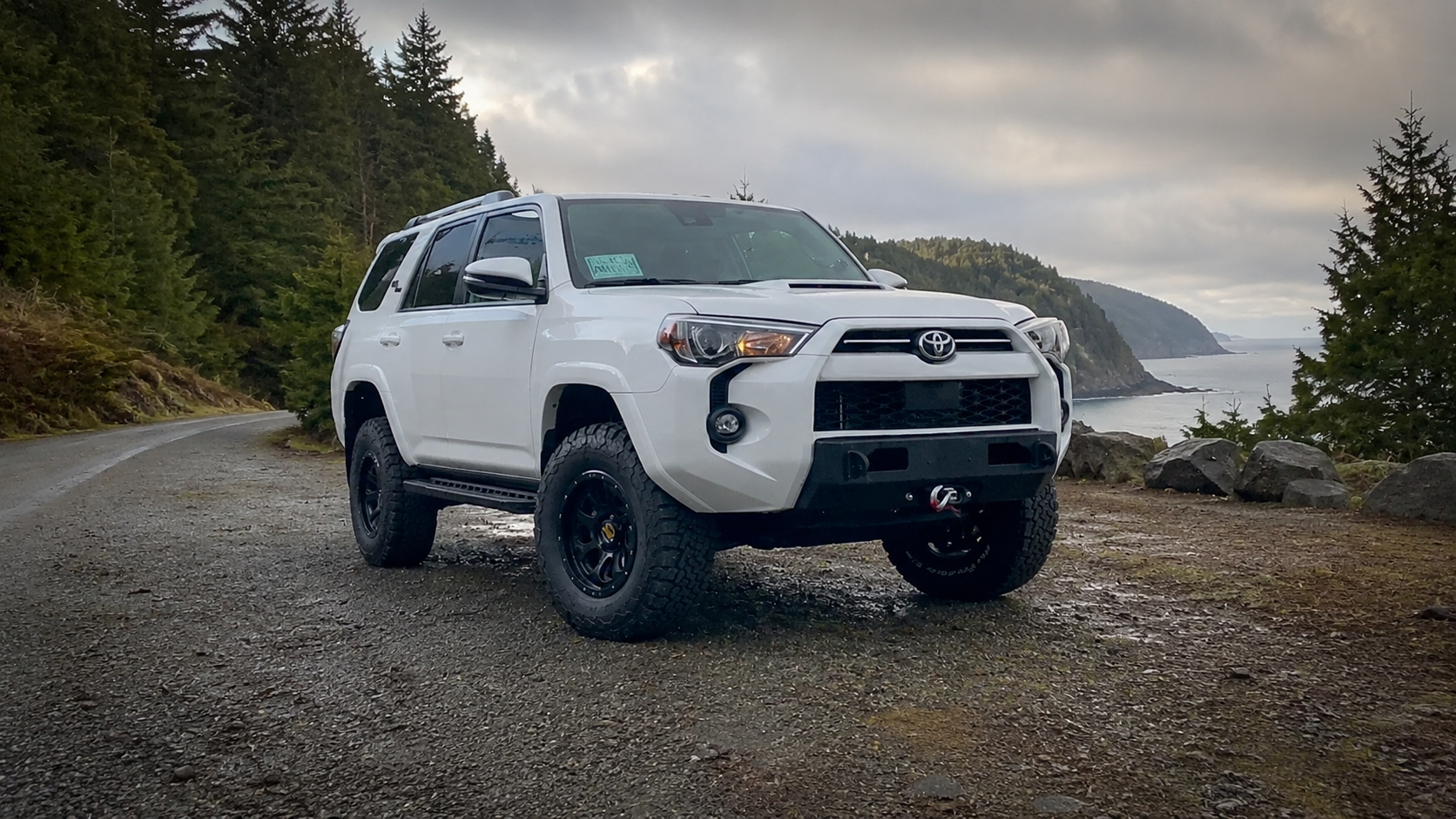
My dad drives a Toyota 4Runner TRD Off-Road.
He’s 75 now, and I’m reasonably confident he has absolutely no idea what he owns.
He knows it’s a Toyota. He knows it’s a 4Runner. He presumably knows how to turn the radio on.
Beyond that, I’m not sure.
His 4Runner has an electronic locking rear differential, Crawl Control, Multi-Terrain Select and enough off-road equipment to negotiate terrain normally associated with documentary film crews.
I don’t think he has ever put it into four-wheel drive.
He may not know how.
Again, the man is 75, still driving and perfectly happy with his truck. He doesn’t need to understand how Crawl Control works. The most hostile terrain his TRD Off-Road regularly encounters is probably a crowded Costco parking lot.
But if a boulder field ever appears between his house and the pharmacy, my father is spectacularly prepared.
And I’m jealous.
Because I like 4Runners.
Pretty much all of them.
Every 4Runner Generation Has Something Going for It
The first-generation 4Runner was essentially a Toyota pickup with rear seats and a removable fibreglass roof.
It was simple, useful and extremely cool. Naturally, clean ones are now priced like small vacation properties.
The second generation became more practical and more SUV-like.
The third generation is probably the classic older 4Runner sweet spot for a lot of people. It’s usefully sized, has the excellent 3.4-litre V6 and still looks right. Unfortunately, finding a clean one now means sorting through rust, enormous mileage and vehicles carrying enough off-road accessories to qualify as commercial equipment.
Then came the fourth generation.
The fourth-gen V8 4Runner is especially desirable because Toyota put the 4.7-litre 2UZ-FE in it. That’s the same basic engine family that helped build the reputation of the first-generation Tundra, Sequoia, Lexus GX and Land Cruiser.
A V8 4Runner is unquestionably cool.
It’s also old enough now that frame condition and maintenance history matter considerably more than the seller telling you Toyota engines last forever.
I like all those generations.
But the fifth generation is the one that really gets me.
Toyota Built the Fifth Generation for Fifteen Years
The fifth-generation 4Runner arrived for 2010 and stayed until 2024.
Fifteen model years.
Most manufacturers would have redesigned an SUV twice during that period, added three turbochargers, removed four physical buttons and installed a touchscreen visible from space.
Toyota just kept building the 4Runner.
It used the same naturally aspirated 4.0-litre V6, producing 270 horsepower and 278 lb-ft of torque, connected to the same five-speed automatic transmission.
It remained body-on-frame.
It kept a proper transfer case.
It could still tow 5,000 pounds.
It was thirsty, heavy and increasingly ancient.
Excellent.
That drivetrain wasn’t exciting in 2010, and it certainly wasn’t exciting in 2024. The five-speed automatic occasionally feels like it’s waiting for written permission before changing gears. Fuel economy is exactly what you’d expect from a brick powered by a large V6.
But it’s proven.
No turbocharger.
No hybrid system.
No CVT.
No ten-speed transmission having an internal debate every time you touch the throttle.
Just an engine and transmission combination Toyota built for approximately six geological eras.
I appreciate that.
The TRD Off-Road Is Hilariously Overqualified
When the fifth generation arrived, its off-road-focused model was called the Trail.
For 2017, Toyota renamed the Trail and Trail Premium as the TRD Off-Road and TRD Off-Road Premium.
That brought the badge my father sees every day without the slightest curiosity about what it means.
The TRD Off-Road includes Multi-Terrain Select, Crawl Control and an electronic locking rear differential. KDSS was also available, allowing the suspension to provide more articulation off-road while controlling body roll on pavement.
My dad likely hasn’t used any of it.
I would enjoy making fun of him for that, but most people don’t use everything their vehicle can do.
Pickup beds carry groceries. Sports cars sit in traffic. Jeeps with 35-inch tires line up at Starbucks. Most Land Rovers encounter more difficulty connecting to Bluetooth than crossing rivers.
You don’t need to drive the Rubicon Trail every weekend to appreciate owning something capable.
And if my dad ever accidentally activates Crawl Control while backing out of his driveway, I look forward to receiving that phone call.
The Fifth-Generation Technology Cutoff Matters
Toyota gave the 4Runner a substantial styling update for the 2014 model year, creating the more aggressive front end that somehow stayed current-looking for another decade.
I like that version.
More specifically, I think the 2017–2019 TRD Off-Road may be the sweet spot.
You get the later appearance, the TRD Off-Road name and all the desirable mechanical equipment without the larger wave of driver-assistance technology that arrived for 2020.
For 2020, Toyota made Safety Sense P standard on every Canadian 4Runner. That included pre-collision braking with pedestrian detection, lane-departure assistance, automatic high beams and dynamic radar cruise control. It also added CarPlay, Android Auto, push-button start and connected services. Toyota Canada’s 2020 announcement confirms the complete changeover.
I like CarPlay.
Collision avoidance may save you from an accident. Radar cruise can make highway trips easier. I understand why people want these things.
I just don’t particularly want them in the 4Runner I’d buy.
If I’m shopping for an old-school Toyota SUV, I don’t need it tugging at the steering wheel, watching lane markings or deciding whether I’m approaching another vehicle too enthusiastically.
I’ve made it this far without the truck supervising me.
Blind-spot monitoring and rear cross-traffic alert arrived on Canadian models for 2022 and became standard across the lineup by 2023.
Again, none of that ruins the 4Runner.
It just makes a 2017–2019 model more appealing to me.
Unfortunately, everyone else apparently reached the same conclusion.
Then You See What They Cost
This is where the fifth-generation 4Runner argument drives directly into a wall.
The Toyota tax is absolutely insane.
Not slightly high.
Not “they hold their value pretty well.”
Insane.
As I’m writing this, there’s a 2018 TRD Off-Road in British Columbia with approximately 124,000 kilometres listed for nearly $43,000.
Another 2018 TRD Off-Road Premium with roughly 98,000 kilometres is asking almost $48,000.
Forty-eight thousand dollars.
For a nine-year-old SUV.
I know it’s a Toyota. I know the 4.0-litre V6 is proven. I know people drive these things for hundreds of thousands of kilometres.
It’s still nine years old.
Rubber ages. Seals age. Suspension wears. Frames rust. Previous owners do stupid things. Toyota did not develop a method of exempting the 4Runner from time.
At nearly $50,000, I don’t want to hear that it has lots of life left.
It should come with a second 4Runner.
And the truly irritating part is that the ridiculous prices aren’t imaginary. People pay them. The 4Runner earned its reputation, supply remained tight, and enough buyers want the same simple drivetrain that depreciation appears to have become optional.
The Toyota tax used to mean paying a little extra for a vehicle likely to hold its value.
Now it sometimes means paying nearly the original price for a vehicle that has already used up a decade of its life.
Reliability Does Not Make Condition Irrelevant
Toyota people occasionally speak as though reliability removes the need to inspect the vehicle.
It does not.
A 4Runner can still rust.
It can still be neglected.
It can still need brakes, suspension work, bearings, cooling-system parts and every other component attached to its famously reliable engine.
The mechanical things don’t scare me much. I work for a parts company. Parts can be sourced, failed components can be diagnosed and worn pieces can be replaced.
Rust is what bothers me.
Mechanical work has a finish line. Rust hangs around and nags at you every time you crawl underneath. It makes every future repair worse and quietly turns an otherwise good vehicle into a long-term structural concern.
I’d rather buy a clean SR5 than a rusty TRD Off-Road with every desirable button.
The badge won’t hold the frame together.
Neither will a snorkel.
The New 4Runner Isn’t the Answer Either
Toyota finally replaced the fifth generation with the all-new 2025 4Runner.
It now uses Toyota’s newer truck platform, a turbocharged 2.4-litre four-cylinder, an eight-speed automatic and, in upper trims, an available hybrid system. It makes more torque, tows more and carries Toyota Safety Sense 3.0.
It is almost certainly better at most measurable things.
The Canadian price starts above $54,000 before fees, with higher trims sailing past $80,000. Toyota Canada’s current pricing stretches from $54,200 to more than $84,000 before additional charges.
So my options are apparently:
Spend new-vehicle money on an old fifth generation.
Or spend luxury-vehicle money on a new turbocharged one.
Excellent.
So Would I Actually Buy One?
Yes.
But the price would have to make some kind of sense.
My ideal version is probably a clean 2017–2019 TRD Off-Road. It has the styling I like, the drivetrain I trust, the equipment I’d enjoy and less of the electronic supervision I don’t need.
Would I use Crawl Control?
Eventually.
Would I lock the rear differential?
Absolutely, even if I had to deliberately find somewhere to justify it.
Would I spend most of my time carrying a five-year-old, bikes, beach gear, camping equipment and groceries?
Of course.
That’s what makes the 4Runner so appealing. It can be a serious off-road vehicle, family SUV, adventure machine or hilariously overqualified retirement vehicle.
My dad doesn’t know everything his can do.
He may never use four-wheel drive.
He still owns one of the best versions of one of the best Toyota SUVs ever made.
I just wish buying my own didn’t require negotiating with someone who believes his nine-year-old 4Runner is a blue-chip investment.
Related Reads
Why Does Everyone Have a Tent on Their Roof?
Rooftop tents, unused recovery boards, airport-grade lighting and the strange urge to outfit every 4Runner for an expedition to Costco.
I Love My GMT800. So Why Do I Keep Looking at Tundras?
The Yukon is comfortable, capable and already paid for. Naturally, that hasn’t stopped me from shopping for an old Toyota pickup.
Is the GMT800 Still the Smartest Vehicle to Own in 2026?
A paid-for old GM SUV against the temptation of something newer, more efficient and considerably more expensive.
