
A Love Letter to Our 23-Year-Old GMT800 — With a Few Repairs Pending
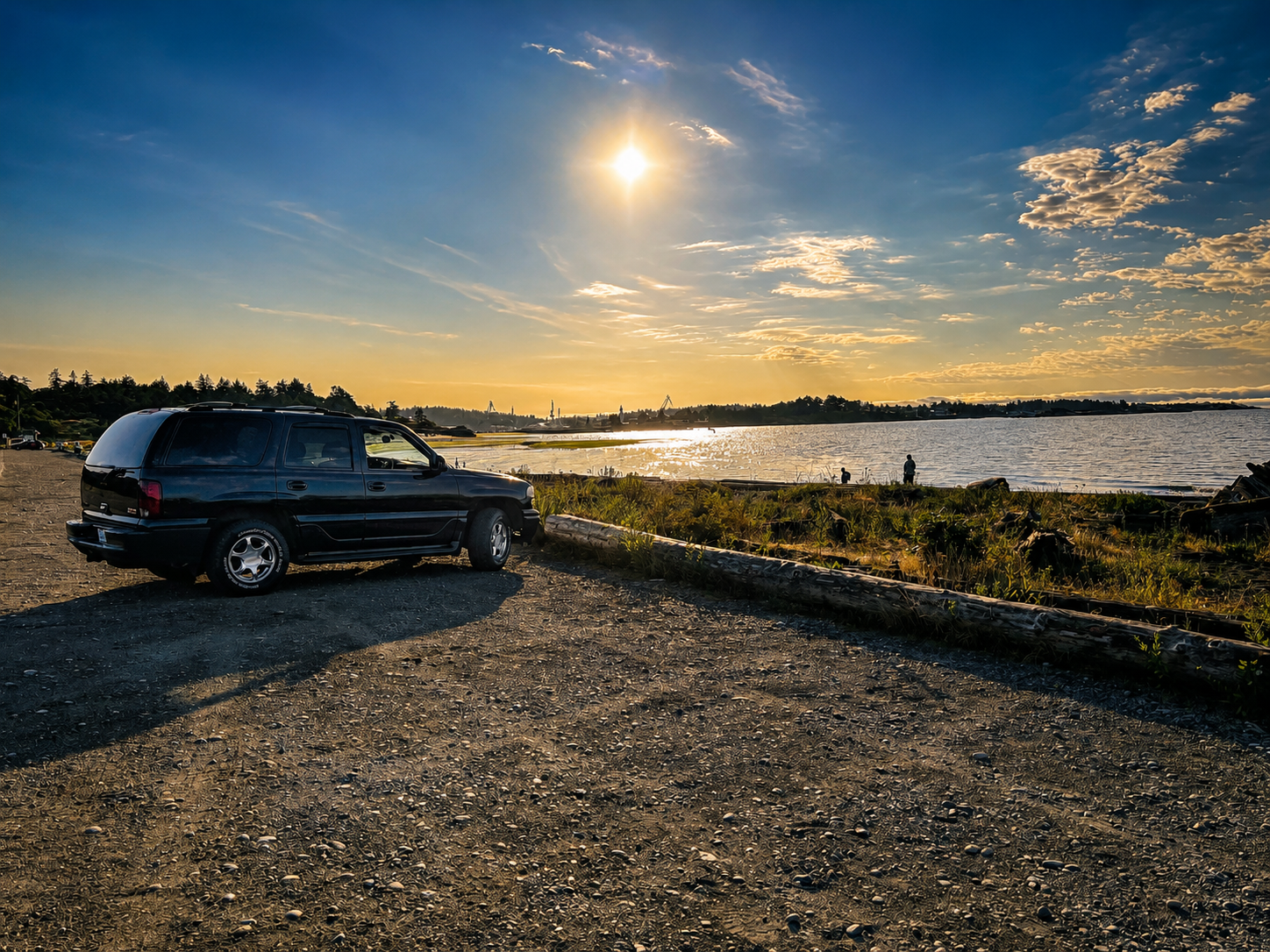
I accidentally made a commercial for my 2003 GMC Yukon Denali.
GM didn’t pay me. Nobody sent me a press vehicle. There was no closed road, camera crew, helicopter or suspiciously attractive family loading designer camping gear into the back.
It was just me, our old Yukon, a DJI Air 3S and a ridiculously nice morning on Vancouver Island.
I sent the drone up over Ocean Boulevard at Esquimalt Lagoon, told it to follow the truck and started driving.
And holy shit.
The old girl looked good.
Water on both sides. Sunrise coming across the lagoon. Olympic Mountains in the distance. The truck rolling along while the drone smoothly moved from behind it to beside it like somebody had actually budgeted money for this production.
For about 57 seconds, our 23-year-old, 276,000-kilometre Yukon looked like the star of a GMC commercial.
Which got me thinking.
Maybe it deserves one.
This Is Not a Restoration
I should probably establish that before somebody sees the pretty drone footage and assumes we’re six months away from a frame-off restoration and a $40,000 build.
Absolutely not.
This is our family truck.
It goes to Costco.
It carries tools.
It hauls paddleboards, kayaks, life jackets, beach chairs and whatever other shit has accumulated in the back because apparently unloading a vehicle after an adventure is optional.
It gets driven.
It gets dirty.
It gets fixed when things wear out.
And occasionally I stand beside it staring thoughtfully at something completely functional while wondering how much better it would look if I removed it.
That’s basically the Driftwood Motoring modification process.
This Yukon isn’t being built to win trophies.
I just want to make an already good old truck a little bit better.
And probably a little louder.
Definitely a little louder.
The GMT800 Just Got a Lot Right
There’s a reason people still love these things.
Our Denali has the 6.0-litre Vortec V8, AWD, comfortable leather seats, three rows, a ridiculous amount of usable space and absolutely no illusion that it’s trying to be something other than a big American SUV.
There’s no turbocharger hiding behind the engine waiting to ruin my afternoon.
There’s no twelve-inch tablet controlling the heater.
It doesn’t pull the steering wheel because I dared move slightly within my own lane.
It doesn’t shut the engine off at every traffic light in a desperate attempt to save six tablespoons of gasoline.
Although, in fairness, this particular vehicle could probably stand to save six tablespoons of gasoline.
The 6.0 has many strengths.
Fuel economy is not among them.
But the entire vehicle has this wonderfully straightforward feeling that I increasingly appreciate.
Push button.
Thing happens.
Turn knob.
Temperature changes.
Step on accelerator.
V8 consumes an environmentally insensitive amount of fuel and Yukon moves forward.
We used to call that operating a vehicle.
It’s Old Enough to Have Earned Some Problems
Now, before this becomes another old-truck internet fantasy where somebody claims a 23-year-old vehicle costs fourteen dollars a year to maintain, ours needs some work.
Because of course it does.
It has travelled more than 276,000 kilometres.
It would actually be slightly concerning if nothing had worn out.
We’ve got inner tie-rod ends coming up. Sway-bar end links. Transmission cooler lines need attention. There’s an oil leak to deal with. The rear brakes are getting down there—not panic-button territory yet, but enough that they’re now on the radar.
All together, I’m expecting roughly another thousand bucks worth of mechanical love in the near future, give or take.
And this is where people sometimes look at an older vehicle and say:
“See? That’s why I bought new.”
Okay.
Except a thousand dollars worth of repairs is less than one monthly payment on a lot of new trucks.
Let that marinate for a minute.
I can replace worn steering and suspension components, fix some leaking lines, address an oil leak and start dealing with the brakes for roughly what someone else might send the bank every month just for permission to continue owning their truck.
I’m not pretending repairs are free.
I’m saying perspective matters.
The Driver’s Seat Is Haunted
The seat also needs some attention.
It’s actually not destroyed the way a lot of GMT800 driver’s seats are. The leather is decent enough.
But it leans.
Not dramatically.
Just enough that after a while you start wondering whether one of your legs has secretly become shorter than the other.
So a replacement seat is on the list.
Probably something nicer, because I spend enough time sitting in this thing that comfort matters.
And after 23 years, I also have to assume the existing driver's seat is haunted by the ghosts of a thousand farts.
There are things upholstery cleaner simply cannot undo.
Sometimes you have to honour the past and move forward.
It Sounds Far Too Responsible
The exhaust is another problem.
Not mechanically.
Emotionally.
It sounds too stock.
You cannot put a 6.0-litre V8 in a large black GMC Yukon Denali and have it whisper around town like it’s embarrassed about itself.
I don’t want something obnoxious.
I’m nearly fifty. I have neighbours. I occasionally enjoy conversation inside my own vehicle.
I do not want a highway drone that slowly drills through my skull during a road trip.
But it needs some rumble.
A little more V8 on startup.
A little more noise when you put your foot into it.
Something that reminds you there are six litres of old-school GM displacement under the hood instead of making the truck sound like it’s apologizing for being there.
That upgrade is coming.
I haven’t decided exactly what yet.
But stock is not the final answer.
The Running Boards Are Currently in Court
Then there are the running boards.
I recently made the mistake of seeing what the Yukon looks like without them.
Now I can’t unsee it.
Removing them makes the truck look taller, cleaner and considerably more like something that belongs near a logging road instead of parked outside a suburban dentist’s office.
The problem?
I use them.
Apparently GMC engineers were aware that not everyone buying a Yukon Denali would have the legs of an NBA forward.
So I’m currently caught between aesthetics and the continued functionality of my knees.
Retractable steps would solve the problem beautifully.
They would disappear when the doors close and give me the cleaner look I want.
They also cost enough that putting them on an $8,000, 23-year-old Yukon starts becoming one of those financial decisions that requires you to avoid eye contact with your spouse.
So the factory boards remain.
For now.
They should not get comfortable.
Bigger Brakes With GM Parts Sounds Interesting
The rear brakes are going to need attention eventually anyway, which naturally means my brain has gone directly past:
“Replace the worn brake parts.”
And arrived at:
“Can I make the brakes bigger?”
Because apparently this is how owning an old vehicle works.
Instead of simply replacing things, you begin asking whether another generation of the same manufacturer made a better version that can somehow be bolted on.
I’m looking into using later-generation GM brake components—calipers, rotors and pads—to get more braking capability while staying largely within factory-style parts rather than buying some enormous shiny aftermarket brake kit.
I wouldn’t start at the rear.
If we do a brake upgrade, the front is where I’d want to make the meaningful improvement first and make sure the whole combination actually makes sense.
But I love this type of upgrade.
Factory parts.
Available replacements.
Nothing exotic.
Nothing requiring me to remember the name of a small brake company in Arizona ten years from now when I need pads.
Just taking advantage of improvements GM made later.
That is exactly the sort of modification that suits this truck.
That's the Plan: Make It Better, Not Different
I don’t want to transform the Yukon into something it isn’t.
No giant lift.
No 24-inch wheels.
No angry headlights.
No enormous touchscreen glued onto the dashboard like somebody mounted an iPad using construction adhesive.
I want it to still feel like a GMT800.
Just my version of one.
Fix the steering.
Tighten up the suspension.
Stop the leaks.
Give it better brakes.
Replace the slightly crooked haunted-fart seat.
Let the V8 actually sound like a V8.
Maybe remove those running boards once I develop either longer legs or worse judgment.
Possibly a mild level eventually.
Nothing crazy.
This isn't a build designed around an Instagram reveal.
It's just what happens when you really like an old vehicle and have no intention of leaving it alone.
And Then I Saw It From the Air
That’s what I liked so much about the drone footage.
From ground level, I see everything that needs doing.
I know where the oil leak is.
I know the steering needs attention.
I notice the seat leaning.
I hear an exhaust that should sound better.
I stare at those running boards every time I walk toward the truck.
You own something long enough and eventually you stop seeing the whole vehicle.
You see the list.
Then I watched the Air 3S footage.
There was our old black Yukon rolling down Ocean Boulevard at sunrise with the water reflecting beside it and the mountains across the Strait.
And for a minute, I didn’t see the list.
I just saw the truck.
And it looked fucking fantastic.
This Is Why We Keep It
Could we replace it?
Absolutely.
There are newer SUVs that use less fuel.
They have better crash technology.
They have CarPlay.
They have more gears than some bicycles.
They'll happily monitor my lane position, following distance, eyelids and probably general emotional wellbeing.
Our Yukon doesn't have Apple CarPlay.
That one I actually want.
Thankfully, the aftermarket exists.
Problem solved.
What the Yukon does have is space, comfort, a proven 6.0-litre V8, an enormous parts supply and a platform that basically every mechanic in North America has seen before.
And it’s ours.
We know it.
We know what has been done.
We know what still needs doing.
It carries our family and all our junk.
It takes us to beaches and car shows and road trips.
It gives me things to fix with my son.
And when you point a drone at it during a Vancouver Island sunrise, the damn thing still looks good enough to sell new trucks.
That counts for something.
So Here’s the Commercial
The 2003 GMC Yukon Denali.
Six litres.
All-wheel drive.
Three rows.
Approximately seventeen litres per hundred kilometres if the wind direction, planetary alignment and mood of the fuel injectors are favourable.
Available with worn tie rods, leaking lines and one lightly haunted driver's seat.
Apple CarPlay sold separately at your nearest aftermarket stereo shop.
Running boards included until the owner finally makes up his mind.
Twenty-three years old.
276,000 kilometres.
Still useful.
Still comfortable.
Still worth fixing.
Still ours.
And apparently still photogenic as hell.
I think we’ll keep it.
Related Reads
The Best GMT800 Upgrades: What’s Worth Doing—and What I’d Skip
From suspension and brakes to cooling, tuning, CarPlay and the popular modifications I’d probably leave on the internet.
Is the GMT800 Still the Smartest Vehicle to Own in 2026?
Why a paid-for old GM truck or SUV can still make more sense than replacing it—fuel bill, repair list and all.
The GMT800 Duramax: Why These Old Diesel Trucks Became Legends
LB7, LLY and LBZ engines, Allison transmissions, rust, Canadian scarcity and why these old diesel trucks earned their reputation.
