
Why People Don’t Trust New Trucks Anymore
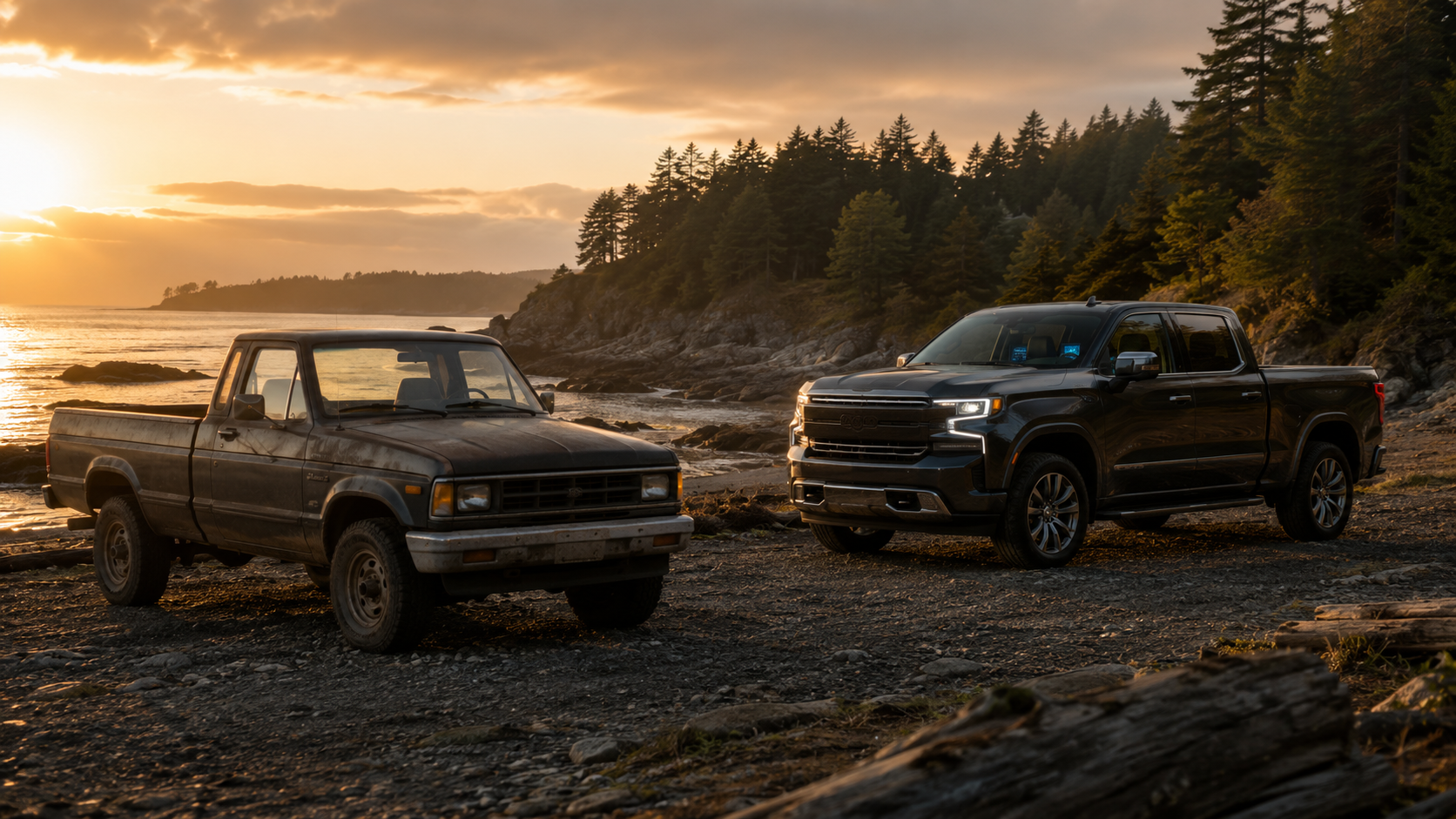
People don’t trust new trucks anymore.
Not because everyone suddenly became an old bastard yelling about carburetors and manual locking hubs.
New trucks are faster, safer, quieter and more capable than the trucks many of us grew up with. They can tow ridiculous amounts of weight while cooling your ass, watching the trailer, reading road signs and politely warning you that you’re drifting toward the ditch.
They’re technological achievements.
They’re also expensive enough to require financing terms normally associated with municipal infrastructure.
And after signing up for seven or eight years of payments, you get to find out whether the engine has a manufacturing defect, the transmission needs another software update, the screen has decided to take the morning off or some electronic safety feature is going to fight you for control of the truck you supposedly own.
So yes, people are nervous.
They should be.
You buy new to avoid the repair shop
I spent years working as a service advisor, and I watched the same cycle play out constantly.
Someone had an older vehicle that needed brakes, suspension work, an oil leak repaired or some other collection of entirely predictable old-car problems. The estimate scared them.
They didn’t want to keep coming back to the shop. They wanted dependability. They wanted peace of mind.
So they traded the old vehicle and bought something new.
That logic makes sense.
At least it used to.
The problem is that many newer vehicles still come back to the shop. They just come back for different reasons.
Warning lights. Software updates. Infotainment problems. Driver-assistance faults. Communication errors between modules. Recalls. Intermittent problems nobody can reproduce until the customer is forty minutes away from the dealership.
The old truck came in because a ball joint had worn out after fifteen years.
The new one comes in because twelve computers had a disagreement about the steering wheel.
Progress.
They cost way too much
A new truck payment can easily reach four figures.
One thousand dollars a month.
Twelve hundred.
Fifteen hundred.
For a truck.
Not a beachfront condo. Not a private aircraft. A pickup with a bed you’re afraid to scratch because it cost more than your parents’ first house.
And manufacturers know the sticker price has become ridiculous, so the solution is not necessarily to make the truck cheaper.
They stretch the loan.
Six years. Seven years. Eight years.
The Consumer Financial Protection Bureau points out the obvious problem: longer terms can lower the monthly payment, but they increase total interest and raise the risk of owing more than the vehicle is worth.
That’s the magic trick.
The truck isn’t affordable.
The debt has simply been spread across enough of your remaining natural life to make the monthly number look survivable.
Then somebody at the dealership asks what payment you’re comfortable with, which is roughly the automotive equivalent of a magician asking you to look away while he steals your watch.
I don’t care whether the payment fits the budget if I’m still paying for the damn thing when it begins needing serious repairs.
An eight-year loan on a complicated modern truck is not peace of mind.
It’s a race between the warranty, the depreciation and whichever expensive component decides to shit itself first.
You pay more and somehow trust it less
That’s the part that has broken people’s confidence.
Paying more used to suggest you were buying something better.
Today, buyers can spend an absurd amount of money and still wonder whether the engine will make it through the loan.
GM recalled certain newer trucks and SUVs equipped with the 6.2-litre V8 because connecting-rod or crankshaft defects could cause engine damage and failure. The remedy began with an engine inspection, with further action depending on what dealers found.
Toyota, the company whose entire reputation was built on making vehicles that would continue running long after the owner stopped caring, has also recalled newer Tundras over machining debris that could lead to knocking, rough running, failure to start or loss of power.
Those are manufacturing defects, not proof that every modern engine is inherently garbage.
But try explaining that distinction to the person making a massive monthly payment on the truck.
They didn’t buy new because they wanted an interesting relationship with the warranty department.
They bought new because they didn’t want problems.
And now the truck may need its engine inspected because some important metal inside it was manufactured incorrectly.
That does not inspire confidence.
The old formula was crude, but it worked
Truck engines used to rely more heavily on displacement.
Need more torque?
Use a larger engine.
Need it to pull something heavy?
Give it some cubic inches, decent cooling and a transmission with enough metal inside it to affect local tides.
Was it efficient?
Not particularly.
But there was mechanical breathing room.
A naturally aspirated V8 or V6 wasn’t necessarily extracting every last possible unit of power from every cubic centimetre. It wasn’t leaning on turbochargers, high boost, complicated thermal management and a transmission with ten gears desperately searching for the precise ratio that would save half a teaspoon of fuel.
A bigger engine could do ordinary work without constantly feeling like it was trying to qualify for something.
Now we’re told smaller displacement and forced induction give us the same power with better efficiency.
That is true on paper.
It can also mean more heat, higher pressure, more plumbing, intercoolers, turbo oil lines, wastegates, high-pressure fuel systems and considerably more shit packed into an engine bay.
Turbochargers are not new, and plenty of turbo engines last.
I’ve owned a tuned twin-turbo V6. It was an absolute blast.
Put your foot down, wait a moment and suddenly every responsible decision you made that week felt unnecessary.
I’m not anti-turbo.
I’m anti-paying-for-two-turbos-after-180,000-kilometres.
Fun for three years and confidence for fifteen years are completely different requirements.
Efficiency has become the excuse for everything
Smaller boosted engines.
Cylinder deactivation.
Stop-start systems.
Ultra-thin oil.
Ten-speed transmissions.
Complicated emissions hardware.
All of it is sold under efficiency.
And yes, improving fuel economy and reducing emissions are legitimate goals. I’m not going to claim burning more gasoline is secretly good because I like the sound of a V8.
But there’s a point where efficiency becomes the shiny wrapper around a product that is more complicated, less forgiving and potentially much more expensive to own long term.
You save a litre or two per hundred kilometres.
Great.
How long does it take those savings to pay for a turbocharger?
A high-pressure fuel pump?
A cylinder-deactivation failure?
A complicated transmission repair?
People see fuel economy every time they fill up. The number is right there on the dashboard, congratulating them.
The repair bill sitting six years in the future is invisible.
Until it isn’t.
Then every dollar you saved at the pump gets summoned back to the service department in one afternoon.
With tax.
I think planned obsolescence is part of this
Can I prove there’s a secret meeting where executives write, “Make sure the engine fails immediately after the final payment” on a whiteboard?
No.
I don’t think they need to.
Look at the incentives.
Manufacturers make money selling vehicles.
Lenders make money financing vehicles.
Shareholders like growth, repeat customers and recurring revenue.
Nobody in that chain gets particularly excited about me driving the same paid-off truck for twenty years and buying a set of tie rods every once in a while.
So build vehicles around smaller hard-working engines, expensive integrated components, software dependency and repair costs that become frightening outside warranty.
Load them with features that may require subscriptions.
Finance them for eight years.
Then start reminding the owner about the exciting new model before the first one is even paid off.
Call it innovation.
Call it efficiency.
Call it progress.
The result still looks a hell of a lot like planned obsolescence.
Maybe they aren’t engineering an exact expiry date into every part.
They don’t have to.
They only need the vehicle to become complicated, undesirable or financially uncomfortable enough that trading it seems easier than fixing it.
Then the payment starts again.
Exactly as intended.
The technology often doesn’t work properly
Modern automotive technology can be brilliant.
Apple CarPlay is excellent. I like plugging in my phone and immediately escaping whatever infotainment system the manufacturer designed during a committee meeting.
Backup cameras are useful.
A forward-collision warning is useful. I’m generally supportive of being told that I am about to drive into something.
After that, my enthusiasm drops off a cliff.
Adaptive cruise control can fuck off.
Lane-keep assist can stop tugging at the wheel because I moved around a pothole.
Automatic stop-start can quit shutting the engine down every time I pause long enough to contemplate my terrible financial decisions.
I don’t need my truck correcting me, steering for me, braking unexpectedly or flashing warnings because I drove in a way the algorithm found emotionally difficult.
Maybe other people love all of it.
Fine.
My issue is that it increasingly isn’t optional.
You aren’t choosing a truck and then adding the technology you want. You’re buying a package full of systems because that’s how the vehicle is built.
The manufacturer calls it safety.
The sales department calls it value.
The owner calls the dealership because the dashboard says one of the cameras is unavailable due to weather.
The truck has been defeated by rain.
Excellent.
Screens are not automatically progress
Some screens are useful.
A proper backup-camera display is great. Navigation can be useful. CarPlay is useful.
But putting climate control, seat heating, lighting, drive modes and half the vehicle settings into one giant centre screen isn’t innovation.
It’s cost reduction wearing a turtleneck.
Physical controls cost money to design, manufacture and install. A screen lets the manufacturer bury everything in software and call the result minimalist.
Then the screen freezes and you can’t adjust the fan speed.
My 2003 Yukon has buttons.
Some of them are worn. Some of them occasionally require a firm conversation.
But I can change the heat without waiting for the dashboard to finish booting.
I can operate the controls by touch.
I don’t need to take my eyes off the road and navigate through a submenu labelled “Comfort Environment.”
That matters more to me than another three inches of display area.
You’re paying to become the test fleet
This may be the greatest source of distrust.
New technology reaches customers before it has developed a long-term track record.
A manufacturer can test a drivetrain for millions of kilometres, but that still doesn’t perfectly recreate fifteen years of Canadian winters, missed oil changes, towing, overheating, short trips, three owners and one teenager who believes the accelerator is an on-off switch.
Dependability takes time to prove.
You can announce horsepower immediately.
You can publish fuel-economy numbers immediately.
You can film a beautiful commercial showing the truck pulling a trailer through a mountain pass immediately.
You cannot prove twenty-year durability until twenty years have passed.
So the first owners become the real-world validation program.
Except they don’t get paid.
They pay $1,300 a month for the privilege.
Previous generation might be the sweet spot
This is why I increasingly like vehicles that are one generation behind.
Not ancient.
Not carbureted.
Not something that requires an archaeological dig to locate replacement parts.
Just modern enough.
Fuel injection. Airbags. Good brakes. Decent crash protection. Comfortable seats. Functional climate control. Reliable electronics. Maybe a factory backup camera if you’re lucky.
But before things got completely carried away.
Before every engine needed forced induction.
Before every control moved into a giant screen.
Before the vehicle started monitoring your eyelids and suggesting you take a break because you blinked in a suspicious manner.
You can always add Apple CarPlay.
The aftermarket is there for you, man.
A quality head unit can give an older vehicle CarPlay, Android Auto, Bluetooth and a backup camera without requiring you to purchase the rest of the modern bullshit attached to a brand-new truck.
That’s the beauty of it.
You can take a proven older platform and add the handful of modern features you actually value.
You don’t need to finance seventy thousand dollars’ worth of technology to get Spotify on the dashboard.
Buying used has risks too
I’m not going to pretend every previous-generation truck is a genius purchase.
Some are rusty.
Some have been beaten like rented farm equipment.
Some have six previous owners, four accidents and wiring installed by somebody whose electrical education consisted of watching half a TikTok.
An old truck can absolutely ruin your life.
You need an inspection. You need maintenance records where possible. You need to look for rust, modifications, neglect and evidence that the previous owner considered warning lights decorative.
But a good used truck with a known drivetrain, available parts and an established repair history can be a much easier risk to understand.
We already know what tends to fail.
Shops know how to fix it.
The aftermarket exists.
Wrecking yards have parts.
Some guy named Darren has two transmissions behind a shed and will answer Marketplace messages at midnight.
That ecosystem matters.
A new truck may be covered by warranty, but a proven older truck can be covered by human knowledge.
I value that more than manufacturers seem to realize.
I just want to drive the truck
That’s really what this comes down to.
I don’t want a mobility platform.
I don’t want an integrated ownership ecosystem.
I don’t want a connected digital experience.
I don’t need my truck to learn my habits, download new features or remind me that a subscription is about to expire.
I want to get in, start it, put it in gear and drive the fucking truck.
I want an engine with enough displacement that it isn’t constantly fighting for its life.
I want a conventional transmission.
I want buttons.
I want parts that can be replaced individually.
I want a competent independent shop to work on it without requesting permission from a server in another country.
And I want to own it long enough that the payments become a distant, unpleasant memory.
That shouldn’t be a radical position.
It used to be the basic product.
New trucks have to earn the trust back
New trucks are incredible in many ways.
They tow more. They make more power. They stop better. They protect occupants better. They’re quieter, more comfortable and more efficient.
But buyers no longer automatically believe that paying more means getting something more dependable.
That trust has been spent.
It was spent on recalls.
It was spent on software problems.
It was spent on complicated drivetrains, giant payments and features people didn’t ask for.
It was spent every time an owner bought new to stay out of the shop and ended up back at the dealership for another update, warning light or campaign.
Manufacturers want us to believe all the complexity is progress.
Maybe some of it is.
But progress should make ownership better, not just make the brochure more impressive.
Until new trucks prove they can survive long enough to justify their prices, I’ll keep looking backward.
Give me the previous generation.
Give me the proven engine.
Give me the normal transmission.
I’ll add CarPlay myself.
Then I’ll maintain the damn thing and keep driving it while somebody else pays $1,500 a month to beta-test the future.
