
Why Does Everyone Have a Tent on Their Roof?
I have a question for the overlanding community.
What the fuck are most of you actually doing?
Not what you’re preparing to do. Not what your truck would theoretically be capable of doing if civilization collapsed next Thursday. What are you honestly doing with it?
Because from where I’m sitting, a surprising number of people have spent thousands of dollars equipping perfectly good trucks and SUVs for expeditions they’re never going to take.
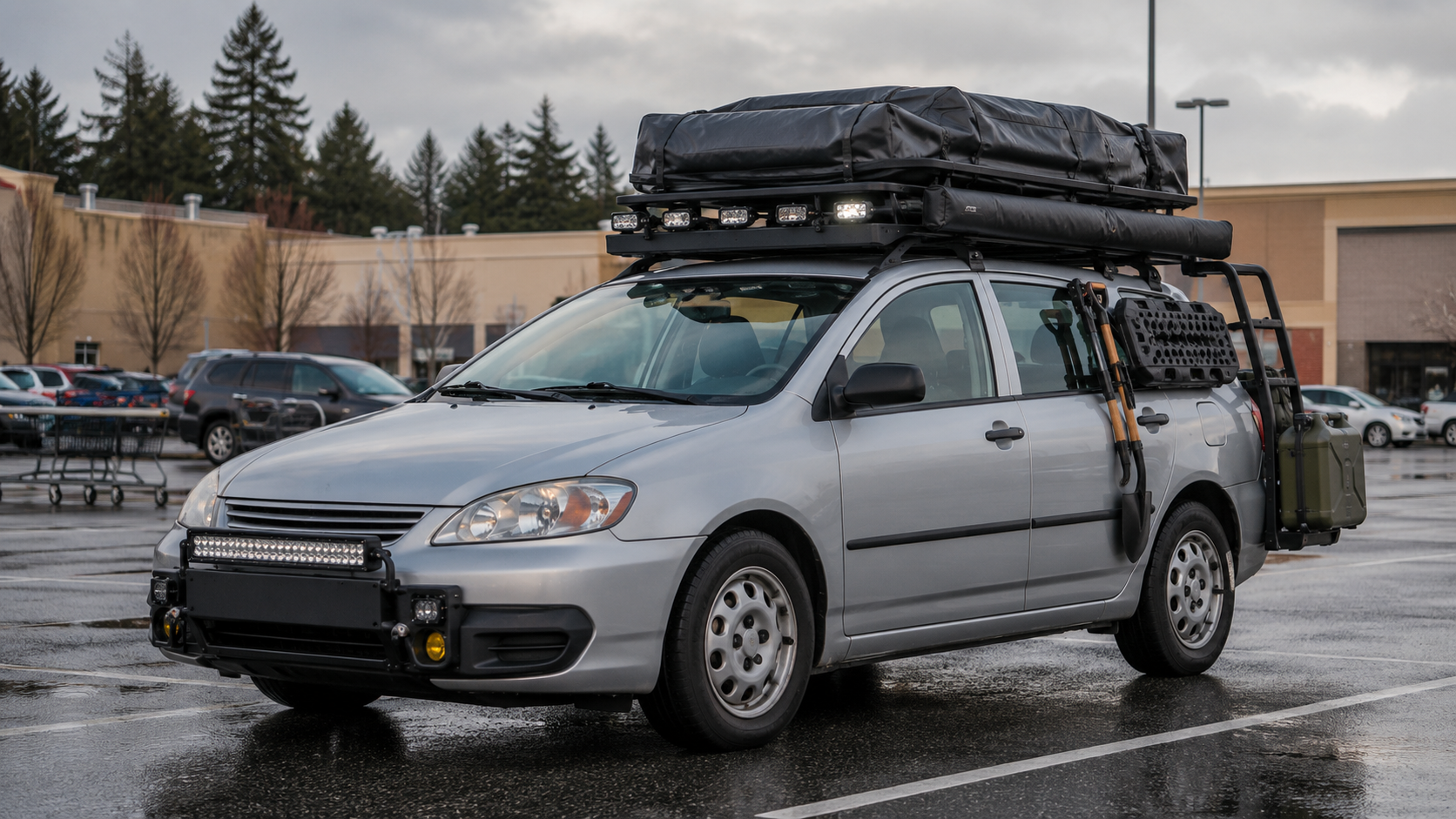
There’s the mandatory roof rack. The rooftop tent. The awning. The recovery boards that have never recovered anything. A shovel that has never touched dirt. Fuel cans that presumably contain fuel, although I’m not convinced. And, of course, enough auxiliary lighting to illuminate a small airport.
Then they drive the whole operation to work every day.
What Is the Light Bar For?
I keep seeing trucks with enormous light bars mounted across the bumper or roof. Sometimes both, because apparently one artificial sun wasn’t enough.
Why?
Where are you driving that requires three thousand dollars’ worth of lighting?
If you’re regularly travelling logging roads in the dark, working somewhere remote or genuinely heading into the backcountry, fair enough. Proper lighting can be extremely useful.
But most of these trucks aren’t doing that.
They’re driving through well-lit suburbs to Costco. They’re commuting to an office. They’re sitting in traffic behind a Corolla while carrying enough forward-facing candlepower to communicate with passing aircraft.
The light bar is never turned on because there’s nowhere legal or appropriate to use the bloody thing. It just sits there collecting bugs and announcing that the owner may theoretically leave pavement one day.
Maybe.
Why Is the Tent Living on the Truck?
The rooftop tent confuses me even more.
I understand the idea if you’re actually overlanding. You travel somewhere remote, set up for the night, sleep and move on the next morning. Your gear stays organized, you’re off the wet ground and the tent becomes part of a genuinely mobile camping setup.
That’s cool. I’m not making fun of that person.
I’m making fun of the person who bolts a tent permanently to the roof in March, drives around with it for eight months and uses it twice—both times at a provincial campsite with a picnic table, bathrooms and a perfectly flat patch of ground specifically intended for a tent.
Why does the tent need to live on your vehicle all year?
You’re carrying it to work. You’re carrying it to the grocery store. You’re carrying it through every drive-through and parking garage. It’s up there making noise, adding weight and presumably hurting fuel economy so that twice a year you can sleep six feet above the exact patch of ground where everybody else puts a tent.
Congratulations. You’ve built a second floor for no reason.
I Don’t Want to Sleep on My Truck
Maybe this is an age thing.
I’m 51 years old and I still happily sleep in a tent. But I like a large cabin tent—something with room to stand up, change clothes and move around without crawling over another human being.
Modern tents are fantastic. For two or three hundred bucks, you can buy an enormous instant cabin tent with the poles already attached. You unfold it, extend everything until those strange little joints lock into place, and the thing is standing.
Folding it back up feels like you’re deliberately hyperextending all of its knees, which is mildly disturbing, but apparently that’s how it works.
Either way, it takes a few minutes.
You can put down a proper mattress. You can stand up. You can bring chairs inside. You can have room for your bags, your kid and all the unnecessary camping crap every family somehow brings along.
You can glamp your ass off without mounting a studio apartment to the roof of your vehicle.
A rooftop tent generally gives you less space, costs several thousand dollars and requires climbing a ladder every time you get in or out.
Who decided this was progress?
When I wake up at two in the morning needing to take a leak, I don’t want to locate a tiny ladder in the dark and climb down from the roof like a drunk firefighter. I want to unzip the door, step onto the ground and take care of business while introducing as little gravity as possible.
The Overlanding Costume
This isn’t really about tents. It’s about honesty.
People like the overlanding look. That’s fine. Trucks with racks, awnings, aggressive tires and expedition gear can look cool. I understand the appeal.
But let’s stop pretending every modified Tacoma, 4Runner, Jeep or Bronco is preparing to cross the Darien Gap.
Most of us are not explorers. We’re going camping.
We’re loading up some chairs, a cooler, sleeping bags and far too much food. We’re driving to a numbered campsite that we reserved online three months ago. We might take a kayak or a paddleboard. We may drive down a gravel road that a 2007 Honda Civic could survive without spilling its coffee.
That doesn’t require an expedition build.
It requires a tent.
The maddening part is that people will spend thousands outfitting a vehicle for imaginary adventures, then leave all that equipment bolted to it every day because removing it would expose the fact that it isn’t being used.
The gear becomes the identity.
It says, “I could disappear into the wilderness at any moment,” even though Saturday’s schedule includes Home Depot, soccer practice and picking up a rotisserie chicken.
If You Actually Use It, This Isn’t About You
There are people who genuinely use this equipment.
They travel into remote places. They camp away from established sites. They need recovery equipment because getting stuck is a legitimate possibility. They use auxiliary lighting because they’re actually driving in darkness where there are no streetlights. Their rooftop tent gets opened regularly somewhere beyond the reach of a reservation system.
That’s awesome.
Frankly, I’m jealous.
But those people know who they are—and they’re probably not feeling defensive right now.
If you’ve had a rooftop tent mounted for two years and can still remember both occasions when you opened it, perhaps this article is about you.
You could have bought a very nice ground tent, an excellent mattress, a ridiculous cooler and several weekends’ worth of campsite fees for considerably less money. You’d have more room, an easier midnight bathroom trip and a roof that wasn’t permanently carrying a small furnished shed.
Buy the truck you like. Modify it however you want. Strap half of an outdoor-equipment store to the roof if it makes you happy.
Just be honest about it.
You’re probably not an overlander.
You’re a camper with an expensive costume.
Related Reads
I Like Every Toyota 4Runner. The Fifth Generation Is the One I’d Buy
The official vehicle of rooftop tents, recovery boards and perfectly clean shovels—and still one of the older SUVs I’d genuinely consider buying.
The Best GMT800 Upgrades: What’s Worth Doing—and What I’d Skip
Suspension, brakes, cooling, tuning, CarPlay and the modifications that improve an old GM truck without turning it into an off-road costume.
I Love My GMT800. So Why Do I Keep Looking at Tundras?
Our Yukon does almost everything we ask of it. Unfortunately, wanting a pickup bed has never been particularly interested in logic.
