
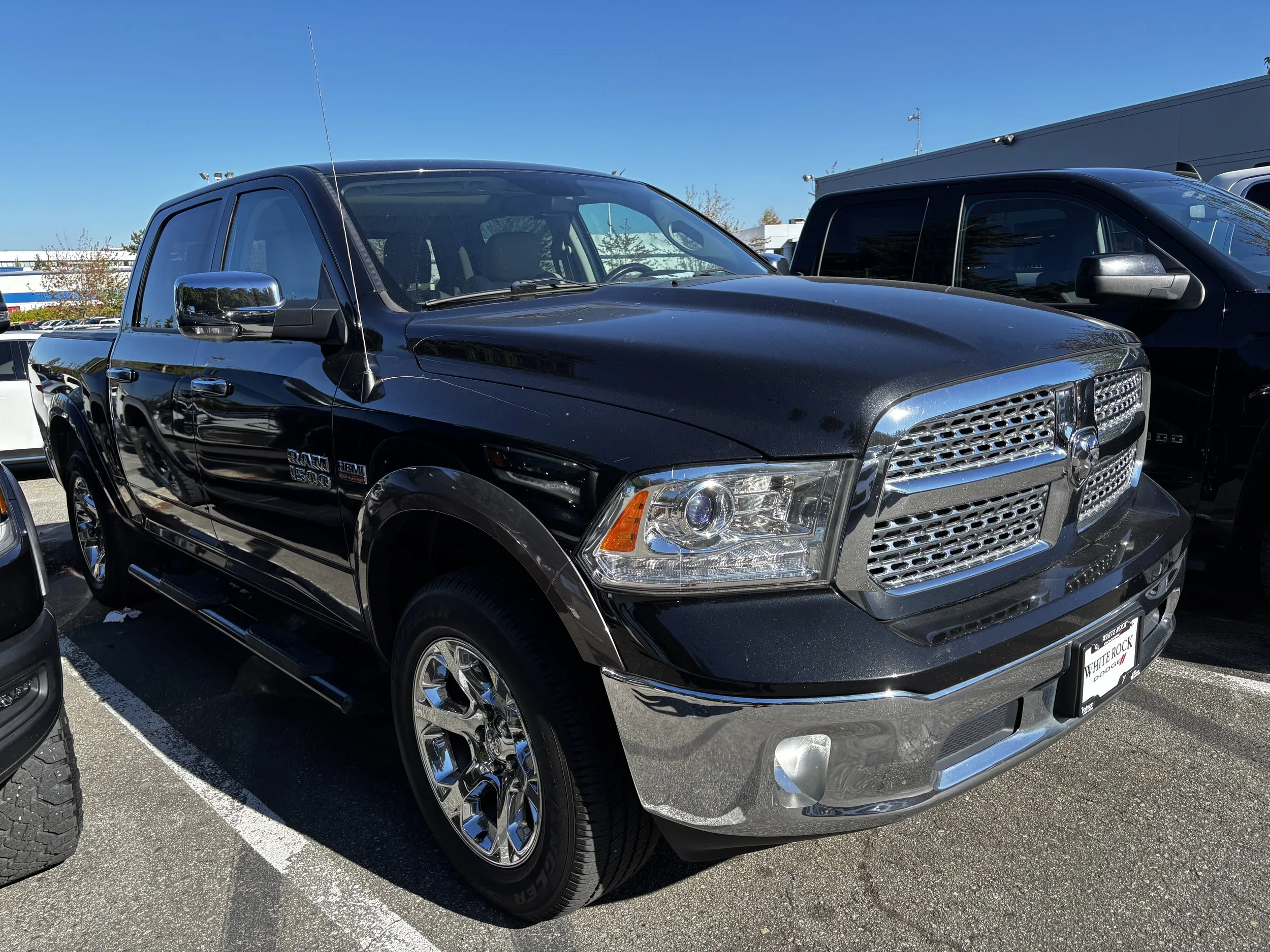
If you spend enough time looking at used trucks, you eventually discover that truck generations are not nearly as tidy as people make them sound.
The fourth-generation Ram is a perfect example. Most people call it a 2009–2018 truck. That is basically correct, right up until it isn’t. The completely redesigned fifth-generation Ram arrived for 2019, but Ram kept building the old truck beside it, renamed it the Ram 1500 Classic, and carried on for several more years.
So you can have a 2021 Ram 1500 that is a fifth-generation truck and a 2021 Ram 1500 Classic that is still, underneath, a fourth-generation truck. Perfectly sensible. No notes.
This matters to me now because I recently went to look at a 2017 Ram 1500 Laramie and things escalated rather quickly. I now own a fourth-generation Ram, there are already oversized tires sitting in the garage, and a levelling kit was ordered before the truck had even made it home.
I should probably know what I bought.
The short answer
For the Ram 1500, the fourth generation began with the 2009 model year. Early trucks were sold as Dodge Rams. Ram became its own brand shortly afterward, so the same basic truck gradually stopped saying Dodge and started simply saying Ram.
The cleanest breakdown is:
2009–2012: the early fourth-generation trucks
2013–2018: the substantially updated version most used-truck shoppers are likely to want
2019–2024 Ram 1500 Classic: the same fourth-generation architecture sold beside the newer fifth-generation Ram
You may also see the fourth-generation truck called the DS-platform Ram. The newer fifth-generation 1500 is the DT. Those codes are useful when ordering parts or trying to determine whether an online seller actually knows what fits your truck. They are less useful at a barbecue unless everyone involved is already very boring.
This article is mainly about the half-ton Ram 1500. The 2500 and 3500 Heavy Duty trucks share the general styling and family resemblance, but their timelines, suspensions, engines and updates do not match the 1500 perfectly. Treating all of them as one truck is how confidently wrong internet advice is born.
Why the 2009 Ram was a genuinely big change
The 2009 redesign did more than round off the body and make the cab nicer. Its biggest mechanical departure was the rear suspension.
Instead of the leaf springs normally found under a full-size pickup, the Ram 1500 moved to a five-link, coil-spring rear suspension. That decision became one of the truck’s defining features. It gave the Ram a smoother, more controlled ride than many of its competitors and helped make it feel less like farm equipment when it was empty.
There are people who will interpret that sentence as an attack on leaf springs and immediately prepare a towing chart. Relax. Leaf springs remain simple, durable and very good at carrying weight. The coil-spring Ram just put more emphasis on ride quality, and for the enormous number of half-ton owners who spend most of their time carrying groceries, children, camping gear and several items they forgot were in the bed, that was a smart decision.
The new truck also had a much better cab than the generation it replaced. Crew Cab models offered useful rear-seat room, the available RamBox bedside storage was genuinely clever, and the upper trim levels began pushing Ram toward the unusually nice interiors it is now known for.
The early trucks: 2009–2012
The first few years established the shape and basic character of the fourth gen, but they predate the update that turned it into the truck most people picture today.
Depending on year and configuration, the engine lineup included:
a 3.7-litre V6 at the bottom of the range
a 4.7-litre V8 in the middle
the 5.7-litre Hemi V8 at the top
The Hemi is the engine that dominates the used market and the conversation around these trucks. It made good power, sounded like a V8 should, and could move a crew-cab truck without making the driver regret every merge onto a highway. It was also available with the Multi-Displacement System, or MDS, which shuts down cylinders under light load in the pursuit of fuel economy.
Transmission choices evolved during these years, but the important shopping point is simple: these early trucks do not have the later eight-speed automatic that transformed the drivetrain. The older automatics can work perfectly well, but they have fewer gears, wider gaps between them and a noticeably older feel.
That does not make every 2009–2012 truck a bad buy. Condition, maintenance and price matter more than internet-approved model-year hierarchies. But if two comparable trucks are sitting beside each other, the 2013-and-newer one usually has the more desirable collection of updates.
The important update: 2013
The 2013 model year is where the fourth-generation Ram became the truck that aged unusually well.
Ram revised the exterior, redesigned the interior electronics and introduced a much more modern powertrain combination. The old 3.7-litre V6 was replaced by the 3.6-litre Pentastar V6, paired with an available eight-speed automatic. The 5.7-litre Hemi also gained eight-speed availability, although some Hemi trucks continued with the six-speed depending on year and configuration.
The eight-speed matters. It keeps the engine in a more useful part of its power band, provides a much lower first gear and lets the truck settle down at highway speed. A Hemi with the eight-speed feels meaningfully newer than a similar truck with the older transmission. The rotary dial shifter that controls it has inspired years of theatrical outrage from people who apparently need to physically wrestle a truck into Drive, but the transmission itself is one of the best parts of the package.
The 2013 update also brought electric power steering, a new generation of Uconnect infotainment and an available four-corner air suspension. The air suspension could lower the truck for entry and highway driving or raise it for additional clearance. When it works, it is clever and comfortable. When moisture and deep cold become involved, particularly in Canada, clever and comfortable can become expensive and motionless. We will give that system its own proper discussion in the buyer’s guide.
Inside, the updated trucks struck a good balance. They are modern enough to have a large touchscreen, Bluetooth, a backup camera and useful steering-wheel controls, but they still have actual knobs and buttons for most everyday functions. My 2017 Laramie occasionally hides something in the touchscreen just to remind me who is in charge, but it has not gone fully tablet-with-a-truck-attached.
The EcoDiesel arrives for 2014
For 2014, Ram added the 3.0-litre EcoDiesel V6 to the 1500. At the time, a diesel in a modern half-ton was a major talking point. It offered substantial low-end torque and impressive highway fuel economy without requiring buyers to move into a heavy-duty truck.
It also added another layer of emissions equipment, complexity and potential expense to a used pickup.
The EcoDiesel has committed owners who have put enormous mileage on them and remain delighted. It also has enough known trouble areas, recalls and expensive failure stories that I would not buy one casually just because the fuel-economy number looked attractive. It is an engine to research deliberately, with service history and intended use in mind—not the one to impulse-buy because the badge says diesel and diesel sounds responsible.
For many used buyers, the 3.6 Pentastar is the sensible gasoline choice and the 5.7 Hemi is the choice they actually want. I understand this because I bought the Hemi.
Trims: from work truck to cowboy living room
Ram offered enough trim levels, appearance packages and regional names to make a complete list unpleasant for both of us.
The broad progression runs from the basic ST/Tradesman work trucks through trims such as SLT, Big Horn or Lone Star, Outdoorsman and Sport, then into Laramie, Laramie Longhorn and Limited territory. The off-road-oriented Rebel joined the lineup for 2015.
The important distinction is that the fourth gen could be almost anything. A regular-cab Tradesman with a vinyl floor and an eight-foot box is fundamentally the same generation as a leather-lined Longhorn with heated and ventilated seats, air suspension and enough western-themed stitching to qualify as interior architecture.
Our 2017 Laramie sits in a nice part of that range. It has leather, heated and ventilated front seats, a heated wheel, the larger Uconnect screen and enough comfort equipment to feel special without the interior pretending I own cattle.
It does, however, have a lot of chrome. We will be discussing that.
Later changes and the end that was not an end
After the 2013 overhaul, Ram mostly refined the formula rather than reinventing it every year. New trims and appearance packages arrived, infotainment improved, lighting and grille designs changed, and equipment availability shifted around.
Two later points are especially useful for shoppers:
First, 2018 trucks could be equipped with the newer Uconnect systems supporting Apple CarPlay and Android Auto. Earlier trucks like mine can still handle Bluetooth music, phone calls and voice access to Siri, which turns out to cover most of what I actually need. Factory CarPlay is still a meaningful dividing line if you care about it.
Second, the arrival of the all-new 2019 Ram did not kill the fourth gen. Ram renamed the old DS truck the 1500 Classic and kept selling it as the cheaper, proven alternative. That is why searching by year alone can get messy. A part listed for a “2019 Ram 1500” may be for the new DT truck and may have nothing to do with a 2019 Ram 1500 Classic.
If you own a 2019-or-newer truck with the older body, the word Classic is not merely a marketing flourish. It is the clue that tells you which generation of parts to buy.
Which years are the sweet spot?
For a general used-truck shopper, I would start with 2013–2018.
That range gets you the updated cabin, modern Uconnect system, better V6, available eight-speed and the mature version of the fourth-generation design. The exact sweet spot depends on budget and equipment. Later does not automatically mean better if it also means neglected, rusty or suspiciously modified by someone whose entire tool collection came from the impulse aisle.
I ended up with a 2017 Laramie Crew Cab 4x4 with the 5.7 Hemi and eight-speed. It has about 131,000 kilometres, useful service history and the combination of space, comfort and truck bed that our Yukon could no longer provide. It also had nine-year-old tires when I went to see it, which became an entire negotiation of its own.
There are known issues to inspect on any fourth gen. Hemi exhaust-manifold leaks, lifter and cam concerns, front-suspension wear, water leaks, electronics, air-suspension problems and EcoDiesel-specific risks all deserve attention. But dumping every possible failure into a platform overview is how you end up convinced that no vehicle has ever successfully reached a grocery store.
We will build a separate fourth-generation Ram buyer’s guide around what to check, which powertrains make sense and where the actual risks live.
Why these trucks still make sense
The fourth-generation Ram lasted because the basic truck was good.
It rides well. The Crew Cab has legitimate family space. The Hemi and eight-speed combination still feels strong. The interior in the updated trucks does not feel ancient, and the aftermarket is enormous. You can buy one as a basic work truck, a comfortable family vehicle or the starting point for a build that consumes every spare dollar while being described to your spouse as “mostly little stuff.”
It also comes from an interesting middle period. There is enough technology to make daily use easy, but not so much that every function feels like it requires an account, a subscription and acceptance of revised terms and conditions.
I am new to owning one, so I am not going to sit here and declare the fourth-gen Ram the greatest truck ever built after one ferry ride and a week of staring at parts. What I can say is that the platform has depth. There are more than fifteen years of trucks, several distinct powertrain combinations, a huge owner community and a very long list of maintenance jobs, upgrades and questionable purchases for us to work through.
The GMT800 is not being erased from Driftwood Motoring. I still love that platform, and I still think the silhouette of our Yukon looks right in a way many newer SUVs do not. But the Yukon is leaving because our needs changed. The Ram is what comes next.
And considering the tires, levelling kit, lights, mirror caps and exhaust ideas already circling in my head, “what comes next” may get expensive rather quickly.
