
I Went to Look at a Ram. That Escalated Quickly.
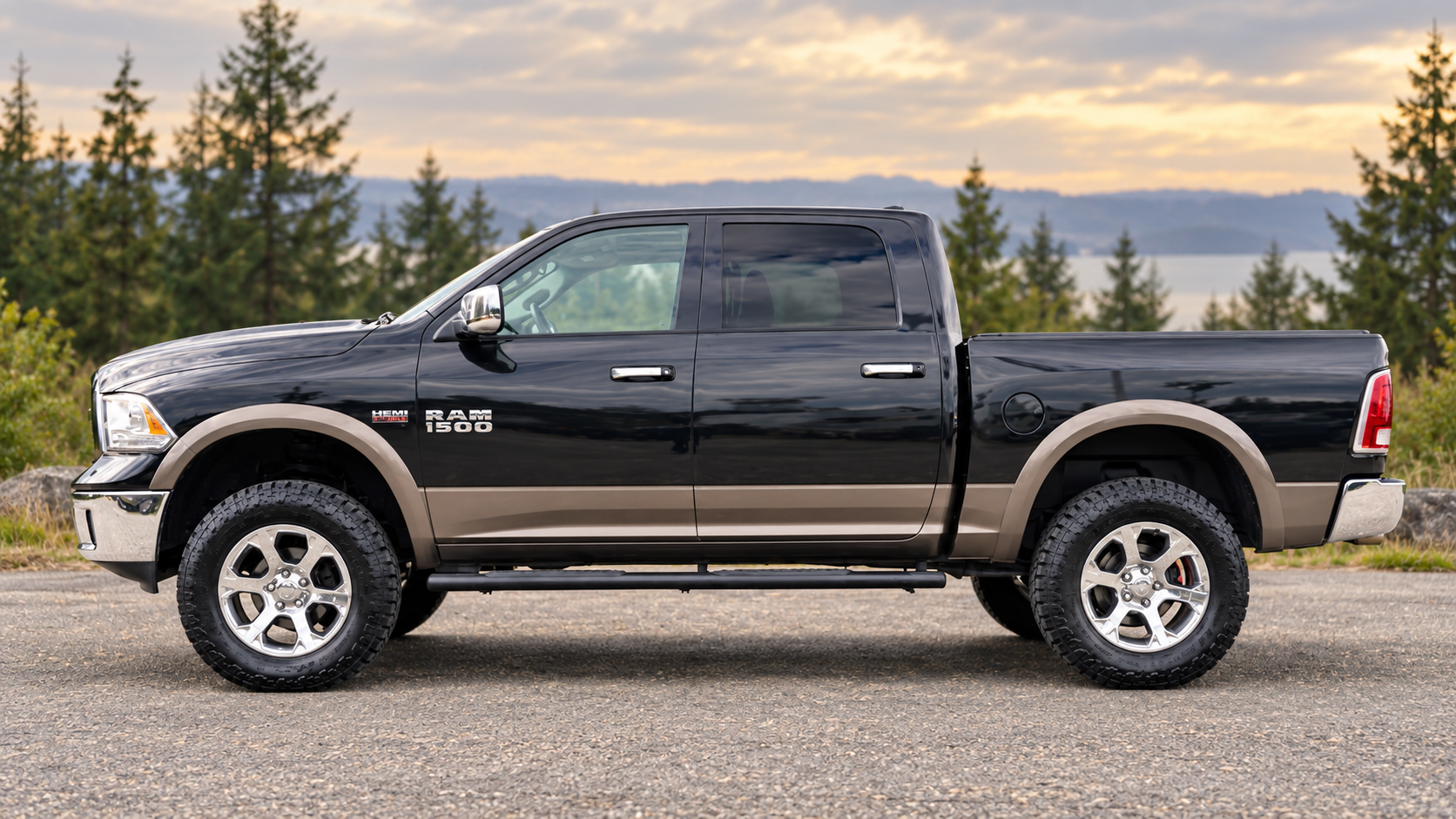
2017 Ram 1500 Laramie
There is a point in every questionable vehicle purchase where you have to stop sitting on the couch, stop opening the same listings every twelve minutes and actually go look at the thing.
For me, that required getting on a ferry.
I had already placed a deposit on a 2017 Ram 1500 Laramie sitting at a dealership in White Rock. That probably sounds like I had made up my mind. I had not.
I had cold feet. Both of them.
I was still actively looking at other trucks, comparing prices and finding increasingly creative reasons why I should or should not buy any of them. The deposit secured the Ram while I figured myself out, but it did not magically make me comfortable buying a used black truck on the other side of the water.
Eventually, there was nothing left to accomplish from the couch. I loaded myself into my beloved 2003 GMC Yukon Denali, drove onto the ferry and headed to the mainland to find out whether this Ram was actually worth replacing it.
The Yukon wasn’t the problem
Let’s get this out of the way first: I wasn’t shopping because the Yukon had failed us.
We’ve owned it for five years. It has taken us on road trips, carried our family, hauled drone equipment and swallowed an impressive amount of outdoor gear. Its 6.0-litre V8 still runs beautifully, parts are readily available and I know the truck well enough to recognize most of its noises.
Some of those noises even have names now.
The Yukon remains comfortable, useful and paid for. That last part deserves considerably more respect than it gets when you’re standing in front of something newer with leather seats and a Hemi badge.
But our needs have changed.
A fat-tire e-bike technically fits inside the Yukon. So does camping gear. So do chairs, helmets, drone cases, life jackets and the endless collection of kid stuff that travels with a five-year-old.
The problem is that they all want to occupy the same space.
Loading a dirty e-bike into the back of a reasonably clean family SUV is awkward. Getting it around the seats is awkward. Stacking everything else around it is awkward. By the time the Yukon is loaded for an actual family outing, it looks less like an adventure vehicle and more like someone tipped over a sporting-goods store inside it.
The Yukon can still carry our lives. It just doesn’t carry them as easily as it used to.
A crew-cab pickup with a proper bed solves that problem without requiring an engineering meeting every time we leave the house.
The truck looked better than its pictures
That’s not always how dealership visits go.
The Ram had looked a little tired in the listing photos. It was dirty, the black paint showed every mark and the pictures didn’t do the two-tone Laramie bodywork any favours.
In person, it made considerably more sense.
It’s a proper crew cab with the brown-and-black Laramie interior, a tonneau cover and enough comfort that it feels like a meaningful upgrade rather than merely exchanging one old vehicle for another. The black paint and lower accent colour work much better together when you’re standing beside the truck.
Unfortunately, it is still black.
I swore I would never buy another black vehicle approximately three black vehicles ago.
Black looks spectacular for fourteen minutes after it has been cleaned. Then somebody breathes near it and the entire thing needs to be polished again. I knew this. I have repeatedly demonstrated that I know this. Apparently, I have learned nothing.
There were some scratches and marks in the paint, but nothing that made me want to get back on the ferry. I pushed the dealership to perform a proper cut and polish as part of the deal. If I’m going to make the mistake of owning another black truck, it can at least begin its time with me looking as good as possible.
Then I checked the tires
The truck had good-looking all-terrain tires in the photos.
It also had nine-year-old all-terrain tires.
That irked me.
Tread depth is not the only measure of a tire. A tire can have plenty of tread and still be old enough that it should no longer be trusted. Rubber ages. It hardens, cracks and loses the characteristics that made it useful in the first place.
If I’m buying a truck that will carry my family, tow, travel and haul our gear, I’m not beginning that relationship on tires manufactured when the truck was nearly new.
The dealership and I did not immediately share the same level of enthusiasm about replacing them.
Seven trips to the sales manager
Used-vehicle negotiation is a strange little performance.
The salesperson listens carefully, nods, agrees that your concerns are reasonable and then disappears to speak with the sales manager.
They return with an answer.
You explain why that answer is not quite good enough.
They disappear again.
By the end of this one, I believe my salesperson had gone back to the sales manager approximately seven times. I may have been his least relaxing customer of the week.
We worked through the condition of the truck, the paint correction, the tires and the final numbers. I did manage to grind some money out of the deal, and they agreed to complete the cut and polish. They had already done brakes and several fluid services, and the truck came with useful service history.
The tires remained the stubborn part.
Eventually, we reached a deal that allowed me to buy a new set essentially at cost: 285/65R20 Toyo Open Country A/T IIIs.
They are larger than the stock tire size—roughly a 35-inch tire—and the dealership was not comfortable installing them on the truck in its current configuration.
Fair enough.
They can put them in the bed.
Apparently I own a leveling kit now
This is where things began moving rather quickly.
I went to look at a used Ram.
Then I bought the Ram.
Then I bought oversized Toyo tires.
Then I came back to work and mentioned the situation to my coworker.
He responded with something along the lines of, “We’ve done a bunch of leveling kits on those. They’re cheap.”
A Rough Country two-inch front leveling kit was ordered almost immediately.
The truck isn’t even home yet.
The plan is to bring the Ram back with the Toyos in the bed, then have my guy install the leveling kit and tires locally. That way we can check clearances, make sure everything fits properly and deal with it through a shop I know and trust.
This is obviously sensible and restrained behaviour.
I have also started looking at replacement taillights.
The standard fourth-generation Ram taillights have always bothered me. I prefer the cleaner appearance of the fifth-generation design, and there are updated versions made to give these trucks a similar look.
To recap: I went over to inspect a truck I wasn’t sure I wanted, negotiated the purchase, added oversized tires, ordered a leveling kit and started shopping for taillights before taking delivery.
Add to cart, apparently.
They offered me $1,800 for the Yukon
At one point during the dealership visit, I looked across the lot at the Yukon that had carried me there.
The dealership offered me $1,800 for it.
No.
I understand how trade values work. The Yukon is 23 years old, has approximately 276,000 kilometres, some rocker rust, paint fade and a roof that has been losing its clear coat one section at a time.
But it is worth considerably more than $1,800 to me—and considerably more than that on the private market.
It has a strong-running 6.0-litre V8, new BFGoodrich tires, recent maintenance and five years of known history. More importantly, I still like it.
The Yukon will have to go because we simply do not have room to keep collecting vehicles. That does not mean I’m throwing it into a trade deal for the price of a questionable riding lawn mower.
It deserves a proper sale and, hopefully, an owner who understands why these old GM trucks and SUVs still have such a following.
Why the Ram finally made sense
The Ram isn’t replacing the Yukon because it is newer, shinier or automatically better.
It is replacing it because it solves a problem.
The crew cab still gives us useful interior space for the family. The bed gives the e-bike, wet gear, camping equipment and assorted outdoor nonsense somewhere else to live. The tonneau cover provides covered storage when we need it. It is also a far better starting point for towing and the other things we expect to do over the next decade.
The Laramie trim matters too. If I’m going to make payments on something and keep it for years, I don’t want to walk toward it every morning wishing I had bought the version I actually liked.
The two-tone body, leather interior, comfort features and 5.7-litre Hemi give it some personality. It doesn’t feel like a purely practical appliance.
At $26,900, it wasn’t the cheapest truck I considered. It also wasn’t another high-mileage compromise purchased simply because it happened to be nearby.
It felt like a genuine upgrade.
Whether it proves to be one is a separate question—and probably several future articles.
One thing led to another
I began this trip with cold feet, a deposit and several competing truck listings still open on my phone.
I came home having committed to the Ram, negotiated some money out of the deal, secured a cut and polish, bought oversized Toyos and arranged for the tires to travel home in the bed.
Before the truck even arrived, a leveling kit was on order and replacement taillights were occupying far too much of my browser history.
That escalated quickly.
The Yukon chapter is ending, which is harder to admit than I expected. It has been one of the best vehicles we’ve owned, and it remains proof that an older, paid-for SUV can still do an enormous amount of useful work.
But vehicles are tools as much as they are objects of affection. Our family now needs a different tool.
It just happens to be a black, two-tone, Hemi-powered tool sitting on 35-inch Toyos.
The shop is currently imaginary.
The parts orders are not.
