
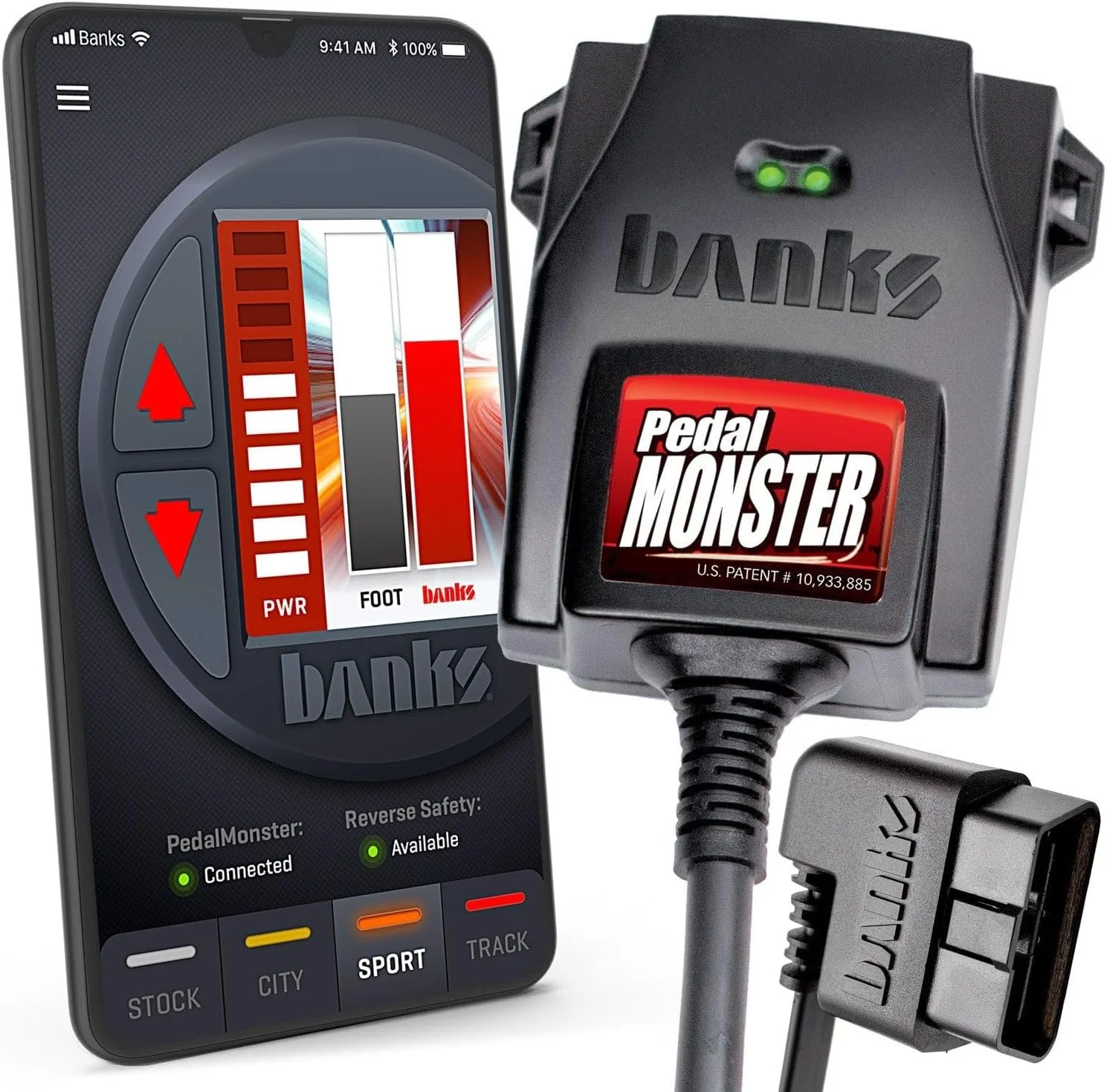
Modern trucks can have enough power to tow a small village and still respond to the accelerator like someone has just asked them to work through lunch.
Press the pedal. Wait for the committee meeting. Eventually, something happens.
That soft pedal response is why throttle controllers exist. Two names come up constantly: Banks PedalMonster and Pedal Commander.
I have a preference. If I were buying one for Boomer, our 2017 Ram 1500 Laramie, I would lean toward the Banks PedalMonster. I would also pay a reasonable premium for it.
Not because the name sounds like it should be painted on a monster truck. The big draw for me is Reverse Safety: on supported vehicles, it automatically restores stock pedal response when you back up. Add the documented fallback design and low-speed adjustment, and Banks gives me reasons beyond a more aggressive accelerator.
I want the truck awake going forward. I do not need it caffeinated going backward.
This is a researched buying comparison, not a back-to-back road test. My preference is based on the manufacturers’ specifications and instructions. I am not going to invent six months of ownership because apparently that is how half the internet reviews things now.
First: neither one installs more horsepower
A throttle controller changes the relationship between accelerator movement and the signal being sent to the vehicle.
With a more aggressive response curve, a smaller pedal movement can request more of the performance already available. A softer setting does the opposite.
It does not install bigger injectors, rewrite your engine into something else or make an extra cylinder appear under the hood.
Pedal Commander explicitly says its product does not increase engine horsepower or torque. Banks describes PedalMonster as changing pedal response, distinguishing it from its power-adding tuning products.[1][2]
A change in feel can still be worthwhile. You use the accelerator every time you drive. But feeling more eager is different from having a higher maximum power output.
If your goal is additional horsepower, investigate an actual tuning solution and its vehicle-specific requirements. A throttle controller is a different purchase.
Why I favour the PedalMonster
It knows more about what the vehicle is doing
The Banks unit uses its OBD connection for power and vehicle information. That data makes functions such as Reverse Safety and speed-based response adjustment possible.[2]
That is the feature direction I like: use information about the situation, rather than simply make every twitch of my foot more exciting.
I want a truck that responds willingly. I do not need it auditioning for a drag race every time I move away from a parking space.
Reverse Safety is a feature I would value
Banks says Reverse Safety restores stock pedal response when reverse is detected. It is available on supported vehicles; confirm your application rather than assuming every vehicle gets every feature.[2][3]
For me, this is a major selling point, not an extra line to pad out a feature chart. You can choose the forward-driving response you enjoy without having to remember to soften it before every reversing manoeuvre.
Backing toward a trailer, another vehicle or whatever Blake has parked behind me is not where I want maximum enthusiasm.
The feature does not prevent every reversing mistake. You are still the driver. But automatically removing the added sensitivity in that situation makes sense to me.
Low-speed trim sounds more useful than maximum aggression
Banks’ current manual calls this Launch Trim. It reduces the controller’s added sensitivity below 10 mph, or roughly 16 km/h, with selectable levels.[3]
A milder start with more response available afterward is much closer to what I would want than “everything, immediately, all the time.”
There is a difference between waking the truck up and making it a pain in the arse to drive smoothly.
Its documented fallback matters to me
Banks describes ActiveSafety as watchdog circuitry controlling normally closed relays, designed to bypass the device and restore stock response when a fault is detected.[2]
That is the part of the design I find persuasive.
It is still a manufacturer’s description, not a guarantee that nothing can go wrong. But if I am putting another electronic device into the accelerator system, I want to understand what it is designed to do when something does.
Leaning toward Banks too? Check the Banks PedalMonster on Amazon Canada. Confirm the kit matches your vehicle and whether it is standalone or intended for an existing Banks display.
Can Pedal Commander throw a check-engine light?
Yes—its own troubleshooting documentation describes circumstances in which that can happen.
The company lists installation and connection problems, as well as changing modes with the accelerator pressed or cruise control engaged, among possible causes. Its instructions explain how to restore the factory connection and troubleshoot the installation.[6]
That is more useful evidence than declaring every angry forum post a controlled experiment.
It also does not prove every Pedal Commander will cause trouble, or that every reported warning light is the controller’s fault.
My concern is simpler: I would rather choose the design whose documented safeguards better match my priorities. For me, that is Banks.
Does that mean PedalMonster can never have a fault?
No. I would not publish that claim.
Banks’ manual includes module fault indications and troubleshooting. Those internal module errors are not automatically the same thing as vehicle diagnostic trouble codes, but their existence is a reminder that this is electronic equipment, not a sacred object.[3]
I did not find independent, representative failure-rate data establishing how often either product causes vehicle codes, limp mode or other problems.
The honest position is a preference for Banks’ design, not a promise of zero failures.
What Pedal Commander gets right
It has its own controller, app control and four modes—Eco, City, Sport and Sport+—with 36 settings. The softer Eco response may appeal to someone who wants less sensitivity in certain conditions.[4]
Its architecture also leaves the OBD port unused. Pedal Commander argues that its simpler inline approach avoids the complexity of an additional diagnostic connection.[5]
Those are legitimate points to consider.
Someone who values a physical controller and a free OBD port may make a different choice from me. They are allowed. I do not have to organize a committee about it.
I simply put more value on the Banks features described above.
Prefer the physical controller and simpler connection? Check Pedal Commander on Amazon Canada. Select the version for your exact year, model and engine.
An OBD wrinkle worth knowing about
I recently bought a vLinker MC+ diagnostic adapter for the Ram. A PedalMonster would also use an OBD connection.
Banks discusses using its product with other OBD equipment and offers a No-OBD mode to stop its diagnostic communication when another device needs access.[2]
Do not assume adding a splitter makes every combination work happily. Check the current instructions and what functions remain available in the selected configuration.
That is an ownership consideration worth sorting out before buying. It does not change my preference, but it belongs in the comparison.
Canadian prices: the extra money may be less than you expect
At the time of research, Pedal Commander’s Canadian Ram 1500 page displayed $399.99 CAD. Canadian Diesel Online displayed $424.80 CAD for the Banks 64310 standalone kit.[4]
[7]
The displayed difference was $24.81.
These are listing snapshots, not verified delivered quotes. Confirm fitment, seller stock, taxes, shipping and the exact package before comparing the checkout totals.
Also, compare standalone kits with standalone kits. A Banks package bundled with an iDash display is a different shopping basket.
I would not make a universal claim that Banks is always substantially more expensive. If the correct kits land close to those prices, I would happily pay the difference for the design I prefer.
The bigger question is whether I want to spend roughly four hundred dollars changing pedal feel in the first place.
Who should buy neither?
Someone who is already happy with the factory response.
Also, someone trying to fix a genuinely malfunctioning vehicle. A throttle controller is not a repair for a misfire, an accelerator fault, a transmission problem or an engine that is not producing its normal power.
And if the vehicle needs tires or overdue maintenance, sort that out first. The throttle does not need a personality transplant more urgently than the truck needs to stop properly.
My choice
For Boomer, I would favour the Banks PedalMonster.
Its OBD power supply, documented fallback design and supported reverse and low-speed functions are the reasons. I would choose a sensible setting and aim for a truck that feels better, rather than one that lunges around like it has had six coffees and an argument.
Pedal Commander has an audience and a different approach. I can acknowledge that without pretending I am equally enthusiastic about both.
Would I buy a throttle controller before essential maintenance? No.
Would I pay a reasonable premium for the Banks unit if I decided I wanted one? Yes.
I like modifications that make a vehicle nicer to live with. I am less interested in paying several hundred dollars to make my right foot more dramatic.
