
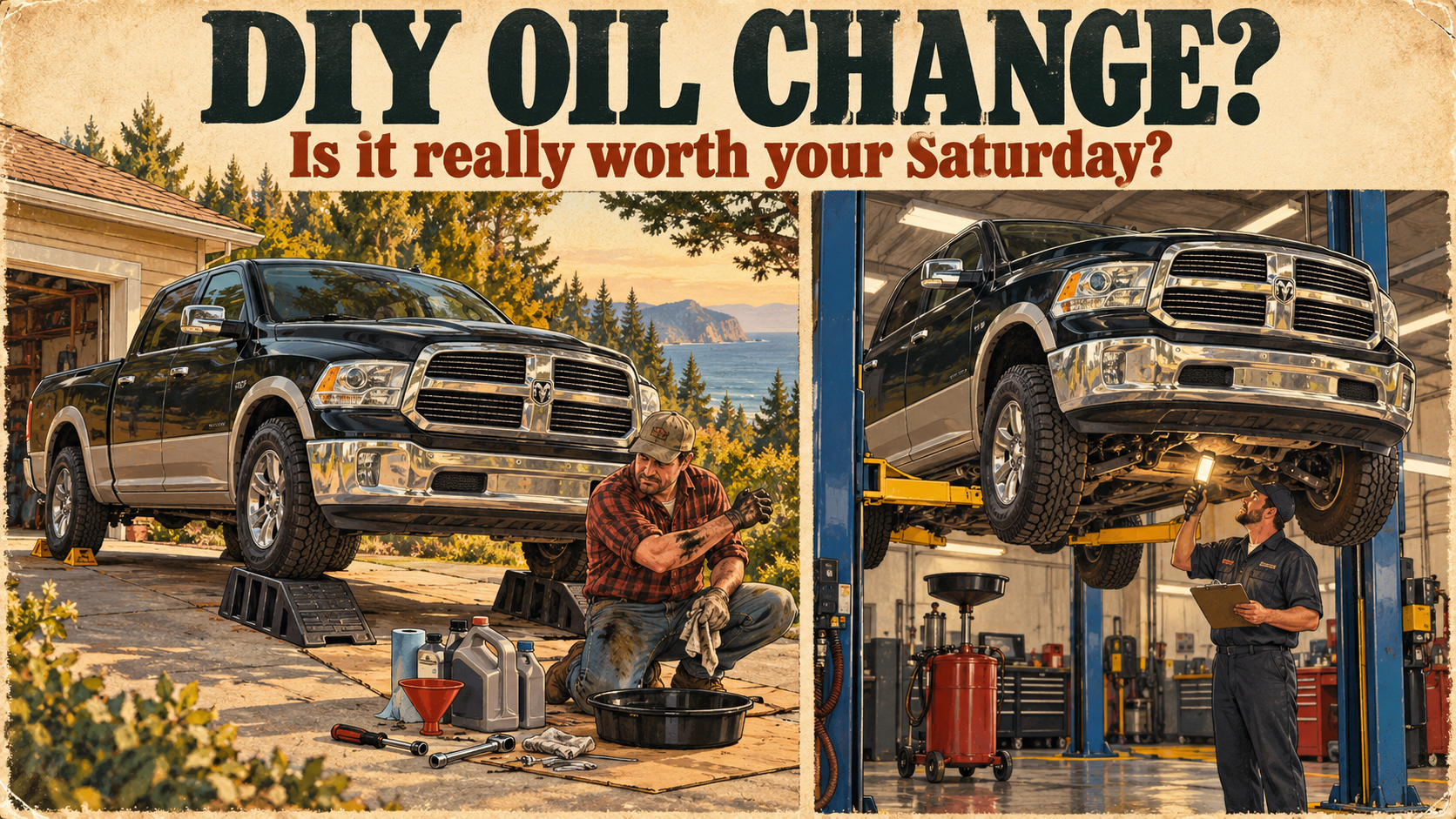
I can change my own oil.
I can also crawl around the driveway, swear at a filter, get oil down my arm and spend part of my weekend transporting a jug of used oil.
Being capable of something does not mean I am desperate to do it.
There is a familiar piece of advice whenever somebody talks about keeping an older vehicle affordable: change your own oil. Save money. Stop paying someone else to do a simple job.
Sometimes that is good advice.
But when I see a full-synthetic oil change advertised for around $89 Canadian, I start questioning how much money we are actually saving.
Especially if a trustworthy shop includes a proper maintenance inspection by a qualified technician.
I have spent most of my adult life in the automotive industry, including time as a service advisor at Honda. I like working on vehicles. I also like knowing when paying someone else is a decent bloody deal.
The price of oil is only the start
For our 2017 Ram 1500 Laramie, Boomer, the 5.7-litre Hemi takes approximately 6.6 litres of engine oil with a filter change, according to the owner's manual.[1]
That matters. A five-litre jug is not an oil change for this truck. It is most of one.
Here is one Canadian retail-price example from the listings checked while researching this article:
Five-litre jug of full-synthetic 5W-20 oil $54.99. Two additional 946 mL bottles at $19.99 each $39.98. Compatible oil filter $9.99 Initial materials purchase $104.96
This is a retail snapshot, not the cheapest possible combination, and prices change. It also leaves some oil for later.[2][3]
Buying two larger jugs instead of expensive small bottles can improve the longer-term arithmetic. At $54.99 per five litres, the cost of the 6.6 litres actually used works out to $72.59.
Add the $9.99 filter and the materials consumed cost approximately $82.58 before tax.
Against an $89 pre-tax service, that leaves $6.42.
Six dollars and forty-two cents.
I have made worse financial decisions buying a sandwich.
That does not prove every DIY oil change costs more than a shop. It shows why “you will save loads of money” deserves a calculator before it deserves a motivational speech.
Yes, sale prices can change the answer
Someone is already preparing to tell me they buy oil on sale.
Good. You should.
If you already own the equipment, buy suitable oil at a discount and keep the leftovers for future changes, DIY can cost less. A smaller engine with a smaller oil capacity can change the comparison too.
For an illustrative example, if the five-litre jug cost $34.99, the oil consumed in Boomer plus that same filter would cost approximately $56.18 before tax.
That is nearly $33 below an $89 service.
The $34.99 is a hypothetical sale price here, not a current deal I am promising you can buy. The calculation simply shows what happens when the price changes.
A fair article has to acknowledge that saving. Otherwise I am just choosing expensive oil to win an argument, which is a bit of a shit way to make a point.
But the materials comparison is only one part of the decision.
You still have to do the job
You need the tools your vehicle requires, a suitable catch basin and a safe way to access the underside if the job demands it.
Then there is the work itself:
Get the supplies.
Set up and change the oil and filter.
Check the level and check for leaks.
Clean up.
Store the used oil securely.
Take the used oil, filter and containers to an appropriate collection point.
In British Columbia, participating collection facilities accept residential quantities free of charge.[4] I know that. I am not inventing a disposal bill.
It is just another chore.
Usually not an enormous chore. Nobody is asking you to carry the oil to Mordor. But it still belongs in the comparison, along with the time you spent doing the change.
If you enjoy the process, that time can be part of the benefit. If you are squeezing it between work, family and everything else, you might value the afternoon differently.
Having someone underneath the vehicle is worth something
This is the part I think gets lost.
At a good shop, an oil-change appointment can give an experienced technician an opportunity to look underneath your vehicle and identify developing problems.
Depending on the inspection included, that might mean visible leaks, worn suspension components, brake concerns, damaged boots or other issues that deserve a closer look.
It is not a guarantee that every fault will be found. A routine maintenance inspection is also not the same thing as a formal vehicle safety certification.
But an experienced person having a boo underneath an older vehicle has value.
If you know what you are looking for and can inspect it properly yourself, excellent. That adds another reason to do the job at home.
If you do not, proximity is not expertise. Being underneath the truck does not automatically turn you into a technician. Sometimes it just means you are a bloke underneath a truck.
I would rather have somebody who knows what they are looking at tell me what needs attention.
Finding work is part of the job
During my time at Honda, and in the local shops I have dealt with, those competitively priced oil changes were not making money once the oil, filter and technician labour were accounted for.
They brought vehicles in for regular maintenance. The inspection gave the shop an opportunity to identify needed work.
That is my experience with those businesses, not a claim about every oil-change operation in Canada.
And honestly, so what?
If my truck needs work, I want someone to point it out.
An inspection finding is not automatically an upsell conspiracy. Sometimes your ball joint is worn. Sometimes there is a leak. Sometimes the thing you have been ignoring has progressed from “interesting noise” to “expensive bastard.”
The difference is how the shop handles it.
A good shop explains the finding, shows you evidence where practical, distinguishes urgent work from things to monitor, and lets you make an informed decision. Photos can make that conversation much easier.
If you do not understand a recommendation, ask questions. A useful inspection should leave you better informed, not simply more frightened.
A good shop and a drive-through are not automatically the same service
There are competent people in quick-lube businesses. There are also good and bad operators across the rest of the industry.
I would not choose purely by the sign outside.
Ask what the appointment actually includes. Is it an oil-and-filter change with a few checks, or a documented maintenance inspection? Who performs that inspection? Will you receive the findings? What happens if something needs further diagnosis?
An inexpensive oil change is more appealing when I trust the people doing it.
Likewise, paying more does not automatically buy a better inspection. Find out what you are getting rather than assigning magical powers to a bigger invoice.
Check the $89 offer before declaring victory
The price I have seen advertised is the starting point for this discussion. We still need to check its exact conditions.
Does it include:
Enough oil for your engine?
The viscosity and specification your vehicle requires?
The filter and labour?
The inspection you expect?
Any additional fees, with tax clearly accounted for?
A price covering five litres is not automatically an $89 oil change for a 6.6-litre Hemi.
Compare your actual quote with your actual DIY costs. Both need to cover the same vehicle and suitable materials.
And use what the manufacturer calls for. Boomer's manual specifies API-certified 5W-20 meeting FCA MS-6395 requirements.[1] “Synthetic” on the front of a bottle is not the entire specification.
The reasons to do it yourself are still legitimate
You choose the oil. You choose the filter. You control the workmanship.
You can combine the oil change with other work, learn about the vehicle and inspect it on your own schedule.
If you have the equipment and experience, it can be convenient. If you enjoy it, that matters too. You do not need a spreadsheet to justify every hobby.
Just be honest about the reason.
“I like doing it myself” is perfectly respectable.
“I save money because I buy suitable oil on sale and already own everything” can be perfectly true.
“Anyone who pays a shop is wasting money” is where you lose me.
Why I would often pay the shop
For me, a competitively priced oil change at a trustworthy shop can be excellent value.
I get the maintenance done, the used oil handled and, where included, a useful inspection by someone with the experience to spot things I might miss.
I do not have to buy equipment for that one job, clear time in the driveway or add another container to the collection of stuff I am definitely going to deal with next weekend.
Could I sometimes save money doing it myself? Yes.
Would I rather pay a good shop if the difference is modest and the inspection is worthwhile? Also yes.
Keeping an older vehicle affordable means choosing where your money and effort do the most good. There is no prize for personally removing every drain plug.
I like working on vehicles.
I also like a clean driveway, an informed opinion about what is happening underneath my truck, and occasionally spending Saturday doing something other than wearing its engine oil.
Sources
[1] 2017 Ram owner's manual: oil capacity, grade and specification. Capacity on PDF page 680; specification on PDF page 627.
[2] Canadian retail oil-price snapshot. Retrieved listing showed Pennzoil Platinum 5 L at $54.99 and 946 mL at $19.99. No shopping link is included in the article body.
[3] Canadian retail filter-price snapshot. Retrieved listing showed PH10060 at $9.99. FRAM fitment reference. Exact product fitment should be checked before purchasing.
[4] Recycling Council of BC: used motor oil drop-off. Residential quantities accepted free at participating facilities; contact the location about capacity.
